

-
Products -PCBA Manufacturing RF Connectors RF Cable Assemblys Embedded Antennas External Antennas GNSS Positioning Solutions
RF Connectors

RF Cable Assemblys
Embedded Antennas
External Antennas
GNSS Positioning Solutions






 Language


Language


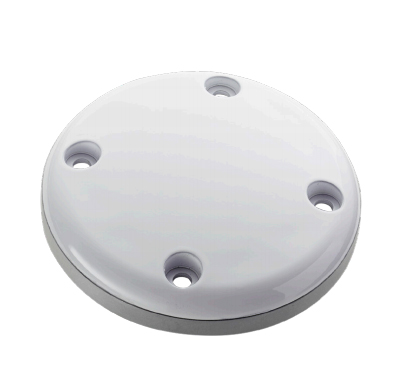
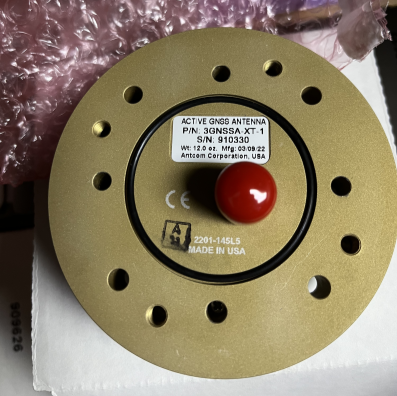
TOXU Model: TX-A106
Reference Model: 3GNSSA-XT-1 / 3GNSSX-XX-X Series
The TOXU TX-A106 is a multi-frequency active GNSS antenna developed with reference to the 3GNSSA-XT-1 configuration of the 3GNSSX-XX-X antenna family. It covers compatible GPS, GLONASS, Galileo, BDS, and NavIC signals across the L1, L2, and L5 frequency regions, together with 1539–1559MHz L-Band correction signals.
● 3GNSSA-XT-1 Reference Design:The TX-A106 is developed for projects requiring a similar multi-frequency GNSS frequency range, active amplification, and FRPA mounting structure.
● Multi-Constellation GNSS Reception:Covers compatible GPS, GLONASS, Galileo, BDS, and NavIC satellite navigation signals.
● L1, L2, L5 and L-Band Coverage:Supports two passbands from 1160–1252MHz and 1539–1610MHz, including compatible L-Band correction signals.
● 33dB Active LNA:The active configuration integrates a 33dB low-noise amplifier powered through the RF connector.
● FRPA Mounting Footprint:The four-hole baseplate supports fixed installation on platforms designed for a compatible FRPA mounting pattern.
● Wide 2.7–15V DC Input:The active antenna supports receiver-supplied bias power over a wide input-voltage range.
The TOXU TX-A106 is a multi-frequency active GNSS antenna developed with reference to the 3GNSSA-XT-1 configuration within the 3GNSSX-XX-X antenna family.
It is designed for professional positioning, navigation, and timing equipment requiring compatible reception of multiple GNSS constellations and frequency bands through one external antenna.
The antenna operates across two wide passbands. The lower passband covers 1160–1252MHz, while the upper passband covers 1539–1610MHz.
These frequency ranges cover compatible GPS, GLONASS, Galileo, BDS, and NavIC signals across the L1, L2, and L5 regions. The upper passband also includes 1539–1559MHz L-Band correction signals.
The active configuration integrates a 33dB low-noise amplifier. DC power is supplied through the RF connector by a compatible GNSS receiver, eliminating the need for a separate antenna power cable.
The specified active circuit operates from 2.7–15V DC with current consumption below 40mA. The receiver’s antenna-bias voltage and current capacity must be checked before integration.
The TX-A106 uses right-hand circular polarization and a nominal 50-ohm impedance. Its specified VSWR is below 2.0:1 across the listed operating frequency ranges.
A four-hole FRPA mounting footprint supports installation on compatible platforms. An O-ring at the antenna base supports sealing between the antenna and the mounting surface.
The TX-A106 is a GNSS antenna only. It does not contain a GNSS receiver, RTK engine, correction-data subscription, positioning processor, inertial navigation system, or navigation data output interface.
The reference model information is provided for product identification and technical comparison. Final mechanical interchangeability, connector configuration, RF performance, and environmental compatibility must be verified against the approved TX-A106 drawing, specification, and sample.
3GNSSA-XT-1 Reference Configuration
Developed for projects requiring a similar multi-frequency GNSS range, active LNA configuration, and FRPA mounting structure.
Multi-Constellation GNSS Coverage
Supports compatible GPS, GLONASS, Galileo, BDS, and NavIC satellite navigation signals.
1160–1252MHz Lower Passband
Covers compatible GPS L2 and L5, GLONASS L2, Galileo E5a and E5b, BDS B2, B2a and B2b, and NavIC L5 signals.
1539–1610MHz Upper Passband
Covers compatible GPS L1, GLONASS L1, Galileo E1, BDS B1, NavIC L1, and L-Band correction signals.
1539–1559MHz L-Band Reception
Receives compatible L-Band correction signals when connected to a receiver and correction service supporting the corresponding frequency range.
33dB Integrated LNA
The active configuration amplifies received GNSS signals before transferring them to the connected receiver.
3.5dB Specified Noise Figure
The integrated active circuit has a specified LNA noise figure of 3.5dB.
+8dBm LNA P1dB Output
The active circuit has a specified output 1dB compression point of +8dBm.
Wide 2.7–15V DC Bias Input
The antenna is powered through the RF connector by a compatible receiver providing the required active-antenna bias voltage.
Current Consumption Below 40mA
The specified low current consumption supports integration into compatible mobile and fixed GNSS equipment.
RHCP Polarization
Right-hand circular polarization supports reception of compatible GNSS satellite signals.
VSWR Below 2.0:1
The specified antenna VSWR is below 2.0:1 across the listed operating ranges.
50-Ohm RF Interface
The nominal 50-ohm impedance supports connection to compatible GNSS receivers and RF cable assemblies.
FRPA Mounting Footprint
Four mounting holes support fixed installation on platforms using a compatible FRPA mounting pattern.
Base O-Ring
An O-ring is installed at the antenna base to support sealing between the antenna and the mounting platform.
-55°C to +85°C Specified Temperature Range
The specified temperature range supports integration into equipment operating under demanding environmental conditions.
Connector and Housing Options
SMA, TNC, Type N, and TNC bulkhead configurations, together with alternative housing colors, can be evaluated according to project requirements.
| TOXU Model | TX-A106 |
| Reference Model | 3GNSSA-XT-1 |
| Reference Product Family | 3GNSSX-XX-X |
| Product Type | Multi-Frequency Active GNSS Antenna |
| Supported Constellations | GPS / GLONASS / Galileo / BDS / NavIC |
| Supported Frequency Regions | L1 / L2 / L5 / L-Band |
| Lower Passband | 1160–1252MHz |
| Upper Passband | 1539–1610MHz |
| GPS L1 / Galileo E1 / BDS B1 | 1575.42MHz ±15MHz |
| GLONASS L1 | 1598.06–1609.31MHz |
| L-Band Corrections | 1539–1559MHz |
| GPS L2 | 1227.60MHz ±15MHz |
| GLONASS L2 | 1242.94–1251.69MHz |
| Galileo E5b / BDS B2 / B2b | 1207.14MHz ±10.23MHz |
| GPS L5 / Galileo E5a / BDS B2a / NavIC L5 | 1176.45MHz ±12MHz |
| Antenna Configuration | Active |
| Polarization | RHCP |
| VSWR | <2.0:1 |
| Nominal Impedance | 50 Ohm |
| LNA Gain | 33dB |
| LNA Noise Figure | 3.5dB |
| LNA P1dB Output | +8dBm |
| Operating Voltage | 2.7–15V DC |
| Current Consumption | <40mA |
| DC Power Input | Through RF Connector |
| Power Handling | 1W CW |
| Mounting Footprint | Four-Hole FRPA-Compatible Footprint |
| Base Sealing | O-Ring Included |
| Housing Diameter | Approximately 3.53in / 89.7mm |
| Housing Height | Approximately 1.06in / 26.9mm, Depending on Connector |
| Typical Weight | Approximately 12.4oz / 352g |
| Operating Temperature | -55°C to +85°C |
| Specified Altitude | Up to 70,000ft |
| Specified Random Vibration | >30Grms |
| Standard Housing Color | Gloss White |
| Optional Housing Colors | Gray / Green / Black / Desert Tan, Subject to Confirmation |
| Connector Options | SMA / TNC / Type N / TNC Bulkhead, Subject to Configuration |
| Customization | Connector / Housing Color / Label / Packaging / RF Cable Assembly |
The TX-A106 uses a low-profile circular enclosure with an approximate diameter of 3.53in or 89.7mm. The enclosure height is approximately 1.06in or 26.9mm for the referenced configuration, but the final overall height can vary according to the selected connector.
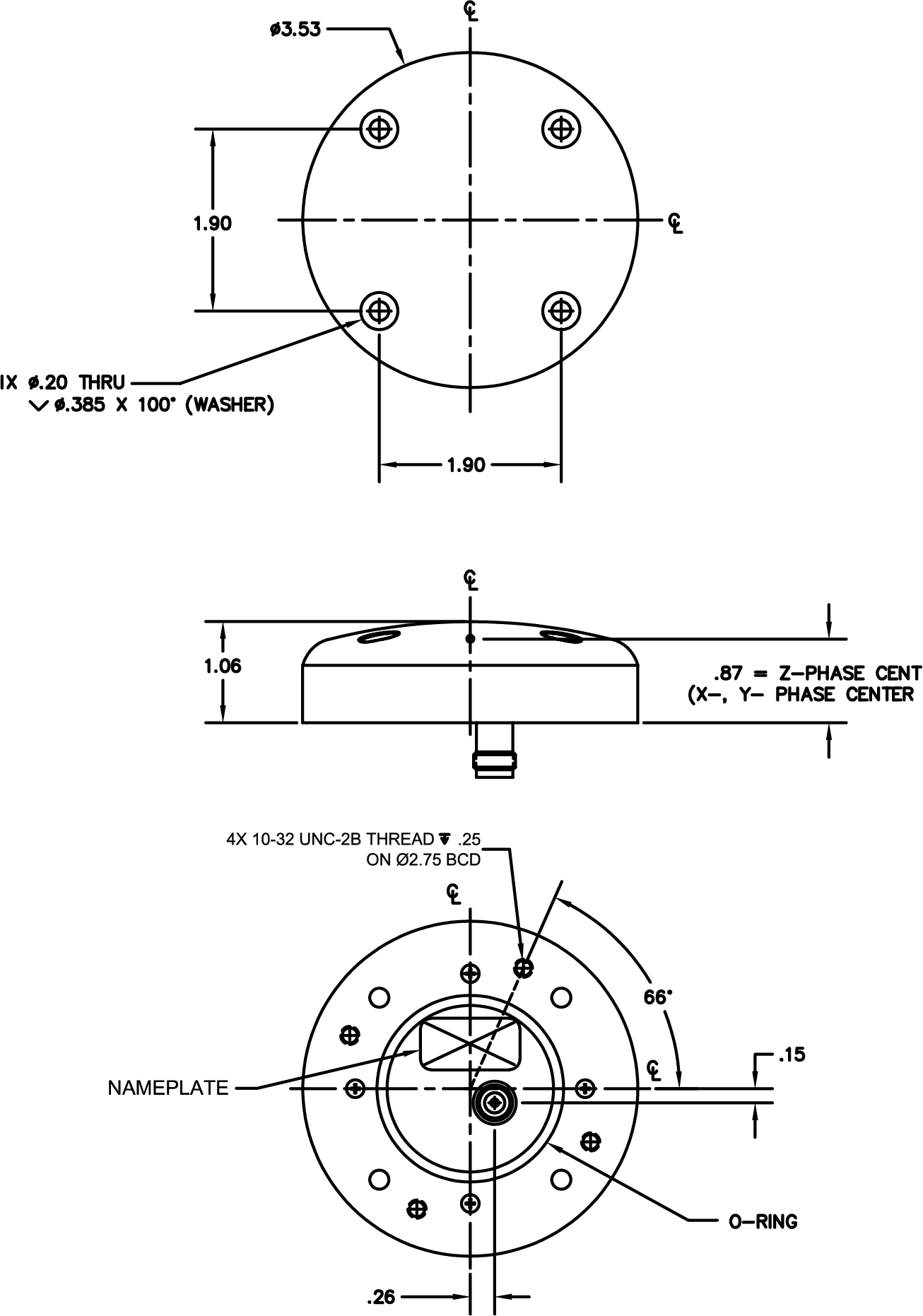
The baseplate uses four mounting holes arranged in an FRPA-compatible mounting pattern. An O-ring is positioned at the antenna base to support sealing between the antenna and the mounting surface.
Before volume production, confirm the mounting-hole positions, hole diameter, connector location, housing height, installation clearance, mounting hardware, sealing surface, and selected connector against the approved TX-A106 drawing.
• Multi-Frequency GNSS Receivers
• RTK GNSS Receiver Systems
• Professional Positioning Equipment
• Unmanned Aerial Vehicles
• Autonomous Vehicles and Mobile Robots
• Precision Agriculture Equipment
• Surveying and Mapping Systems
• GNSS Reference Stations
• Timing and Synchronization Equipment
• Industrial Navigation Systems
• L-Band Correction-Service Receivers
• Fixed and Mobile PNT Platforms
The TX-A106 must be connected to a compatible multi-frequency GNSS receiver capable of supporting the required constellations and signals.
The antenna does not add unsupported frequencies or constellations to the connected receiver. For example, L5 reception requires both an L5-capable antenna and an L5-capable GNSS receiver.
The active antenna requires 2.7–15V DC bias power through the RF connector. Before connection, confirm the receiver’s antenna-bias voltage, current capacity, short-circuit protection, and active-antenna monitoring functions.
The selected connector must match the receiver or RF cable assembly. SMA, TNC, Type N, and TNC bulkhead configurations are not mechanically interchangeable.
Receiving an L-Band signal does not automatically provide correction data. The connected receiver must support the relevant L-Band frequency, signal format, service provider, subscription, and decoding method.
The antenna can be used in an RTK system, but it does not independently calculate RTK positions. RTK performance depends on the receiver, correction data, firmware, satellite visibility, antenna installation, RF environment, and complete system design.
Install the antenna with a clear view of the sky and away from high-power transmitters, switching power supplies, metal obstructions, and other potential interference sources.
The O-ring supports base sealing, but an O-ring alone does not establish a complete IP rating. Final protection depends on the enclosure interface, mounting surface, connector sealing, installation method, and system-level validation.
Final RF performance, mechanical compatibility, environmental performance, and mounting strength should be verified on the customer’s finished equipment before volume production.
TOXU provides GNSS antenna design, multi-frequency antenna integration, RF matching, mechanical development, connector configuration, prototype verification, testing, and volume-production support for equipment manufacturers and system integrators.
Our product range includes GPS and GNSS antennas, multi-frequency RTK antennas, automotive combination antennas, cellular antennas, WiFi and Bluetooth antennas, RF cable assemblies, RF connectors, GNSS modules, receiver boards, PCBA manufacturing, and integrated positioning solutions.
With IATF16949 and ISO9001-certified manufacturing capabilities, TOXU supports customized connectors, housings, labels, packaging, RF cable assemblies, quality control, and stable delivery for overseas B2B projects.
Q: What is the relationship between TX-A106 and 3GNSSA-XT-1?
A: TX-A106 is the TOXU product model developed with reference to the 3GNSSA-XT-1 configuration of the 3GNSSX-XX-X antenna family. It should not be represented as an original Antcom or NovAtel product.
Q: Is TX-A106 a drop-in replacement for 3GNSSA-XT-1?
A: Mechanical interchangeability should not be assumed without verification. The connector, mounting-hole pattern, housing dimensions, RF performance, and environmental requirements must be compared using the approved drawings and samples.
Q: Which GNSS constellations does it support?
A: The listed frequency ranges cover compatible GPS, GLONASS, Galileo, BDS, and NavIC signals.
Q: Does it support L1, L2 and L5?
A: Yes. The antenna covers the corresponding L1, L2, and L5 frequency regions through its 1160–1252MHz and 1539–1610MHz passbands.
Q: Does the antenna support L-Band corrections?
A: It covers 1539–1559MHz L-Band signals. The connected receiver must separately support the applicable signal, correction service, subscription, and decoding method.
Q: Is the TX-A106 an active antenna?
A: Yes. The specified configuration integrates a 33dB LNA powered through the RF connector.
Q: What bias voltage is required?
A: The active configuration operates from 2.7–15V DC with specified current consumption below 40mA.
Q: Can it be used with an RTK receiver?
A: Yes, provided the receiver supports the required frequency bands and supplies compatible antenna bias power. The antenna itself does not calculate RTK positions.
Q: Is the antenna anti-jamming?
A: No anti-jamming or CRPA performance should be claimed from the available specifications. The TX-A106 is a fixed reception pattern GNSS antenna, not an adaptive anti-jamming antenna array.
Q: Is it an aviation-certified antenna?
A: No aviation certification is stated in the available specifications. It may be evaluated for compatible platforms, but it should not be marketed as an aviation-certified antenna.
Q: Is it waterproof?
A: The antenna includes a base O-ring, but no specific IP rating is provided. Final environmental sealing must be validated at the complete installation level.
Q: Which connectors are available?
A: SMA, TNC, Type N, and TNC bulkhead configurations can be evaluated. The final connector must be confirmed before quotation and production.
Q: Can TOXU customize the antenna?
A: Connector configuration, housing color, marking, label, packaging, and matching RF cable assemblies can be evaluated according to project requirements.
Lucy Yang | lucy.y@toxutech.com
Nicole Li | nicole@toxutech.com
Dotty Zhao | sales04@toxutech.com
Global Business Director / Sales Team / Global Operations


 En
En Cn
Cn Korean
 Home >

