

-
Products -PCBA Manufacturing RF Connectors RF Cable Assemblys Embedded Antennas External Antennas GNSS Positioning Solutions
RF Connectors

RF Cable Assemblys
Embedded Antennas
External Antennas
GNSS Positioning Solutions




 Language


Language



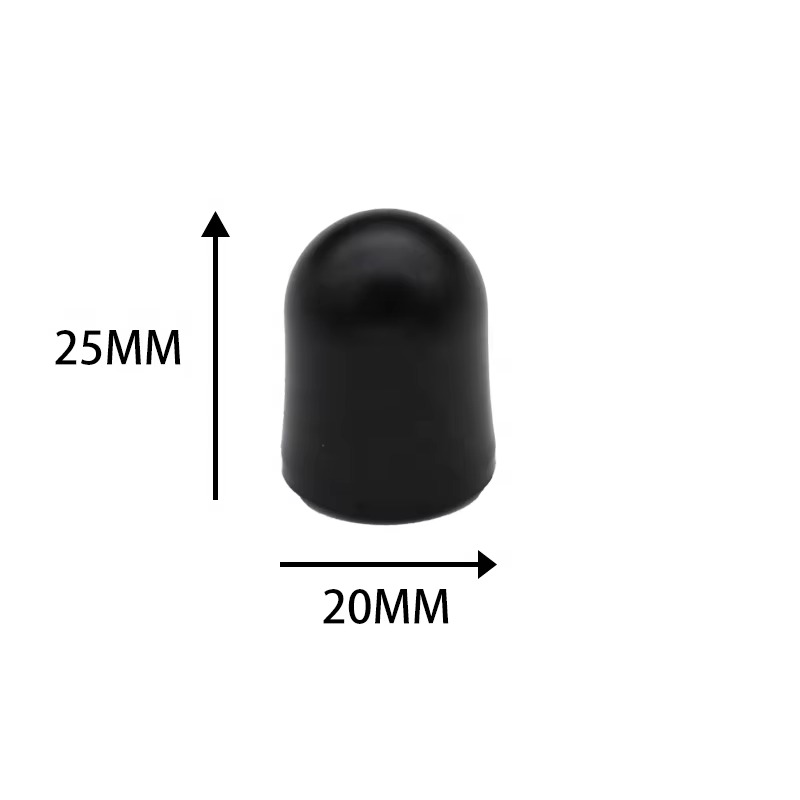
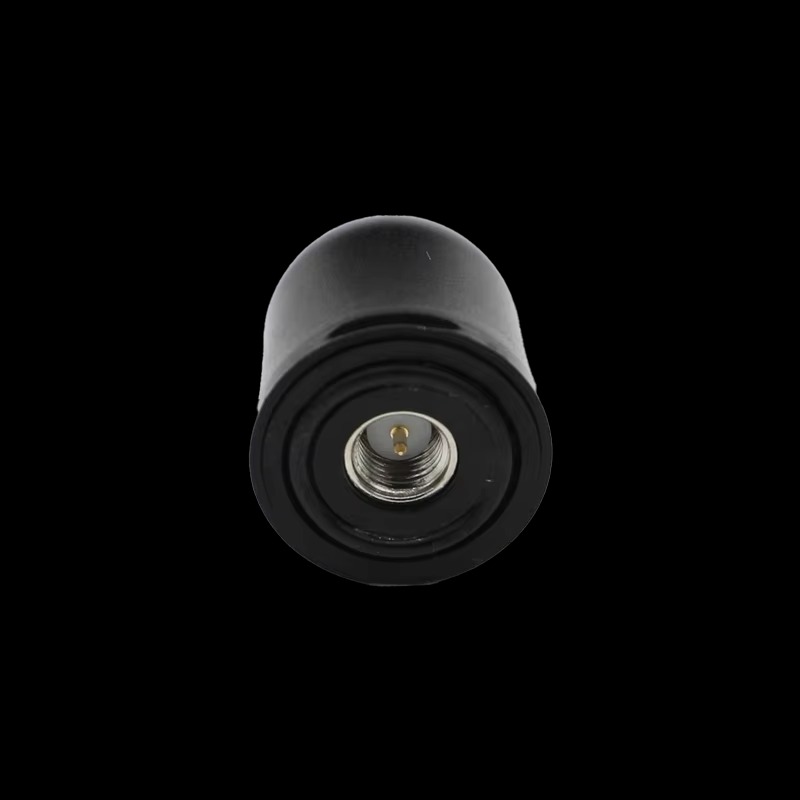
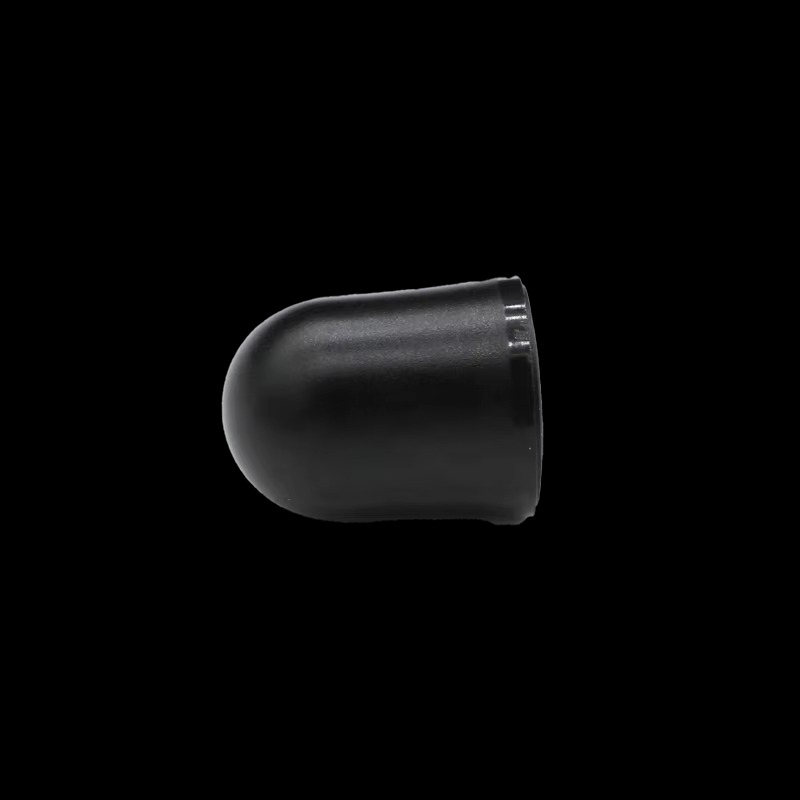
Model: TX-G43
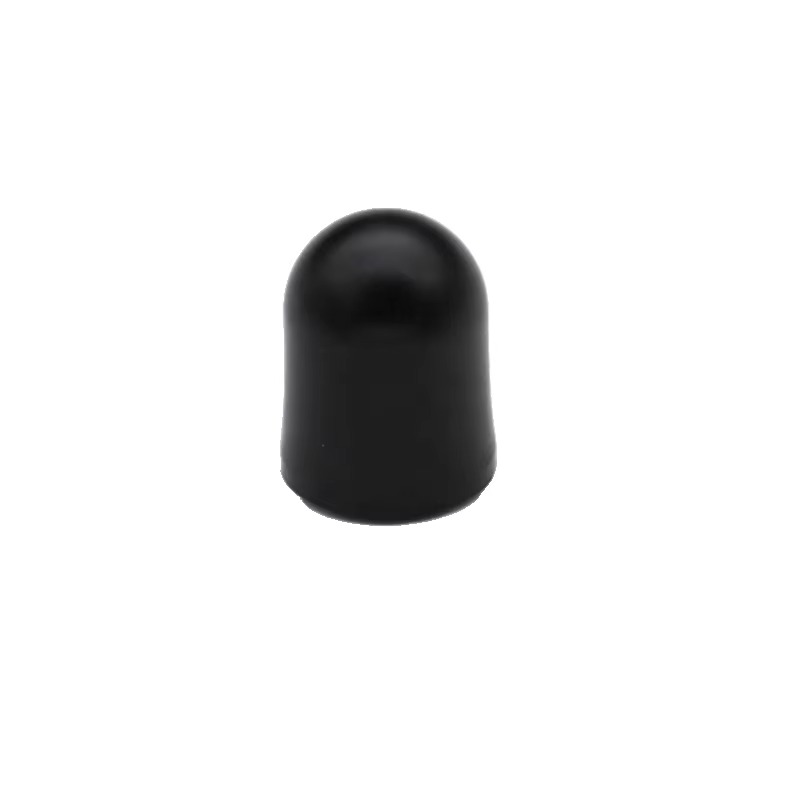
The TOXU TX-G43 is a compact dual-band active GNSS ceramic antenna covering 1168–1188MHz and 1559–1585MHz. Its Ø20 × 30.6mm threaded housing, integrated 18±2dB low-noise amplifier, and SMA male connector support installation in UAVs, handheld terminals, radios, and other space-constrained positioning equipment.
● Dual-Band GNSS Reception:Covers the 1168–1188MHz and 1559–1585MHz frequency ranges for compatible dual-band GNSS receivers.
● Integrated Low-Noise Amplifier:Provides 18±2dB amplifier gain with a noise figure of no more than 1.5dB.
● Compact Ceramic Construction:The Ø20 × 30.6mm housing supports integration into equipment with limited installation space.
● RHCP Signal Reception:Right-hand circular polarization supports reception of compatible GNSS satellite signals.
● Threaded External Mounting:The antenna is mechanically secured to the equipment through its threaded mounting structure.
● Direct SMA Connection:The standard SMA male connector eliminates the need for an integrated coaxial cable and supports direct connection to compatible RF equipment.
The TOXU TX-G43 is a compact dual-band active ceramic GNSS antenna developed for UAVs, handheld terminals, radios, navigation equipment, and other space-constrained positioning systems.
The antenna covers two GNSS frequency ranges: 1168–1188MHz and 1559–1585MHz. This dual-band configuration supports connection to compatible GNSS receivers requiring reception in both the lower and upper satellite-navigation frequency regions.
The ceramic antenna element adopts right-hand circular polarization and has a nominal impedance of 50 ohms. Its specified gain at zenith is typically 1dBi when measured with a 70mm square ground plane.
An integrated low-noise amplifier provides 18±2dB gain with a noise figure of no more than 1.5dB. The active circuit operates from 1.8–3.6V DC and draws no more than 5mA.
The black housing measures Ø20 × 30.6mm and weighs approximately 15g. A threaded fastening structure and SMA male connector support compact external installation without an integrated coaxial cable.
The TX-G43 is an antenna assembly only. It receives and amplifies compatible GNSS signals but does not independently calculate coordinates, provide RTK corrections, determine positioning accuracy, or output navigation data. These functions are handled by the connected GNSS receiver.
Dual-Band GNSS Frequency Coverage
Covers 1168–1188MHz and 1559–1585MHz for compatible dual-band satellite-navigation receivers.
Active 18±2dB Amplifier
The integrated amplifier strengthens received GNSS signals before transmission to the connected receiver.
Low Noise Figure
A specified noise figure of no more than 1.5dB supports low-noise amplification of compatible GNSS signals.
Low-Voltage Operation
The active circuit operates from 1.8–3.6V DC and consumes no more than 5mA.
RHCP Ceramic Antenna Element
The ceramic antenna adopts right-hand circular polarization for reception of compatible satellite-navigation signals.
Compact Ø20mm Housing
The small Ø20 × 30.6mm enclosure supports installation in UAVs, handheld equipment, radios, and compact positioning terminals.
Lightweight Construction
The antenna weighs approximately 15g, helping reduce the load added to compact and mobile equipment.
Threaded Fastening Structure
The antenna can be mechanically secured through the equipment panel using its threaded mounting structure.
SMA Male RF Interface
The standard SMA male connector supports direct connection to a compatible antenna port or RF adapter.
Environmental Verification
The supplied specification includes high-temperature, low-temperature, rain, and salt-spray test requirements.
| Model | TX-G43 |
| Product Type | Dual-Band Active GNSS Ceramic Antenna |
| Receiving Frequency Range | 1168–1188MHz / 1559–1585MHz |
| Center Frequency with 30 × 30mm Ground Plane | 1568MHz |
| Bandwidth | ≥20MHz at Return Loss ≤-10dB |
| VSWR at Center Frequency | ≤2.0 |
| Gain at Zenith | 1dBi Typical, with 70mm Square Ground Plane |
| Axial Ratio | 6dB, with 70mm Square Ground Plane |
| Polarization | RHCP |
| Characteristic Impedance | 50 Ohm |
| Frequency Temperature Coefficient | 0±10ppm/°C |
| Amplifier Frequency Range | 1176–1575MHz |
| Amplifier Gain | 18±2dB |
| Amplifier VSWR | <2.0 |
| Noise Figure | ≤1.5dB |
| DC Voltage | 1.8–3.6V |
| DC Current | ≤5mA |
| Overall Dimensions | Ø20 × 30.6mm |
| Weight | 15g |
| Mounting Method | Threaded Fastening |
| Connector | SMA Male |
| Integrated Cable | Not Applicable |
| Housing Color | Black |
| Operating Temperature | -40°C to +85°C |
| Storage Temperature | -40°C to +85°C |
| Relative Humidity | 95% to 100% |
The following mechanical drawing shows the principal dimensions of the TX-G43. All dimensions are expressed in millimeters.
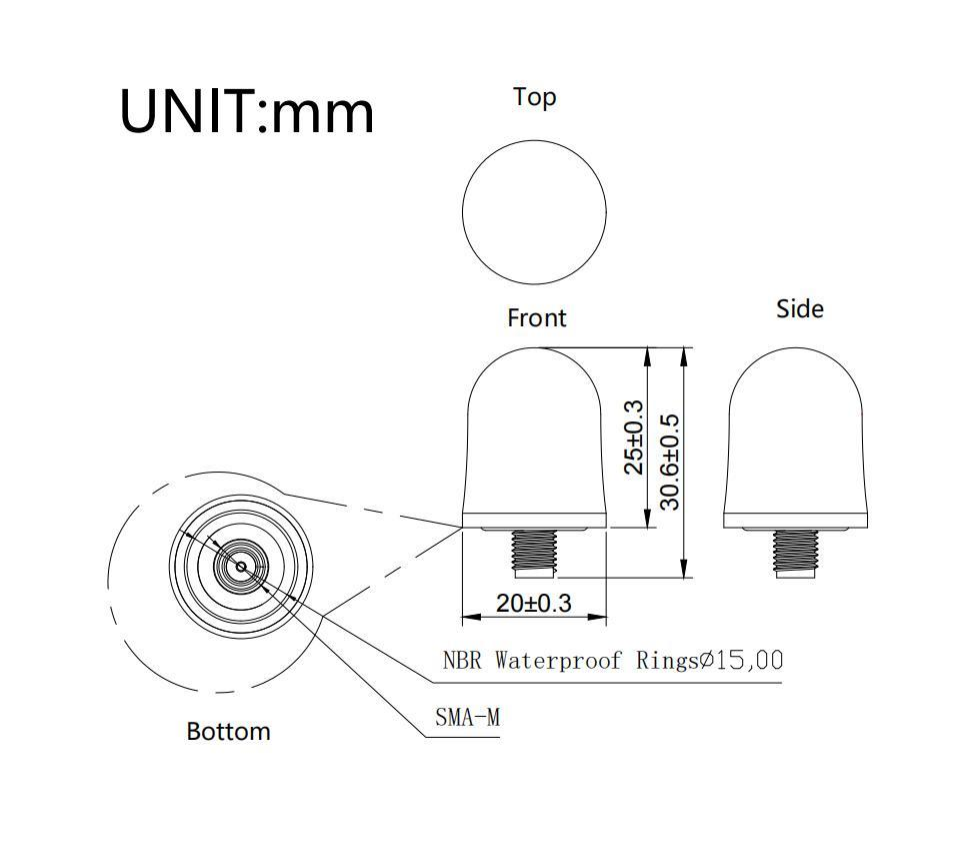
General drawing tolerances are ±2mm for X dimensions, ±0.3mm for X.X dimensions, and ±0.05mm for X.XX dimensions. Dimensions and tolerances shown in the controlled mechanical drawing take precedence.
Confirm the latest controlled drawing before enclosure machining, tooling, or volume production.
High-Temperature Test
Samples are stored in a dry oven at 80°C for 48 hours. After visual inspection and 24 hours of recovery at room temperature, the housing must show no deformation or oxidation.
Low-Temperature Test
Samples are stored at -40°C for 48 hours. After recovery at room temperature, the housing must show no deformation, oxidation, or rust.
Rain Test
The product is exposed to running water for four hours. After the test, no water ingress is permitted at the bottom of the housing. This test description must not be interpreted as a certified IP protection rating.
Salt-Spray Test
The supplied specification defines salt-spray test conditions and requires no visible oxidation or corrosion after testing, rinsing, and drying.
• Unmanned Aerial Vehicles
• Handheld GNSS Terminals
• Portable Radios with Positioning Functions
• Compact Navigation Equipment
• Mobile Positioning Terminals
• Asset-Tracking Equipment
• Industrial GNSS Devices
• Remote-Monitoring Equipment
• OEM Positioning Systems
• Space-Constrained GNSS Integration
The TX-G43 must be connected to a compatible GNSS receiver operating within the specified 1168–1188MHz and/or 1559–1585MHz frequency ranges.
Because the TX-G43 is an active antenna, the receiver must supply 1.8–3.6V DC bias power through the RF interface. The specified current consumption is no more than 5mA.
Before integration, confirm that the receiver antenna port uses a compatible SMA interface, 50-ohm impedance, supported frequency range, and suitable antenna-bias voltage.
The standard antenna uses an SMA male connector and does not include an integrated cable. If the equipment cannot accept a direct SMA male connection, a suitable 50-ohm RF cable assembly or adapter may be required.
A suitable ground plane and installation environment are important to antenna performance. The specified gain and axial-ratio values were measured using the ground-plane conditions stated in the specification; results in the final equipment may differ.
Install the antenna where it has the clearest practical sky view. Keep it away from large metal obstructions, high-power transmitters, motors, switching power supplies, and other possible sources of signal blockage or electromagnetic interference.
Final performance can be affected by the GNSS receiver, bias-power quality, mounting structure, ground-plane size, equipment enclosure, nearby electronics, and satellite visibility.
Sample testing with the actual receiver and complete equipment is recommended before volume production.
TOXU provides GNSS antennas, communication antennas, RF cable assemblies, connectors, GNSS modules, receiver boards, and integrated RF hardware for equipment manufacturers and system integrators.
Our engineering team supports frequency selection, receiver compatibility evaluation, antenna-bias confirmation, connector and cable matching, installation analysis, RF testing, sample verification, and customized antenna development.
With IATF16949 and ISO9001-certified manufacturing capabilities, TOXU supports prototype verification, product inspection, customized RF interconnections, OEM requirements, packaging, and stable volume-production delivery.
Q: Which frequency ranges does the TX-G43 cover?
A: It covers 1168–1188MHz and 1559–1585MHz.
Q: Is the TX-G43 an active or passive antenna?
A: It is an active GNSS antenna with an integrated 18±2dB amplifier.
Q: What bias voltage does it require?
A: The specified operating voltage is 1.8–3.6V DC, with current consumption of no more than 5mA.
Q: What connector does the antenna use?
A: The standard TX-G43 uses an SMA male connector.
Q: Does it include an RF cable?
A: No. The connector is integrated into the antenna structure. A compatible RF adapter or cable assembly can be evaluated separately if required.
Q: What are the antenna dimensions?
A: The overall dimensions are Ø20 × 30.6mm, and the specified weight is approximately 15g.
Q: Is the antenna suitable for UAVs?
A: Its compact and lightweight structure supports compatible UAV positioning equipment. Final suitability must be verified using the actual receiver, installation structure, and operating environment.
Q: Does the antenna provide RTK positioning independently?
A: No. It receives and amplifies compatible GNSS signals. RTK processing, position calculation, correction-data handling, and navigation output are performed by the connected GNSS receiver.
Q: Does the rain test mean the antenna has an IP67 rating?
A: No. The specification describes a four-hour running-water test but does not declare a certified IP protection rating.
Q: Can TOXU help confirm receiver compatibility?
A: Yes. Please provide the receiver model, supported frequencies, antenna-bias voltage, connector interface, installation structure, and expected order quantity for evaluation.
Lucy Yang | lucy.y@toxutech.com
Nicole Li | nicole@toxutech.com
Dotty Zhao | sales04@toxutech.com
Global Business Director / Sales Team / Global Operations


 En
En Cn
Cn Korean
 Home >

