

-
Products -PCBA Manufacturing RF Connectors RF Cable Assemblys Embedded Antennas External Antennas GNSS Positioning Solutions
RF Connectors

RF Cable Assemblys
Embedded Antennas
External Antennas
GNSS Positioning Solutions









 Language


Language






Model: TX-G015
The TOXU TX-G015 is a compact multi-band RTK GNSS receiver module integrating a ZED-F9P positioning engine and a four-arm helical GNSS antenna in one housing. It supports compatible GPS, GLONASS, BDS, Galileo, and QZSS signals and provides NMEA, UBX, and RTCM 3.3 data for integration into UAVs, robotics, mobile mapping equipment, and other positioning systems.
● Integrated Receiver and Antenna:Combines a multi-band GNSS receiver and four-arm helical antenna in a compact Φ47 × 35.9mm structure.
● ZED-F9P Positioning Engine:Supports multi-constellation and multi-band satellite tracking for standalone and RTK positioning applications.
● Multi-Constellation Reception:Supports compatible GPS L1/L2, GLONASS G1/G2, BDS B1/B2, Galileo E1/E5b, and QZSS L1/L2 signals.
● RTK Positioning Capability:Provides specified horizontal RTK accuracy of ±(8 + 10 × D)mm and vertical accuracy of ±(15 + 10 × D)mm under defined conditions.
● Multiple Data Protocols:Supports NMEA, UBX, and RTCM 3.3 data formats through UART and I²C interfaces.
● Compact Lightweight Design:The integrated module measures Φ47 × 35.9mm and weighs less than 20g for space- and weight-sensitive equipment.
The TOXU TX-G015 is an integrated multi-band RTK GNSS receiver module designed for positioning systems requiring a compact antenna-and-receiver configuration.
Unlike a standalone GNSS antenna, the TX-G015 integrates a four-arm helical GNSS antenna, a ZED-F9P positioning engine, signal-processing circuitry, and digital communication interfaces in one compact housing.
The receiver supports compatible GPS L1/L2, GLONASS G1/G2, BDS B1/B2, Galileo E1/E5b, and QZSS L1/L2 satellite navigation signals. Actual signal availability and operating mode depend on receiver configuration, firmware, antenna environment, and regional satellite visibility.
For standalone positioning, the specified horizontal accuracy is ≤1.5m and vertical accuracy is ≤2.5m under the stated test condition of 1σ and PDOP below 4.
When valid correction data is supplied and an RTK fixed solution is achieved, the specified horizontal RTK accuracy is ±(8 + 10 × D)mm and vertical RTK accuracy is ±(15 + 10 × D)mm, where D represents the baseline distance in kilometers.
The receiver supports NMEA, UBX, and RTCM 3.3 data formats. Available hardware interfaces include three UART ports and one I²C interface through an eight-pin, 1.25mm-pitch locking connector.
The TX-G015 operates from 3.3–3.45V DC and has a specified power consumption of approximately 0.95W. Its Φ47 × 35.9mm housing weighs less than 20g.
This integrated configuration is suitable for UAVs, robotics, mobile mapping equipment, precision positioning terminals, autonomous platforms, and other embedded systems requiring compact multi-band GNSS reception and RTK positioning capability.
Integrated GNSS Receiver and Helical Antenna
Combines the GNSS antenna and positioning receiver in one compact assembly, reducing the need for a separate external antenna and RF cable.
ZED-F9P Multi-Band Positioning Engine
The integrated receiver supports multi-constellation, multi-band satellite tracking and RTK positioning functions.
Multi-Constellation Signal Support
Supports compatible GPS, GLONASS, BDS, Galileo, and QZSS satellite navigation signals within the specified bands.
RTK Fixed-Solution Capability
Supports centimeter-level RTK positioning under suitable correction-data, baseline, satellite-visibility, installation, and RF-environment conditions.
RTK Initialization Below 5 Seconds
The available specification states an RTK initialization time below five seconds for baseline distances below 10km under defined test conditions.
RTK Initialization Confidence Above 99.9%
Provides the stated initialization confidence when operating under suitable satellite, correction-data, signal-quality, and environmental conditions.
NMEA, UBX and RTCM 3.3 Support
Supports standard positioning output, receiver configuration, and differential correction-data integration.
Three UART Ports and One I²C Interface
Provides multiple digital interfaces for connection to flight controllers, embedded processors, industrial computers, and other host equipment.
20ns Timing Accuracy
Supports timing-sensitive system integration according to the available product specification.
Compact Φ47 × 35.9mm Housing
The compact integrated structure supports installation in equipment with limited space.
Weight Below 20g
The lightweight design is suitable for UAVs and other weight-sensitive mobile platforms.
| Model | TX-G015 |
| Product Type | Integrated Multi-Band RTK GNSS Receiver Module |
| GNSS Receiver | ZED-F9P |
| Integrated Antenna | Four-Arm Helical GNSS Antenna |
| Supported Constellations | GPS / GLONASS / BDS / Galileo / QZSS |
| Compatible GPS Signals | L1 / L2 |
| Compatible GLONASS Signals | G1 / G2 |
| Compatible BDS Signals | B1 / B2 |
| Compatible Galileo Signals | E1 / E5b |
| Compatible QZSS Signals | L1 / L2 |
| Cold Start | <24s |
| Timing Accuracy | 20ns |
| Standalone Horizontal Accuracy | ≤1.5m, 1σ, PDOP <4 |
| Standalone Vertical Accuracy | ≤2.5m, 1σ, PDOP <4 |
| Speed Measurement Accuracy | ≤0.03m/s, RTK Fixed Solution, 1σ |
| RTK Initialization Time | <5s at D <10km, Under Defined Conditions |
| RTK Initialization Confidence | >99.9%, Under Defined Conditions |
| Horizontal RTK Accuracy | ±(8 + 10 × D)mm |
| Vertical RTK Accuracy | ±(15 + 10 × D)mm |
| Baseline Definition | D in Kilometers |
| Supported Data Formats | NMEA / UBX / RTCM 3.3 |
| Supported NMEA Sentences | RMC / VTG / GGA / GSA / GSV / GLL |
| Hardware Interfaces | 3 × UART / 1 × I²C |
| Electrical Connector | 1.25mm-Pitch 8-Pin Locking Connector |
| Supply Voltage | 3.3–3.45V DC |
| Power Consumption | 0.95W |
| Dimensions | Φ47 × 35.9mm |
| Weight | <20g |
| Operating Temperature | -40°C to +85°C |
| Storage Temperature | -55°C to +95°C |
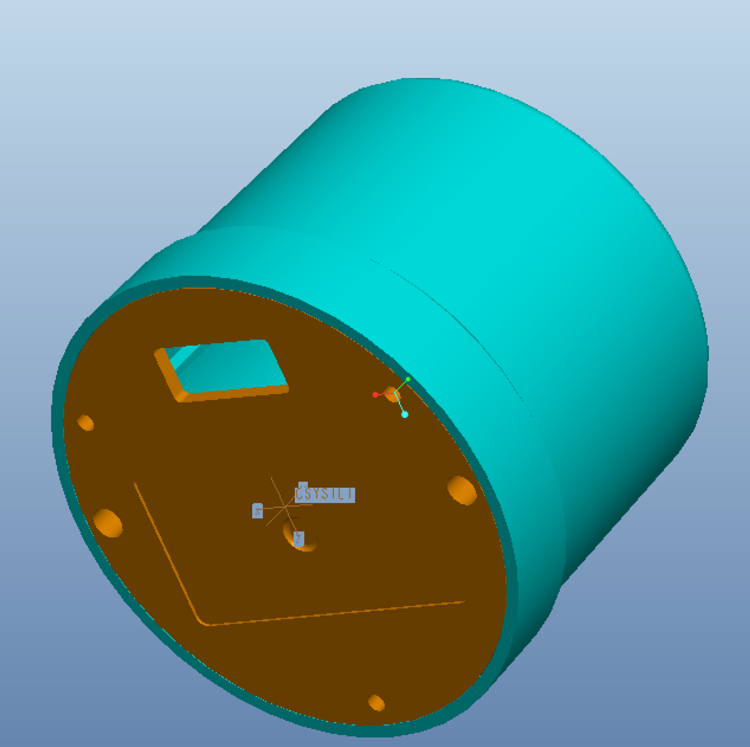
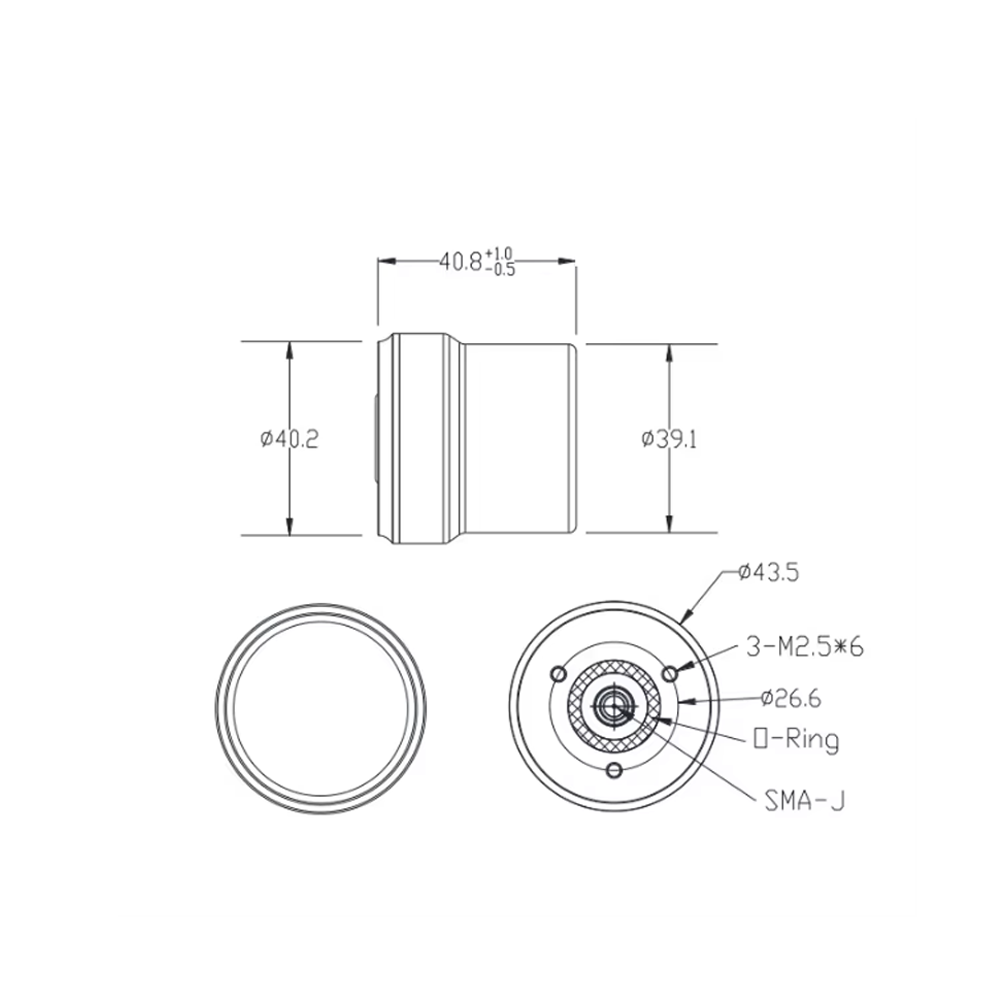
The standard TX-G015 integrated receiver module measures Φ47 × 35.9mm.
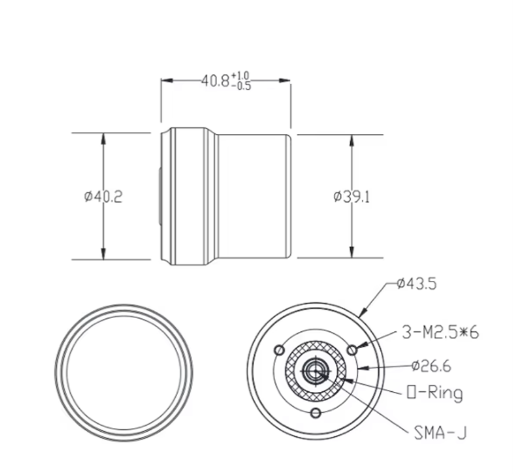
Before sample approval and volume production, confirm the overall diameter, height, mounting structure, cable or connector orientation, installation clearance, eight-pin interface position, and mechanical tolerance against the approved drawing and physical sample.
• Unmanned Aerial Vehicles
• Autonomous Mobile Robots
• Mobile Mapping Equipment
• Precision Positioning Terminals
• Agricultural Guidance Systems
• Surveying and Mapping Equipment
• Robotic Navigation Systems
• Embedded RTK Positioning Devices
• Vehicle Positioning and Tracking Systems
• Industrial Automation Platforms
The TX-G015 integrates both the GNSS antenna and ZED-F9P receiver, so a separate external GNSS antenna is normally not required for the standard configuration.
The module requires a regulated 3.3–3.45V DC power supply. The host system should provide sufficient current capacity, low ripple, correct grounding, and suitable protection against reverse polarity, overvoltage, and electrostatic discharge.
Positioning data and receiver communication are available through three UART interfaces and one I²C interface. The exact pin assignment, voltage level, baud rate, communication configuration, and cable definition must be confirmed using the approved interface document.
For RTK operation, the module must receive valid correction data from an RTK base station, NTRIP service, radio modem, cellular modem, or another compatible correction source.
Support for RTCM 3.3 does not mean that correction data is included with the product. The customer must provide or subscribe to a compatible correction-data source.
The integrated antenna should be installed with a clear view of the sky and away from motors, high-current wiring, switching power supplies, telemetry transmitters, digital clock sources, metal shielding, and other potential sources of interference or signal blockage.
For UAV integration, the module should be mounted where vibration, conductive structures, propeller systems, flight-controller electronics, and high-power radio transmitters have minimal influence on GNSS reception.
Final positioning performance must be verified on the customer’s completed equipment because enclosure materials, installation attitude, electromagnetic interference, ground structure, power quality, correction data, and firmware configuration can affect operating results.
TOXU provides integrated GNSS positioning hardware support covering GNSS antennas, RTK receiver modules, receiver boards, RF cable assemblies, connectors, enclosure integration, PCBA manufacturing, prototype verification, and volume production.
Our engineering team supports antenna selection, receiver integration, interface confirmation, cable configuration, RF testing, system-level troubleshooting, and product customization for UAV, robotics, automotive, industrial, and positioning-equipment manufacturers.
With IATF16949 and ISO9001-certified manufacturing capabilities, TOXU supports engineering verification, quality control, customized labels and packaging, and stable production delivery for overseas B2B projects.
Q: Is the TX-G015 only a GNSS antenna?
A: No. It integrates a four-arm helical GNSS antenna and a ZED-F9P multi-band positioning receiver in one compact module.
Q: Which satellite navigation systems does it support?
A: The available specification lists compatible GPS, GLONASS, BDS, Galileo, and QZSS signals.
Q: Does the module support RTK positioning?
A: Yes. It supports RTK positioning when valid compatible correction data is supplied and suitable operating conditions are available.
Q: Does the product include an RTK correction service?
A: No. The customer must provide correction data through a compatible base station, NTRIP service, communication modem, or other correction source.
Q: What positioning protocols are supported?
A: The listed data formats include NMEA, UBX, and RTCM 3.3.
Q: Which hardware interfaces are available?
A: The available specification lists three UART interfaces and one I²C interface through an eight-pin locking connector.
Q: What power supply does the module require?
A: It requires a regulated 3.3–3.45V DC supply and has a specified power consumption of approximately 0.95W.
Q: Is an external GNSS antenna required?
A: The standard TX-G015 configuration already contains an integrated four-arm helical GNSS antenna, so a separate external antenna is normally unnecessary.
Q: Is it suitable for UAV installation?
A: Its compact size, weight below 20g, integrated antenna, and RTK receiver support evaluation in UAV applications. Final performance must be verified on the complete aircraft.
Q: Is the product waterproof?
A: No IP rating is provided in the available specification, so waterproof performance must not currently be claimed.
Q: Is the RTK accuracy guaranteed in every environment?
A: No. RTK performance depends on correction-data quality, baseline distance, satellite visibility, multipath, interference, installation, firmware configuration, and the complete operating environment.
Lucy Yang | lucy.y@toxutech.com
Nicole Li | nicole@toxutech.com
Dotty Zhao | sales04@toxutech.com
Global Business Director / Sales Team / Global Operations


 En
En Cn
Cn Korean
 Home >

