

-
Products -PCBA Manufacturing RF Connectors RF Cable Assemblys Embedded Antennas External Antennas GNSS Positioning Solutions
RF Connectors

RF Cable Assemblys
Embedded Antennas
External Antennas
GNSS Positioning Solutions


 Language


Language

Model: TX-ZED-F9P-04B-RTK
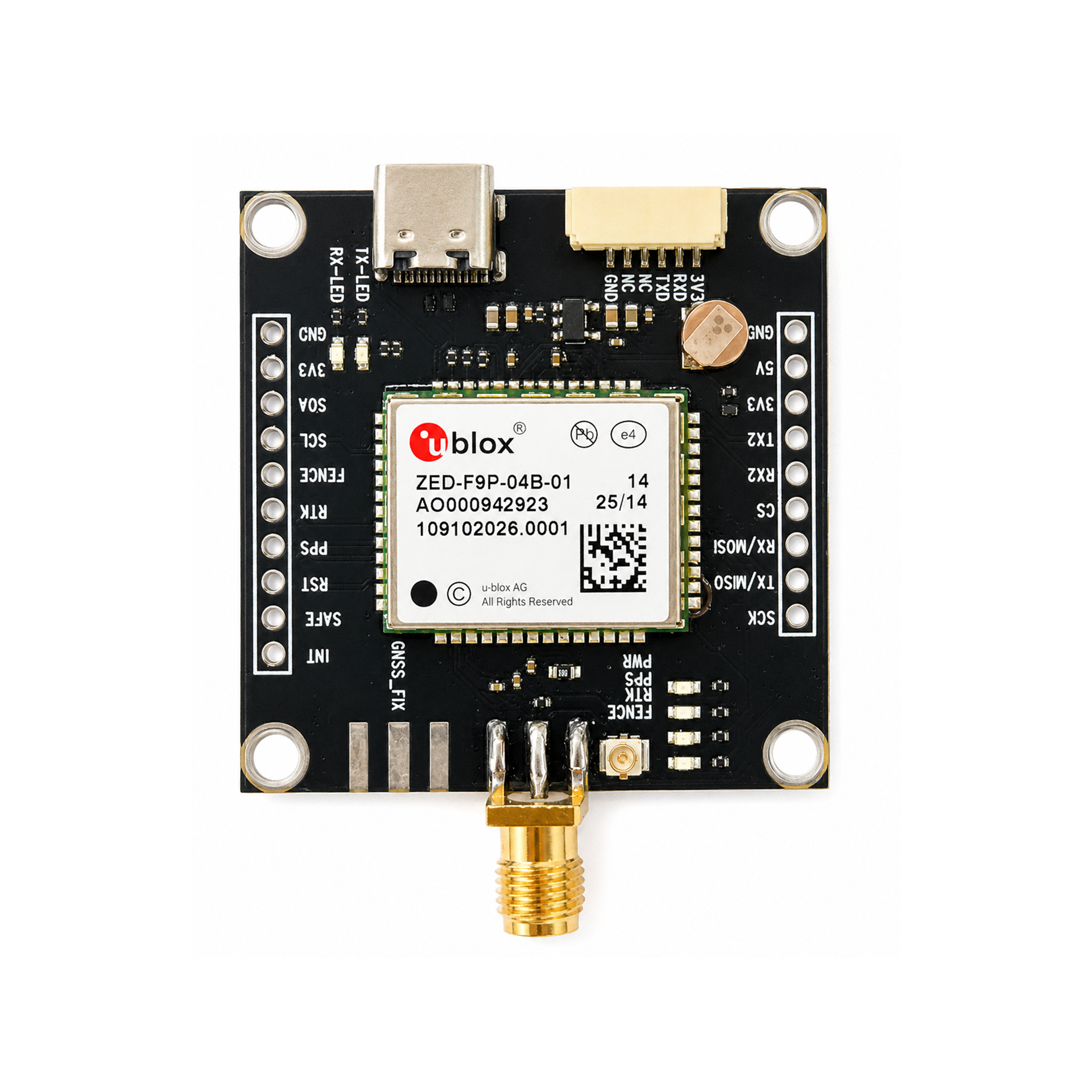
The TOXU TX-ZED-F9P-04B-RTK is a dual-frequency RTK GNSS development board built around the u-blox ZED-F9P-04B-01 module. Its USB-C port, six-pin serial connector and labeled breakout pads support receiver evaluation and integration into OEM navigation and data acquisition systems.
u-blox ZED-F9P-04B-01 Module
Tracks GPS L1/L2 and supported GLONASS, Galileo, BeiDou and QZSS signals.
RTCM 3.3 Correction Support
Supports centimeter-level RTK positioning with compatible corrections, a suitable active antenna and good satellite reception.
USB-C and Six-Pin Serial Connector
Provides a USB-C connection for bench setup and a separate connector with labeled TXD and RXD pins for host wiring.
PPS and Serial Breakout
Labeled PPS, RTK and TX2/RX2 pads provide access points for timing, status monitoring and serial integration.
External Antenna and Four-Point Mounting
Mount the receiver PCB on standoffs inside the equipment and position the external antenna where it has better sky visibility.
The TOXU TX-ZED-F9P-04B-RTK is a dual-frequency GNSS development board for teams building RTK positioning into their own equipment. It combines a u-blox ZED-F9P-04B-01 module with a USB-C port, a six-pin serial connector and two rows of labeled breakout pads.
The module can operate as an RTK rover or be configured to generate RTCM corrections as a base station. In rover operation, centimeter-level positioning depends on a compatible correction stream, a suitable external active antenna and satellite reception sufficient for a fixed RTK solution.
The board gives engineers access to serial, timing and status signals during development. A host can consume NMEA or UBX position messages, while a compatible timing input can use the PPS signal to align measurements with the receiver time base.
Dual-Frequency GNSS Tracking
The ZED-F9P-04B-01 processes observations from two frequency ranges. An active antenna matched to the signals used in the project allows the receiver to use both ranges for RTK processing.
RTK Rover and Base Station Configuration
The module accepts supported RTCM 3.3 messages as a rover and can generate correction messages in base station mode. This lets engineers evaluate each role using the appropriate antenna installation and data link.
Separate USB-C and Serial Connections
Use the USB-C connection for bench access and the six-pin TXD/RXD connector when developing a dedicated host harness. The breakout rows also carry separately labeled TX2 and RX2 pads.
PPS and RTK Status Access
The PPS breakout provides a timing reference for compatible logging or acquisition hardware. The board also has labeled PPS and RTK indicators for visual checks during setup.
Labeled Expansion Pads
Through-hole rows provide access points for serial, timing and control signals. On the ZED-F9P-04B module, SPI shares signal pins with the host UART and I²C, so interface availability depends on the selected mode.
External RF Connection and Four Mounting Points
An edge-mounted threaded RF connector allows coaxial cable routing away from the PCB. Four corner holes provide mounting points for standoffs or a carrier plate.
| Attribute | Value |
|---|---|
| Product Model | TX-ZED-F9P-04B-RTK |
| Product Type | Dual-frequency RTK GNSS development board |
| GNSS Module | u-blox ZED-F9P-04B-01 |
| Board Connectors | USB Type-C Six-pin connector with TXD and RXD markings |
| Selected Breakout Labels | TX2, RX2, PPS, RTK, RST and FENCE |
| Onboard LED Markings | PWR, PPS, RTK, FENCE, TX-LED and RX-LED |
| Antenna Requirement | External active dual-frequency GNSS antenna |
| PCB Mounting | Four corner mounting holes |
| GNSS Signals (Module) | GPS L1 C/A and L2C GLONASS L1OF and L2OF Galileo E1-B/C and E5b BeiDou B1I and B2I QZSS L1 C/A and L2C with GPS enabled |
| Operating Modes (Module) | Standalone GNSS, RTK rover and configurable RTK base station |
| Data Protocols (Module) | NMEA and UBX for position data RTCM 3.3 for correction data |
| Horizontal RTK Accuracy (Module, CEP) | 0.01 m + 1 ppm |
| Vertical RTK Accuracy (Module, Median) | 0.01 m + 1 ppm |
The accuracy figures are published by u-blox for the ZED-F9P-04B module under specified test conditions. Installed performance depends on the antenna, satellite visibility, multipath, reference-station distance and correction quality.
The USB-C port and six-pin serial connector sit along one edge of the square PCB. The two through-hole breakout rows flank the GNSS module. The opposite edge carries the threaded RF connector, with a miniature coaxial connector next to it. Allow room for the mating plugs, coaxial cable bend radius and mounting hardware when laying out the enclosure.
OEM Navigation Development
Evaluate GNSS position messages and RTCM delivery before incorporating the receiver into a vehicle, robot or industrial controller.
UAV and Mobile Robot Prototypes
Feed position updates into compatible navigation software and check RTK solution status during outdoor testing.
Surveying and Mapping Instruments
Pair rover position data with survey observations, sensor records or mapping data on an embedded host.
GNSS-Synchronized Data Acquisition
Use PPS with a compatible logger or controller to align sensor samples with GNSS time.
Active GNSS antenna → TX-ZED-F9P-04B-RTK → Host controller
Connect a compatible active antenna to the designated RF connection. Match the board pinout, supply and signal levels to the host before wiring. Configure the receiver to deliver the required NMEA or UBX messages and connect PPS to a compatible timing input where needed.
For rover operation, forward RTCM data from a reference station or from a host running an NTRIP client. For base station operation, configure the module with the reference position and route the generated RTCM messages through the system's data link.
TOXU can help select a matching active GNSS antenna and RF cable assembly based on the supported signals, antenna location and enclosure layout. Share the host interface and harness requirements for a review of the receiver and interconnects.
Receiver, Antenna and Cable Integration
Review antenna placement, connector clearance and RF cable routing together with the receiver board layout before finalizing the equipment design.
OEM / ODM Manufacturing Support
Discuss project-specific RF assemblies and PCBA integration for prototypes and volume production.
TOXU Tech supplies GNSS positioning hardware, GNSS and communication antennas, RF connectors and coaxial cable assemblies for OEM equipment manufacturers and system integrators.
TOXU also provides PCBA manufacturing and OEM / ODM integration services for the development and production of RF and GNSS hardware.
Which module is installed on the board?
The TX-ZED-F9P-04B-RTK uses the u-blox ZED-F9P-04B-01 dual-frequency GNSS module.
Can the module be used as both an RTK rover and a base station?
Yes. In rover mode, the module uses compatible RTCM input to compute an RTK position. In base station mode, it can generate RTCM messages after the reference position is established.
What is the PPS breakout used for?
PPS provides a timing reference for compatible controllers and data loggers. Match the signal level and timing configuration to the host input.
Can the host UART, I²C and SPI be used at the same time?
The ZED-F9P-04B module uses shared pins for SPI and for host UART and I²C signals. The module interface selection and board configuration determine which functions are available.
Which antenna should I use?
Use an external active antenna that covers the dual-frequency signals required for your application. Check the mating connector and antenna bias requirements when selecting the RF cable.
How do I feed NTRIP corrections to the receiver?
Use an NTRIP client on a host or communications device to receive the correction stream, then forward compatible RTCM messages through the configured receiver interface.
Lucy Yang | lucy.y@toxutech.com
Dotty Zhao | sales04@toxutech.com
Global Business Director / Sales Team / Global Operations


 En
 Cn
 Korean
 Home >


