

-
Products -PCBA Manufacturing RF Connectors RF Cable Assemblys Embedded Antennas External Antennas GNSS Positioning Solutions
RF Connectors

RF Cable Assemblys
Embedded Antennas
External Antennas
GNSS Positioning Solutions



 Language


Language

Model: TX-UM982-DB
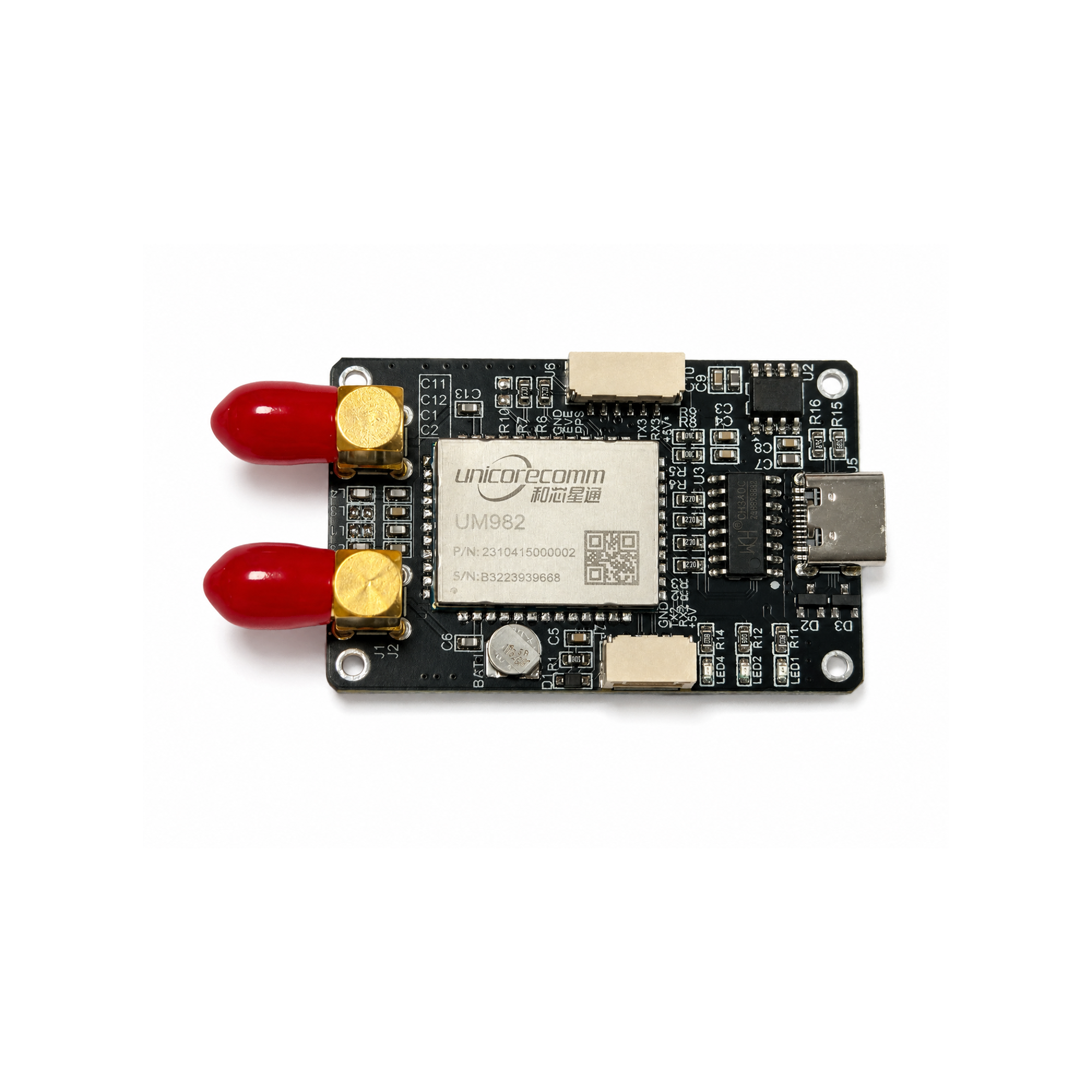
The TOXU TX-UM982-DB is a Unicore UM982 development board for evaluating multi-frequency RTK positioning and dual-antenna GNSS heading. Its two external antenna inputs, USB-C port and serial headers support bench testing and integration into OEM navigation systems.
Unicore UM982 GNSS Module
Evaluate multi-frequency GNSS reception across GPS, BeiDou, GLONASS, Galileo and QZSS.
RTK Positioning
Use compatible RTCM corrections and suitable satellite reception to evaluate centimeter-level positioning.
Dual-Antenna GNSS Heading
Connect two external GNSS antennas on a fixed baseline to derive heading from their relative positions.
USB-C Setup and Debugging
Use the USB-C interface for bench configuration and receiver output checks.
Serial Access for OEM Integration
Use COM2 and COM3 to evaluate communication with a compatible host controller or flight controller.
The TOXU TX-UM982-DB is an RTK GNSS development board built around the Unicore UM982 positioning and heading module. It gives hardware teams access to two external GNSS antenna inputs, USB-C for bench setup and serial headers for host integration.
The UM982 processes multi-frequency signals from GPS, BeiDou, GLONASS, Galileo and QZSS. With compatible RTCM correction data and suitable satellite reception, the module can deliver centimeter-level RTK positioning. The primary and secondary antenna channels track different sets of signals, so antenna selection should account for the signals used by each channel.
With two antennas mounted at a fixed separation, the receiver derives heading from the direction of the antenna baseline. This lets engineers evaluate heading while the platform is stationary, subject to suitable reception and a valid heading solution. The board is intended for development work on UAVs, mobile robots and precision agriculture equipment.
Multi-Frequency GNSS Reception
The UM982 tracks multiple signals from five GNSS constellations. Engineers can evaluate satellite reception with the antennas and mounting positions planned for their equipment.
RTCM Correction Input
The UM982 accepts RTCM 3.x differential data. A compatible reference station or correction service can supply the data needed to evaluate the rover's absolute RTK position.
Heading from a Fixed Antenna Baseline
The module calculates heading using carrier-phase measurements from two GNSS antennas. A rigid mount and known baseline orientation let the host relate the reported heading to the platform's forward direction.
Two External GNSS Antenna Inputs
Separate primary and secondary inputs let the antennas be mounted away from the receiver board. This gives designers flexibility to select antenna locations and route RF cables through the equipment.
USB-C for Bench Setup
Connect the board to a development computer for configuration and output checks before wiring it into the host system.
COM2 and COM3 Serial Headers
The two headers provide access to serial communication for embedded integration. Match the connector pinout, signal voltage, baud rate and message format to the host before connecting.
| Attribute | Value |
|---|---|
| Product Model | TX-UM982-DB |
| Product Type | Dual-antenna RTK GNSS development board |
| GNSS Module | Unicore UM982 |
| Antenna Inputs | 2 × external GNSS antenna inputs, primary and secondary |
| USB Interface | USB Type-C for configuration and debugging |
| Serial Interfaces | COM2 and COM3 UART headers |
| PCB Mounting | Four corner mounting holes |
| GNSS Constellations (UM982 Module) | GPS, BeiDou (BDS), GLONASS, Galileo and QZSS |
| Selected GNSS Signals (UM982 Module) | Primary channel: GPS L1/L2/L5 and Galileo E1/E5a/E5b Secondary channel: GPS L1/L2 and Galileo E1/E5b |
| Navigation Functions (UM982 Module) | Multi-frequency GNSS positioning, RTK positioning and dual-antenna heading |
| Differential Data Format (UM982 Module) | RTCM 3.x |
| Navigation Output Formats (UM982 Module) | NMEA 0183 and Unicore formats |
| RTK Positioning Accuracy (UM982 Module, RMS) | Horizontal: 0.8 cm + 1 ppm Vertical: 1.5 cm + 1 ppm |
| Heading Accuracy (UM982 Module) | 0.1° at a 1 m antenna baseline |
Accuracy figures are published by Unicore for the UM982 module. Performance in an installed system depends on antenna selection and placement, baseline geometry, satellite reception and, for absolute RTK positioning, correction quality.
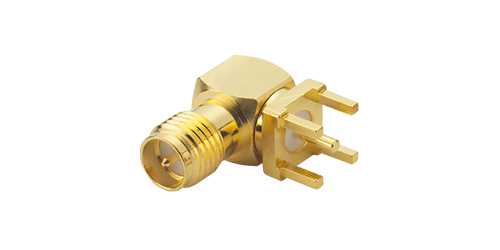
The two right-angle RF connectors are on one edge of the board, with the USB-C port on the opposite edge. The UM982 module sits between the two interfaces, and the COM2 and COM3 headers are accessible from the component side. Four corner mounting holes support installation on standoffs or a carrier plate. Allow clearance around the connectors for cable mating and routing.
UAV Navigation Development
Evaluate RTK position and GNSS heading inputs for flight controllers that support the required serial interface and receiver messages.
Precision Agriculture Equipment
Prototype guidance systems for agricultural machines and evaluate heading at low speeds using a fixed antenna baseline.
Autonomous Mobile Robots
Test how a navigation controller uses RTK position and GNSS heading during starts, stops and changes in direction.
Robotic Mower Development
Assess antenna placement and available baseline length on compact outdoor equipment before finalizing the enclosure and cable routing.
Two GNSS antennas → TX-UM982-DB → Position and heading data → Host controller
Mount the primary and secondary antennas rigidly on the same platform with a known separation and orientation. Connect each antenna to its designated input and configure the heading offset for the installation. Check the heading output while stationary and while moving.
For absolute RTK positioning, route compatible RTCM corrections from a reference station or correction service to the receiver through the system's correction-data link. Configure the host to read the required position and heading messages through a compatible serial connection.
TOXU can help OEM teams select external GNSS antennas, RF coaxial cable assemblies and connectors for the board. Share the intended antenna mounting positions, cable lengths and host interface requirements so the hardware can be selected for the installation.
Receiver and RF Hardware Integration
Work with one supplier to evaluate how the receiver, antennas and RF interconnects fit your mechanical layout and electrical interfaces.
OEM / ODM Engineering and Manufacturing
Discuss project-specific cable assemblies, connector configurations and PCBA integration for prototype builds and volume production.
TOXU Tech supplies GNSS positioning hardware, GNSS and communication antennas, RF connectors and coaxial cable assemblies for equipment manufacturers and system integrators.
TOXU also provides PCBA manufacturing and OEM / ODM hardware integration services. Support covers prototype assemblies and volume manufacturing for RF and GNSS equipment.
Which GNSS module is installed on the TX-UM982-DB?
The board uses the Unicore UM982, a multi-frequency GNSS module with on-module RTK positioning and dual-antenna heading processing.
Can the board operate with one GNSS antenna?
Yes. Connect a compatible antenna to the primary input for positioning. GNSS heading requires two antennas on a fixed baseline.
Can the receiver report heading while the platform is stationary?
Yes, when both antennas have suitable satellite reception and the receiver has a valid heading solution. Heading comes from the antenna baseline.
What is required for centimeter-level RTK positioning?
The rover needs compatible RTCM corrections, a suitable GNSS antenna and sufficient satellite reception to obtain a fixed RTK solution.
Do both antenna inputs track GPS L5?
Unicore lists GPS L5 on the UM982 primary channel. The secondary GPS channel tracks L1 C/A and L2C.
How do I connect the board to a flight controller?
Use a compatible serial interface and match the pinout, UART logic voltage, baud rate and message format. Verify that the flight controller firmware supports the GNSS position and heading messages required for your application.
Can TOXU supply matching antennas and RF cables?
Yes. Share the installation layout, antenna spacing and cable routing requirements so TOXU can help select suitable GNSS antennas and cable assemblies.
Lucy Yang | lucy.y@toxutech.com
Dotty Zhao | sales04@toxutech.com
Global Business Director / Sales Team / Global Operations


 En
 Cn
 Korean
 Home >


