

-
Products -PCBA Manufacturing RF Connectors RF Cable Assemblys Embedded Antennas External Antennas GNSS Positioning Solutions
RF Connectors

RF Cable Assemblys
Embedded Antennas
External Antennas
GNSS Positioning Solutions











 Language


Language


Time:2026-10-17 Views:0
In the era of smart vehicles, autonomous driving, and connected mobility, reliable positioning and wireless connectivity are no longer optional features—they are fundamental requirements for modern automotive systems. A vehicle GNSS WiFi combo antenna stands as a core component that integrates dual functions of high-precision GNSS positioning and stable WiFi wireless communication into a single compact unit. This all-in-one antenna solution has gradually replaced traditional single-function antennas and become the mainstream choice for passenger cars, commercial trucks, engineering vehicles, smart RVs, and intelligent transportation equipment.
As automotive IoT, V2X communication, and in-vehicle infotainment systems continue to upgrade globally, the demand for high-gain vehicle GNSS WiFi combo antennas, waterproof automotive combo antennas, and multi-band vehicle GNSS WiFi antennas has surged rapidly. This comprehensive guide will elaborate on the working principle, core features, key benefits, application scenarios, selection criteria, installation tips, and market advantages of vehicle GNSS WiFi combo antennas, helping buyers, automotive engineers, and fleet managers fully understand this essential automotive connectivity component.
1. What Is a Vehicle GNSS WiFi Combo Antenna?
A vehicle GNSS WiFi combo antenna is a specialized dual-function automotive radio frequency antenna designed exclusively for in-vehicle environments. It integrates an advanced GNSS positioning antenna unit and a high-speed WiFi communication antenna unit within one unified housing, enabling simultaneous stable reception of satellite positioning signals and wireless network signals without mutual signal interference.
Different from ordinary civilian combo antennas, vehicle-grade GNSS WiFi combo antennas strictly comply with automotive industry standards such as TS16949, with enhanced resistance to high temperature, low temperature, vibration, and electromagnetic interference. The GNSS module supports multiple global satellite navigation systems including GPS, GLONASS, Galileo, and BeiDou, covering full L1-band frequency ranges to ensure centimeter-level to meter-level positioning accuracy. The WiFi module supports dual-band 2.4GHz and 5.8GHz frequency bands, compatible with WiFi 4, WiFi 5, and the latest WiFi 6 protocols, meeting high-speed and low-latency wireless connection demands for in-vehicle devices.
Most vehicle GNSS WiFi combo antennas adopt a low-profile shark fin or flat screw-mount design, which is not only beautiful and aerodynamic but also effectively reduces wind resistance during vehicle driving. This integrated structure solves the problems of messy wiring, large installation space occupation, and inconsistent signal stability caused by installing separate GNSS and WiFi antennas in traditional vehicle modification and OEM production.
2. Core Working Principles of Vehicle GNSS WiFi Combo Antennas
To understand why vehicle GNSS WiFi combo antennas deliver superior performance in complex automotive environments, it is necessary to clarify their independent and collaborative working mechanisms of GNSS positioning and WiFi communication.
2.1 GNSS Positioning Mechanism
The built-in GNSS antenna unit adopts high-precision ceramic antenna chips with high signal gain and low noise figure. It can continuously capture and decode satellite navigation signals from multiple constellations in all weather conditions. After filtering and amplifying weak satellite signals through the built-in low-noise amplifier (LNA), the antenna transmits accurate positioning data to the vehicle’s navigation host, ADAS system, or fleet management terminal. Even in complex scenarios such as urban canyons, tunnel entrances, and dense building areas, the multi-constellation signal compatibility effectively avoids positioning drift and signal loss, ensuring continuous and accurate vehicle positioning.
2.2 WiFi Communication Mechanism
The WiFi antenna unit uses omnidirectional radiation technology, covering 360-degree signal reception and transmission without blind spots. Supporting dual-band 2.4GHz and 5.8GHz switching, it balances the long-distance penetration advantage of the 2.4GHz band and the high-speed low-interference performance of the 5.8GHz band. When the vehicle is running, the antenna maintains stable connection with in-vehicle WiFi hotspots, mobile terminals, roadside V2X equipment, and cloud servers, realizing real-time transmission of in-vehicle entertainment data, driving data, and remote monitoring data.
2.3 Anti-Interference Collaborative Technology
The biggest technical difficulty of combo antennas is mutual interference between different frequency bands. Professional vehicle GNSS WiFi combo antennas adopt independent frequency isolation design and built-in filter circuits. The GNSS L1 band (1560–1580MHz) and WiFi dual band (2400–2500MHz, 5725–5850MHz) are completely isolated in the internal structure, eliminating crosstalk between positioning signals and communication signals. This ensures that high-speed WiFi data transmission will not affect positioning accuracy, and high-sensitivity GNSS signal reception will not limit WiFi network speed, achieving synchronous stable operation of dual functions.
3. Key Features of Premium Vehicle GNSS WiFi Combo Antennas
Automotive working environments are extremely harsh, with extreme temperature changes, violent vibration, rainwater erosion, and strong electromagnetic interference from vehicle engines and electrical equipment. Therefore, qualified vehicle-grade GNSS WiFi combo antennas must have a series of professional industrial-grade features, which are also the core standards for users to select products.
3.1 Full-Band GNSS Global Positioning Support
High-quality vehicle combo antennas support all mainstream global GNSS constellations, including American GPS, Russian GLONASS, European Galileo, and Chinese BeiDou, as well as regional augmentation systems such as QZSS. The wide frequency coverage ensures that vehicles can obtain accurate positioning signals in any country and region worldwide, fully meeting the global layout needs of commercial vehicles, cross-border logistics fleets, and overseas smart mobility projects. Compared with single-GPS antennas, multi-constellation GNSS antennas have 30% higher signal capture speed and 50% stronger anti-shielding ability.
3.2 Dual-Band High-Speed WiFi Compatibility
Supporting 2.4GHz and 5.8GHz dual-band WiFi signals, the antenna is fully compatible with WiFi 6 and backward compatible with WiFi 5 and WiFi 4 protocols. The maximum WiFi transmission rate can reach gigabit level, meeting the high-bandwidth demands of in-vehicle 4K video playback, real-time map updating, cloud data synchronization, and multi-terminal simultaneous networking. The omnidirectional signal coverage design ensures stable network connection even when the vehicle is driving at high speed, avoiding network disconnection and stuttering.
3.3 Automotive-Grade Rugged Environmental Adaptability
Vehicle GNSS WiFi combo antennas adopt IP67/IP68 waterproof and dustproof enclosure standards, which can completely resist rainwater, snow, dust, and mud erosion, adapting to outdoor all-weather working conditions. The internal components undergo high and low temperature aging tests, supporting stable operation in the temperature range of -40℃ to +85℃, which fully covers extreme temperature environments in cold northern regions and hot southern regions. In addition, the product has professional anti-vibration and anti-shock performance, resisting continuous vibration during vehicle driving and bumpy road impacts, avoiding internal component loosening and signal failure.
3.4 High Gain and Low Noise Signal Performance
Equipped with a high-performance low-noise amplifier, the GNSS antenna has ultra-high signal sensitivity, which can capture weak satellite signals in complex shielding environments. The WiFi antenna adopts high-gain radiation design, effectively improving signal transmission distance and penetration. While ensuring strong signal receiving ability, the product strictly controls internal noise, avoiding signal distortion and delay, achieving high-precision positioning and low-latency network transmission.
3.5 Compact Integrated and Easy Installation Design
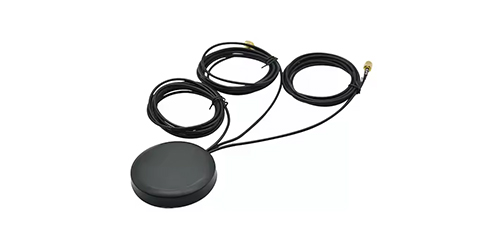
The integrated combo antenna abandons the bulky design of traditional dual antennas, with a miniaturized and streamlined shark fin appearance, which is perfectly compatible with vehicle body aesthetics. It supports multiple installation methods including roof screw fixing, adhesive pasting, and embedded installation, suitable for different vehicle models such as sedans, SUVs, trucks, and engineering vehicles. The dual-cable independent output design realizes separate transmission of GNSS and WiFi signals, facilitating wiring arrangement and equipment docking, and greatly reducing installation time and labor costs.
3.6 Strict Automotive Standard Certification
Formal vehicle GNSS WiFi combo antennas pass TS16949 automotive quality system certification, RoHS environmental protection certification, and REACH certification, meeting OEM vehicle factory supporting standards and after-market modification requirements. No electromagnetic radiation overload, no interference with vehicle original electronic systems, safe and reliable for long-term vehicle use.

4. Unique Advantages of Vehicle GNSS WiFi Combo Antennas Over Single-Function Antennas
In the past, most vehicles used separate GNSS positioning antennas and WiFi communication antennas. With the upgrading of smart vehicle technology, dual-function combo antennas have completely replaced single antennas in most application scenarios, relying on their irreplaceable comprehensive advantages.
4.1 Save Installation Space and Optimize Vehicle Body Structure
Installing two single antennas requires two independent installation positions on the vehicle roof or body, occupying valuable vehicle body space and easily destroying the overall aerodynamic and aesthetic design of the vehicle. The integrated combo antenna only needs one installation position to realize dual functions, greatly saving vehicle body space, optimizing the streamlined design of the vehicle body, and reducing wind resistance and driving noise during high-speed driving.
4.2 Reduce Wiring Complexity and Lower Failure Rate
Dual single antennas require two sets of independent wiring and fixing structures, with messy internal vehicle wiring, which is not conducive to later maintenance and is prone to wiring aging, falling off, and short circuit failures after long-term vibration. The combo antenna adopts integrated wiring design, with neat and standardized lines, fewer connection nodes, effectively reducing circuit failure rate and improving the overall stability of vehicle electronic systems.
4.3 Lower Comprehensive Cost and Improve Cost-Effectiveness
Purchasing two single antennas separately has higher procurement costs, while the integrated combo antenna realizes dual functions at a lower unit price. At the same time, it saves installation labor costs, wiring material costs, and later maintenance costs. For vehicle manufacturers, fleet operation companies, and modification merchants, the long-term comprehensive cost performance of combo antennas is far higher than that of single antennas.
4.4 Stronger Signal Synchronization and System Compatibility
Independently installed single antennas have different installation positions and signal receiving angles, which easily cause asynchronous data transmission between positioning and network systems, affecting the accuracy of vehicle navigation and remote data monitoring. The combo antenna integrates dual modules in the same position, with consistent signal receiving environment and synchronous data transmission, perfectly matching the operating logic of smart vehicle systems, ADAS systems, and fleet management platforms.
5. Wide Application Scenarios of Vehicle GNSS WiFi Combo Antennas
With the rapid development of smart transportation and automotive intelligence, vehicle GNSS WiFi combo antennas have been widely used in various types of vehicles and intelligent mobile equipment, covering civilian, commercial, industrial, and intelligent transportation fields.
5.1 Smart Passenger Vehicles
New energy vehicles and traditional smart fuel vehicles are the largest application scenarios of combo antennas. The antenna provides high-precision positioning for vehicle navigation, automatic parking, and lane keeping assist systems, and provides high-speed WiFi network support for in-vehicle central control screens, carplay, in-vehicle entertainment systems, and passenger mobile device networking. It realizes real-time update of navigation maps, online music and video playback, and vehicle intelligent interconnection functions, improving driving experience and vehicle intelligence level.
5.2 Commercial Fleet Vehicles
Logistics trucks, express delivery vehicles, taxi fleets, and online car-hailing vehicles rely heavily on vehicle positioning and network communication. The GNSS WiFi combo antenna supports real-time vehicle positioning, driving track recording, speed monitoring, and remote fleet scheduling. The stable WiFi network ensures real-time data transmission between vehicle terminals and fleet management cloud platforms, helping enterprises realize intelligent fleet management, optimize transportation routes, and reduce operation costs.
5.3 Special Engineering and Industrial Vehicles
Engineering machinery such as excavators, cranes, loaders, and special vehicles such as sanitation vehicles and fire trucks work in complex and changeable environments. The rugged vehicle GNSS WiFi combo antenna adapts to harsh working conditions such as dust, mud, and severe vibration. It provides accurate positioning for vehicle operation monitoring and real-time network transmission for equipment fault data, realizing remote monitoring and intelligent scheduling of engineering equipment.
5.4 Smart RVs and Mobile Campers
RVs and mobile campers have high demands for outdoor networking and travel positioning. The combo antenna provides stable high-speed WiFi for outdoor office, entertainment, and live broadcast of RV users, and provides accurate navigation positioning for self-driving tours. The waterproof and dustproof design fully adapts to outdoor wild travel environments, ensuring continuous positioning and network coverage in remote areas.
5.5 Autonomous Driving and V2X Intelligent Transportation
In L2 to L4 level autonomous driving systems and V2X vehicle-road collaboration scenarios, vehicle GNSS WiFi combo antennas act as key signal transmission terminals. High-precision GNSS positioning provides basic position data for autonomous driving decision-making, and low-latency WiFi communication realizes real-time information interaction between vehicles and roads, vehicles and vehicles, vehicles and cloud platforms, ensuring the safety and efficiency of intelligent transportation systems.
5.6 Vehicle Monitoring and IoT Intelligent Equipment
Vehicle-mounted IoT terminals, driving recorders, remote monitoring equipment, and vehicle-mounted security systems all need positioning and network support. The combo antenna provides stable dual-function signal support for these intelligent devices, realizing real-time upload of driving data, video monitoring data, and vehicle status data, facilitating remote vehicle management and safety monitoring.
6. How to Choose a High-Quality Vehicle GNSS WiFi Combo Antenna? (2026 Buying Guide)
Facing a large number of vehicle GNSS WiFi combo antenna products on the market with uneven quality, many buyers and engineers are confused about product selection. Combining automotive industry standards and actual application needs, we summarize the core selection criteria to help users quickly screen high-quality products.
6.1 Check Core Frequency and Parameter Configuration
First, confirm whether the GNSS module supports full-band multi-constellation positioning (GPS/GLONASS/Galileo/BeiDou) to ensure global positioning adaptability. For the WiFi part, prioritize dual-band 2.4G+5.8G products compatible with WiFi 6, avoiding single-band WiFi antennas with slow speed and strong interference. At the same time, check key parameters such as antenna gain, noise figure, and transmission power—high gain and low noise parameters directly determine signal stability and positioning accuracy.
6.2 Verify Automotive-Grade Environmental Resistance
Prioritize products with IP67 and above waterproof and dustproof ratings, which can adapt to all-weather outdoor use. Confirm the working temperature range covers -40℃ to +85℃ to adapt to extreme seasonal temperature changes. For engineering vehicles and long-distance commercial vehicles, it is necessary to select products with enhanced anti-vibration and anti-aging performance to ensure long-term stable operation.
6.3 Confirm Interface and Installation Compatibility
Common antenna interfaces include SMA, RP-SMA, and IPEX. Users need to select matching interfaces according to vehicle terminal equipment to avoid docking failure. At the same time, select appropriate installation methods (screw mounting, adhesive mounting) according to vehicle model and installation position to ensure convenient installation and firm fixation. It is recommended to choose dual independent cable output products to avoid signal crosstalk caused by shared lines.
6.4 Check Industry Certification and Quality Standards
Formal vehicle-grade combo antennas must pass TS16949 automotive quality certification, RoHS environmental protection certification, and relevant electromagnetic compatibility certification. Certified products have stable quality, no electromagnetic interference with vehicle original systems, and meet OEM supporting and after-market modification standards, with longer service life and higher safety.
6.5 Match Actual Application Scenario Needs
Civil passenger cars can choose conventional low-profile shark fin combo antennas with beautiful appearance and stable performance; commercial fleets and engineering vehicles need to choose enhanced rugged waterproof and anti-vibration models; autonomous driving and high-precision monitoring scenarios need to select high-gain low-noise high-precision positioning models to meet professional-level signal demands.
7. Professional Installation and Maintenance Tips for Vehicle GNSS WiFi Combo Antennas
Even high-quality products need standardized installation and daily maintenance to exert the best performance. Improper installation will lead to signal attenuation, positioning deviation, and network instability, and shorten the service life of the antenna.
7.1 Standard Installation Guidelines
The best installation position for the vehicle combo antenna is the top of the vehicle roof, which is free from metal shielding and has the best signal receiving angle. Avoid installing it under metal roofs, metal decorations, or inside the car, as metal shielding will seriously weaken GNSS satellite signals and WiFi network signals. During installation, ensure the antenna is fixed firmly to avoid loosening caused by vehicle vibration. The wiring should be neat and avoid winding with vehicle high-voltage lines to prevent electromagnetic interference. After installation, test positioning accuracy and WiFi network speed to confirm normal dual-function operation.
7.2 Daily Maintenance and Fault Troubleshooting
Regularly clean the antenna surface of dust, mud, and snow to avoid covering the antenna radiation unit and affecting signal reception. Check the fixing screws and wiring terminals regularly to ensure no loosening, aging, or water ingress. If problems such as slow positioning, frequent network disconnection, and weak signal occur, first check whether the installation position is shielded and whether the wiring is loose. If no abnormality is found in the appearance, test the antenna parameters with professional equipment to eliminate internal component failure.
7.3 Service Life and Replacement Cycle
High-quality vehicle GNSS WiFi combo antennas have a service life of more than 5 years under normal working conditions. For vehicles working in harsh environments for a long time (such as dust, high temperature, and vibration), it is recommended to check and replace the antenna every 3–4 years to ensure stable positioning and network performance.
8. Market Development Trends of Vehicle GNSS WiFi Combo Antennas (2026–2028)
With the rapid iteration of smart vehicle technology, automotive antenna products are developing towards integration, miniaturization, high precision, and multi-function. In the next three years, the vehicle GNSS WiFi combo antenna market will show three major development trends.
First, multi-function integration will be further upgraded. Traditional 2-in-1 GNSS+WiFi combo antennas will gradually iterate to 3-in-1 and 4-in-1 integrated antennas covering 4G/5G cellular signals, V2X signals, and Bluetooth signals, realizing more comprehensive vehicle connectivity functions.
Second, high-precision positioning will become the standard configuration. With the popularization of high-level autonomous driving, the market demand for centimeter-level high-precision GNSS positioning antennas will surge, and combo antennas will be compatible with RTK high-precision positioning technology to meet the needs of autonomous driving and intelligent vehicle control.
Third, miniaturization and hidden installation will be popularized. In order to adapt to the streamlined design of new energy vehicles, antennas will develop towards more miniaturized and hidden embedded installation, while maintaining high signal performance, balancing vehicle aesthetics and functional practicality.
9. Frequently Asked Questions (FAQ) About Vehicle GNSS WiFi Combo Antennas
Q1: Will the GNSS function and WiFi function of the combo antenna interfere with each other?
Professional vehicle-grade combo antennas adopt independent frequency isolation and built-in filter design, with completely isolated working frequency bands of GNSS and WiFi. There is no signal crosstalk or mutual interference during operation, which can ensure synchronous stable operation of high-precision positioning and high-speed network transmission.
Q2: Is the combo antenna suitable for all vehicle models?
Yes. Vehicle GNSS WiFi combo antennas support all vehicle models such as sedans, SUVs, trucks, RVs, and engineering vehicles. With multiple installation methods such as screw mounting and adhesive mounting, they can adapt to different vehicle body structures and installation environments.
Q3: Does the antenna work normally in extreme weather?
Qualified products have IP67 waterproof and dustproof performance and wide temperature resistance, which can work stably in rain, snow, high temperature, low temperature, and dusty environments, realizing all-weather uninterrupted positioning and network services.
Q4: What is the difference between vehicle-grade and ordinary civilian combo antennas?
Vehicle-grade antennas comply with automotive industry standards, with stronger anti-vibration, anti-interference, and environmental adaptability, stable long-term driving performance, and no impact on vehicle original electronic systems. Civilian antennas cannot adapt to vehicle vibration and extreme temperature environments, and are prone to signal failure and short service life.
As a key connecting component of smart vehicle positioning and wireless communication systems, the vehicle GNSS WiFi combo antenna undertakes the core functions of vehicle positioning navigation, in-vehicle networking, and intelligent data transmission. Compared with traditional single-function antennas, it has obvious advantages in space saving, cost reduction, stable performance, and convenient installation, and has become an indispensable core component of modern smart vehicles, commercial fleets, and intelligent transportation equipment.
With the continuous development of autonomous driving, V2X collaboration, and automotive IoT technology, the performance requirements for vehicle GNSS WiFi combo antennas will continue to improve. Choosing high-quality automotive-grade dual-band GNSS WiFi combo antennas can effectively improve vehicle positioning accuracy and network stability, guarantee the safe and efficient operation of intelligent vehicle systems, and bring more intelligent and convenient travel and operation experience for vehicle users.
Lucy Yang | lucy.y@toxutech.com
Dotty Zhao | sales04@toxutech.com
Global Business Director / Sales Team / Global Operations


 En
 Cn
 Korean
 Home >
