

-
Products -PCBA Manufacturing RF Connectors RF Cable Assemblys Embedded Antennas External Antennas GNSS Positioning Solutions
RF Connectors

RF Cable Assemblys
Embedded Antennas
External Antennas
GNSS Positioning Solutions









 Language


Language


Time:2026-10-17 Views:0
In the era of intelligent connectivity and industrial Internet of Things (IoT), reliable high-speed cellular communication, stable wireless network access, and precise satellite positioning have become three core technical pillars for smart devices, vehicle terminals, and industrial automation systems. A multi-function LTE WiFi GNSS antenna integrates 4G LTE cellular communication, dual-band WiFi wireless transmission, and multi-system GNSS satellite positioning functions into a single compact enclosure, breaking the limitations of traditional single-function antennas. This all-in-one antenna solution eliminates the need for multiple independent antennas, simplifies equipment installation and wiring, reduces overall system costs, and ensures synchronous stability of communication and positioning signals. Widely applied in vehicle telematics, industrial IoT gateways, smart city devices, mobile monitoring terminals, and outdoor intelligent equipment, the multi-function LTE WiFi GNSS antenna has become the preferred connectivity accessory for modern intelligent hardware. This article comprehensively analyzes its working principle, core features, technical specifications, application scenarios, selection criteria, and market advantages to help global users and enterprise buyers fully understand this high-efficiency integrated antenna solution.
1. What Is a Multi-Function LTE WiFi GNSS Antenna?
A multi-function LTE WiFi GNSS antenna is a composite radio frequency antenna device that integrates three independent signal receiving and transmitting modules: LTE cellular network, WiFi wireless local area network, and GNSS global satellite navigation. Unlike traditional single antennas that only support a single signal band, this integrated antenna adopts multi-frequency isolation design and professional RF filtering technology, which effectively avoids signal interference between different frequency bands while realizing simultaneous operation of three major functional modules.
Specifically, the LTE module supports full-band 4G LTE cellular signals, covering global mainstream operator frequency bands to ensure stable mobile data transmission and network access. The WiFi module supports 2.4GHz and 5.8GHz dual-band WiFi signals, compatible with mainstream WiFi protocols such as 802.11b/g/n/ac/ax, meeting high-speed wireless networking and device pairing requirements. The GNSS positioning module supports multiple global satellite navigation systems including GPS, GLONASS, Galileo, and Beidou, achieving high-precision real-time positioning, timing, and navigation functions.
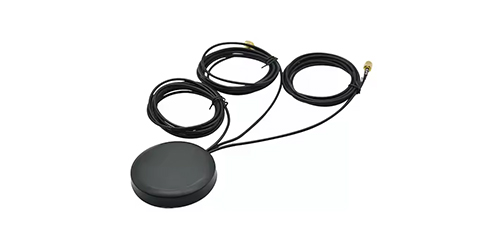
Most multi-function LTE WiFi GNSS antennas adopt a low-profile integrated shell design, equipped with independent SMA/RP-SMA connectors for each functional channel. The built-in high-isolation filter and low-noise amplifier (LNA) greatly improve signal reception sensitivity and anti-interference ability. It perfectly solves the problems of messy wiring, large installation space occupation, and mutual signal interference caused by the separate installation of traditional LTE, WiFi, and GNSS antennas, providing a miniaturized, high-stability, and low-cost connectivity solution for intelligent terminal equipment.
2. Core Technical Specifications of Multi-Function LTE WiFi GNSS Antenna
The excellent performance of the multi-function LTE WiFi GNSS antenna is based on standardized and optimized technical parameters. All parameters are designed to adapt to global commercial and industrial application scenarios, ensuring compatibility, stability, and durability. The core technical specifications are summarized as follows:
2.1 LTE Cellular Communication Parameters
The LTE antenna unit supports full global 4G LTE frequency bands, including 700MHz, 800MHz, 900MHz, 1800MHz, 2100MHz, 2300MHz, 2600MHz and other mainstream operator frequency bands, compatible with 2G, 3G, and 4G multi-network automatic switching. The antenna gain ranges from 3dBi to 5dBi, with omnidirectional signal coverage, no need for directional alignment, and a wide signal reception range. It adopts MIMO dual-channel design in mainstream models, which doubles the cellular data transmission rate and improves network stability and anti-fading ability. The standing wave ratio (VSWR) is less than 1.5, ensuring low signal loss and high-efficiency signal transmission.
2.2 WiFi Wireless Network Parameters
The WiFi antenna unit covers dual-band 2.4GHz–2.5GHz and 5.1GHz–5.8GHz, fully compatible with WiFi 4, WiFi 5, and WiFi 6 mainstream protocols. The 2.4GHz band provides long-distance coverage and strong wall-penetrating performance, suitable for long-range wireless signal transmission and wide-area device connection; the 5.8GHz band features low interference and high bandwidth, meeting high-speed data transmission, video streaming, and large-file transmission requirements. The WiFi antenna gain is 2dBi–4dBi, with omnidirectional coverage, stable signal output, and support for 2x2 MIMO technology, effectively improving wireless network throughput and connection stability.
2.3 GNSS Satellite Positioning Parameters
The GNSS antenna unit adopts high-precision active positioning design, supporting four major global satellite navigation systems: GPS (L1 band), GLONASS, Galileo, and Beidou B1 band. The working frequency is 1559MHz–1606MHz, with ultra-high signal reception sensitivity. The built-in low-noise amplifier reduces signal noise interference, enabling fast satellite search and fixed-point positioning even in complex environments such as urban buildings, suburban jungles, and cloudy weather. The positioning accuracy can reach meter-level or even sub-meter-level (depending on terminal matching), realizing real-time positioning, accurate timing, trajectory recording, and navigation correction functions.
2.4 General Structural and Environmental Parameters
In terms of structural design, the multi-function LTE WiFi GNSS antenna adopts a compact integrated radome, mostly using high-strength UV-stable ASA engineering plastic shell and aluminum alloy base, which is waterproof, dustproof, anti-aging, and anti-corrosive. The protection grade reaches IP67, adapting to outdoor rain, snow, wind, and sun exposure environments. The working temperature range is -40℃ to +85℃, meeting the extreme temperature operation requirements of industrial and vehicle equipment. It is equipped with high-flexibility shielded coaxial cables and standard SMA/RP-SMA connectors, which are plug-and-play, easy to install, and not easy to loose or damage. The overall volume is small and the weight is light, which does not occupy installation space and is suitable for various miniaturized intelligent terminals.
3. Unique Advantages of Multi-Function LTE WiFi GNSS Integrated Antenna
Compared with the traditional scheme of using three separate LTE, WiFi, and GNSS antennas, the integrated multi-function antenna has obvious comprehensive advantages in installation, performance, cost, and applicability, which is the key reason for its wide popularity in the global market.
3.1 Highly Integrated Design, Simplify Installation and Wiring
The traditional separate antenna solution requires reserved installation positions for three antennas, with complicated wiring, messy internal equipment lines, and high installation and maintenance costs. The multi-function LTE WiFi GNSS antenna integrates three functional modules into one shell, with only one fixed position needed and three independent shielded cables leading out respectively. It greatly simplifies the equipment assembly process, shortens the installation cycle, reduces manual wiring errors, and makes the internal structure of intelligent terminals more concise and standardized. For mass-produced industrial equipment and vehicle terminals, it can effectively improve production efficiency and reduce assembly failure rates.
3.2 Professional Isolation Technology, Effectively Avoid Signal Interference
Different frequency band signals of traditional adjacent antennas are prone to mutual interference, resulting in reduced cellular network speed, unstable WiFi connection, and delayed GNSS positioning. This integrated antenna adopts independent frequency band isolation design and built-in high-performance RF filters for each module, which completely isolates LTE, WiFi, and GNSS signal frequency bands. It eliminates crosstalk and interference between different signals, ensuring that each functional module works independently and stably. The low-noise amplification technology further optimizes signal quality, improving the stability and accuracy of communication and positioning.
3.3 Cost-Effective, Reduce Overall System Expenses
Purchasing three independent antennas requires higher procurement costs, while the integrated multi-function antenna realizes three functions in one device, significantly reducing material procurement costs. At the same time, the simplified installation process saves labor costs and time costs for equipment production and on-site construction. In addition, the unified structural design reduces the types of spare parts for enterprise after-sales maintenance, lowers maintenance and replacement costs, and brings higher cost performance for long-term project operation.
3.4 Strong Environmental Adaptability, Wide Application Range
With IP67 waterproof and dustproof grade, high and low temperature resistance, UV resistance, and anti-corrosion properties, the multi-function LTE WiFi GNSS antenna can operate stably in harsh environments such as outdoor open air, vehicle vibration, industrial workshops, and humid and cold areas. It is not affected by natural environments such as wind, rain, snow, and strong light, and has a long service life, which can meet the long-term uninterrupted operation requirements of industrial-grade and vehicle-grade equipment.
3.5 Global Full-Band Compatibility, No Regional Restrictions
The LTE full-band design covers all mainstream 4G frequency bands of global operators, supporting network access in Europe, America, Southeast Asia, Africa, and other regions. The dual-band WiFi is compatible with global wireless network standards, and the multi-system GNSS positioning supports global full-scene navigation and positioning. It has no regional use restrictions, perfectly adapting to the export and global layout needs of intelligent equipment manufacturers, and is an international universal antenna solution.

4. Main Application Scenarios of Multi-Function LTE WiFi GNSS Antenna
Relying on its integrated communication, networking, and positioning capabilities, as well as excellent environmental adaptability, the multi-function LTE WiFi GNSS antenna is widely used in commercial, industrial, vehicle, and smart city fields, covering almost all intelligent terminal equipment that needs simultaneous network access and positioning functions.
4.1 Vehicle Telematics and Fleet Management
Vehicle-mounted intelligent terminals are the largest application scenario of multi-function LTE WiFi GNSS antennas. In fleet management, logistics vehicles, engineering vehicles, taxis, and online car-hailing equipment, the antenna provides 4G LTE cellular network for real-time vehicle data upload and remote monitoring, dual-band WiFi for in-vehicle wireless networking and passenger device connection, and high-precision GNSS positioning for vehicle trajectory tracking, driving route navigation, and vehicle location monitoring. It helps enterprises realize intelligent fleet scheduling, driving behavior analysis, and vehicle safety management, greatly improving fleet operation efficiency and safety management level. In addition, it is also applicable to intelligent driving auxiliary equipment and vehicle-mounted monitoring terminals, providing stable data transmission and positioning support for vehicle intelligent systems.
4.2 Industrial IoT Gateways and Intelligent Monitoring Equipment
Industrial IoT gateways, outdoor monitoring cameras, environmental monitoring terminals, and power intelligent monitoring equipment need stable network transmission and equipment positioning functions. The multi-function LTE WiFi GNSS antenna enables industrial equipment to upload operating data, environmental monitoring data, and video monitoring data to the cloud platform through 4G cellular network. The WiFi function supports local wireless device networking and data transmission, and the GNSS positioning realizes accurate geographic location marking of equipment, facilitating remote management, equipment troubleshooting, and regional data statistics of industrial IoT platforms. Its industrial-grade high and low temperature resistance and anti-interference performance ensure long-term stable operation of equipment in complex industrial environments.
4.3 Smart City and Public Intelligent Equipment
In the construction of smart cities, intelligent street lamps, smart parking terminals, public monitoring equipment, and environmental sensing terminals all need integrated communication and positioning solutions. The multi-function LTE WiFi GNSS antenna provides wireless network access and accurate positioning for these public equipment, realizing real-time data transmission, remote equipment management, and regional intelligent scheduling. For example, intelligent street lamps can upload equipment status and environmental sensing data through LTE network, provide WiFi signal coverage for citizens, and realize accurate equipment positioning and maintenance through GNSS, improving the intelligent management level of urban public facilities.
4.4 Mobile Intelligent Terminals and Outdoor Portable Equipment
Outdoor portable monitoring devices, mobile detection terminals, field operation intelligent equipment, and emergency communication terminals have high requirements for miniaturization, portability, and multi-function integration. The compact multi-function LTE WiFi GNSS antenna saves equipment space, supports mobile network access, local WiFi networking, and real-time positioning, meeting the needs of field detection, emergency rescue, mobile monitoring, and other scenarios. It is not limited by fixed network wiring, and can work stably in outdoor unattended and mobile operation environments.
4.5 Shared Intelligent Equipment and Intelligent Hardware
Shared electric vehicles, shared charging piles, intelligent access control, and community intelligent monitoring equipment need real-time network communication and equipment positioning management. The integrated antenna provides stable 4G network data transmission for shared equipment, supports WiFi device pairing and debugging, and realizes accurate positioning of shared equipment, facilitating enterprise operation management, equipment fault monitoring, and regional resource scheduling, which is an essential core accessory for shared intelligent hardware.
5. How to Choose a High-Quality Multi-Function LTE WiFi GNSS Antenna?
With the increasing market demand, there are many types of integrated LTE WiFi GNSS antennas on the market, with uneven performance and quality. To help users and enterprise buyers select suitable high-quality products, we summarize the core selection criteria from the aspects of performance parameters, structural quality, and scene matching.
5.1 Check Core Frequency Band and Gain Parameters
First of all, it is necessary to confirm whether the antenna supports full-band LTE signals to adapt to the network frequency bands of the user's regional operators. For global export projects, full 4G frequency band coverage must be guaranteed. The WiFi dual-band 2.4G/5.8G must be complete and compatible with mainstream WiFi 5 and WiFi 6 protocols. The GNSS module needs to support multi-system positioning such as GPS and Beidou to ensure positioning accuracy and speed. In terms of gain, select 3dBi–5dBi LTE gain and 2dBi–4dBi WiFi gain according to the usage scenario, which can balance signal coverage and transmission stability.
5.2 Focus on Isolation and Anti-Interference Performance
Signal isolation is the core index of integrated antennas. High-quality multi-function antennas are equipped with independent filter modules for each frequency band, with high isolation between channels, which can effectively avoid signal crosstalk. It is necessary to select products with low VSWR (less than 1.5) and low noise coefficient to ensure low signal loss and strong anti-interference ability, avoiding network stuttering, disconnection, and positioning deviation caused by signal interference.
5.3 Verify Industrial-Grade Environmental Adaptability
For outdoor, vehicle, and industrial scenarios, the antenna must have IP67 waterproof and dustproof protection grade, UV resistance, anti-corrosion, and wide temperature adaptation performance. It is necessary to confirm that the product shell is made of high-quality engineering plastics and aluminum alloy base, with strong seismic and drop resistance, to ensure stable operation in harsh environments and extend the service life of the equipment.
5.4 Confirm Interface and Wiring Compatibility
Mainstream multi-function antennas adopt standard SMA/RP-SMA independent interfaces for three channels, with clear differentiation and strong compatibility. It is necessary to select the interface type matching the terminal equipment module to avoid installation mismatch. At the same time, check whether the cable has shielding layer protection, high flexibility, and tensile resistance, which is convenient for equipment wiring and long-term use.
5.5 Select Regular Manufacturers with Quality Assurance
High-quality integrated antennas need professional RF design and precision production processes. It is recommended to choose regular wireless communication equipment manufacturers, with complete product test reports, certification qualifications (CE, FCC, RoHS), and perfect after-sales service system, to avoid quality problems such as unstable signal and short service life of inferior products, and ensure the stability and reliability of project operation.
6. Market Development Trend of Multi-Function LTE WiFi GNSS Antenna
With the rapid development of global IoT, intelligent transportation, and smart city industries, the market demand for multi-function integrated antennas continues to grow, and the industry presents three major development trends. First, miniaturization and high integration. With the continuous miniaturization of intelligent terminal equipment, antennas are developing towards smaller size, lighter weight, and more integrated functions, and some products have begun to integrate 5G, WiFi 6E, and higher-precision GNSS dual-band positioning functions. Second, industrial-grade high performance. The market has higher and higher requirements for antenna anti-interference, environmental adaptability, and stability, and industrial-grade waterproof, high and low temperature resistance, and anti-vibration designs have become the standard configuration of high-end products. Third, intelligent and customized development. According to the differentiated needs of vehicle, industrial, and civil scenarios, manufacturers continue to launch customized antennas with different gain, cable length, and installation methods, and support MIMO multi-channel high-speed transmission to meet the high-bandwidth and high-stability communication needs of new intelligent equipment.
As a key connecting component of intelligent equipment network and positioning, the multi-function LTE WiFi GNSS antenna will maintain a sustained growth market demand in the next few years, and gradually replace traditional single-function antennas to become the mainstream configuration of new intelligent terminals.
7. Frequently Asked Questions (FAQ) About Multi-Function LTE WiFi GNSS Antenna
Q1: Can the multi-function antenna work normally while ensuring no signal interference?
Yes. High-quality multi-function LTE WiFi GNSS antennas adopt independent frequency band isolation structure and built-in professional filter modules for each functional channel. The LTE, WiFi, and GNSS signals work independently without mutual crosstalk and interference. The low-noise amplification technology further optimizes signal quality, ensuring stable communication network and accurate positioning effect.
Q2: What is the difference between integrated antenna and three separate antennas?
The integrated antenna integrates three functions in one, with simple installation, low cost, and no messy wiring, and solves the problem of mutual interference of separate antennas. The three separate antennas have high procurement and installation costs, complex wiring, and are prone to signal interference and space occupation. For most intelligent terminal scenarios, integrated antennas have obvious comprehensive advantages.
Q3: Is the antenna suitable for outdoor long-term use?
Absolutely. Regular industrial-grade multi-function antennas have IP67 waterproof and dustproof grade, UV-resistant and anti-corrosive shell, and wide temperature working range (-40℃ to +85℃). They can resist rain, snow, wind, sun exposure, and high and low temperature changes, and are suitable for long-term unattended outdoor operation.
Q4: Does the antenna support global network and positioning?
Yes. The full-band LTE design covers global 4G operator frequency bands, dual-band WiFi is compatible with global wireless standards, and the GNSS module supports four major global satellite navigation systems, realizing global unrestricted network access and high-precision positioning.
The multi-function LTE WiFi GNSS antenna is an efficient, economical, and high-stability integrated communication and positioning accessory, which perfectly integrates cellular network communication, wireless WiFi networking, and satellite navigation positioning functions. It solves many pain points of traditional single antenna solutions such as complicated installation, high cost, and easy signal interference. With its compact structure, excellent performance, strong environmental adaptability, and global universal compatibility, it is widely used in vehicle telematics, industrial IoT, smart cities, mobile intelligent terminals, and other fields.
With the continuous upgrading of global intelligent connectivity technology, the demand for integrated multi-function antennas in various industries will continue to expand. Choosing a high-quality multi-function LTE WiFi GNSS antenna can effectively improve the operating stability of intelligent terminal equipment, reduce project operation costs, and bring more reliable technical support for the intelligent upgrading of various industries. For enterprise purchasers, equipment developers, and engineering contractors, this all-in-one antenna solution is the best choice to realize efficient and stable connectivity of intelligent equipment.
Lucy Yang | lucy.y@toxutech.com
Dotty Zhao | sales04@toxutech.com
Global Business Director / Sales Team / Global Operations


 En
 Cn
 Korean
 Home >
