

-
Products -PCBA Manufacturing RF Connectors RF Cable Assemblys Embedded Antennas External Antennas GNSS Positioning Solutions
RF Connectors

RF Cable Assemblys
Embedded Antennas
External Antennas
GNSS Positioning Solutions







 Language


Language


Time:2026-10-17 Views:0
GNSS 4G combo antenna has become an indispensable core component for modern intelligent wireless devices, integrating high-precision GNSS satellite positioning and full-band 4G LTE cellular communication functions into a single compact unit. As the demand for IoT devices, intelligent vehicles, industrial terminals, and mobile monitoring equipment surges globally, traditional single-function antennas can no longer meet the dual requirements of real-time network transmission and accurate positioning. A professional GNSS 4G combo antenna solves the pain points of large installation space, high signal interference, and inconsistent performance matching caused by separate antennas, delivering stable, high-efficiency dual-service support for wireless communication and satellite positioning systems.
This comprehensive guide covers everything you need to know about GNSS 4G combo antennas, including core working principles, key technical features, industry-leading specifications, diverse application scenarios, selection criteria, installation tips, and common troubleshooting. Optimized for Google SEO, this article targets high-intent keywords such as GNSS 4G combo antenna, 4G LTE GNSS combination antenna, industrial GNSS 4G antenna, vehicle combo positioning antenna, and IoT dual-band communication antenna, providing valuable technical insights and purchasing guidance for global engineers, procurement specialists, and system integrators.
1. What Is a GNSS 4G Combo Antenna?
A GNSS 4G combo antenna is a multi-functional integrated wireless antenna that combines two independent radio frequency working systems: Global Navigation Satellite System (GNSS) positioning antenna and 4G LTE cellular communication antenna. Unlike dual-antenna separate solutions, this combo antenna integrates all antenna elements, signal amplification modules, filter circuits, and wiring structures into one unified housing, realizing synchronous reception and transmission of 4G network signals and GNSS satellite positioning signals without mutual interference.
The GNSS module of the antenna supports mainstream global satellite navigation systems, including GPS, BeiDou, GLONASS, and Galileo, covering the classic L1 frequency band (1565–1606 MHz) to achieve meter-level or even centimeter-level high-precision positioning. The 4G LTE module covers full global 4G frequency bands (700–960 MHz and 1710–2690 MHz), compatible with FDD-LTE and TDD-LTE networks of major global operators, ensuring stable 4G data transmission, voice communication, and network roaming capabilities.
Most high-performance GNSS 4G combo antennas adopt an active GNSS amplification design with a built-in low-noise amplifier (LNA). The LNA provides 18±3 dB high gain for GNSS signals, effectively compensating for signal attenuation caused by housing shielding, long-distance transmission, and complex environmental obstacles, greatly improving satellite signal reception sensitivity. Meanwhile, the 4G antenna part optimizes impedance matching and radiation efficiency, with a maximum radiation efficiency of up to 65.3%, ensuring strong anti-interference ability and stable signal output in complex industrial and mobile scenarios.
2. Core Working Principle of GNSS 4G Combo Antenna
The working mechanism of the GNSS 4G combo antenna is based on independent radio frequency signal processing and integrated structural isolation design, ensuring that 4G communication signals and GNSS positioning signals work simultaneously without crosstalk. Its internal working process is divided into two independent modules, with a high-isolation shielding structure to separate the two signal systems fundamentally.
2.1 GNSS Positioning Signal Working Principle
The GNSS antenna unit is responsible for receiving weak satellite navigation signals from space. After capturing GPS, BeiDou, GLONASS, or Galileo satellite signals in the L1 frequency band, the built-in high-sensitivity LNA amplifies the extremely low-power satellite signals while filtering out high-frequency noise and clutter interference in the environment. The processed clean positioning signals are transmitted to the terminal’s positioning module through low-loss coaxial cables. The terminal calculates accurate longitude, latitude, altitude, and speed data through satellite signal parsing and algorithm operation, realizing real-time positioning, navigation, and trajectory recording functions.
Thanks to the active amplification design, the GNSS unit can still capture stable satellite signals in shielded environments such as vehicle interiors, industrial equipment cabinets, and urban dense buildings, solving the problem of positioning failure or drift caused by weak satellite signals in passive antennas.
2.2 4G LTE Communication Signal Working Principle
The 4G antenna unit supports full-band transceiving of 4G cellular network signals. It covers low-frequency and high-frequency bands required by global 4G networks, adapting to different operator frequency specifications in Europe, America, Asia, and other regions. The antenna realizes omnidirectional signal radiation and reception through optimized oscillator design, efficiently receiving base station downlink signals and uploading terminal data signals. Its excellent impedance matching design reduces signal reflection and loss, ensuring low latency and high stability of 4G data transmission, which is suitable for real-time data upload, remote monitoring, and wireless networking scenarios.
2.3 Anti-Interference Isolation Technology
The biggest technical difficulty of combo antennas is mutual interference between different frequency band signals. Professional GNSS 4G combo antennas adopt physical isolation and radio frequency filtering dual protection technology. The internal metal shielding layer completely isolates the GNSS and 4G antenna oscillators, and the built-in band-pass filters strictly filter out out-of-band interference signals. This ensures that the high-power 4G communication signals will not suppress the weak GNSS satellite signals, achieving high isolation of dual-band signals and stable synchronous operation.
3. Key Features & Technical Advantages of GNSS 4G Combo Antenna
Compared with traditional separate GNSS antenna + 4G antenna solutions, the integrated GNSS 4G combo antenna has obvious advantages in structural design, performance stability, installation cost, and environmental adaptability, becoming the preferred antenna solution for new-generation intelligent wireless terminals.
3.1 Integrated Compact Structure, Saving Installation Space
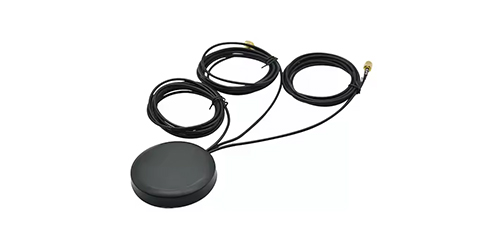
The GNSS 4G combo antenna integrates two independent antenna systems into a single miniaturized housing. The mainstream puck-type antenna size is only Φ81.4 × 16.5 mm, and the flexible FPC type is more lightweight and thin. It completely avoids the bulky layout of two separate antennas, greatly saving the internal installation space of vehicles, industrial control equipment, and IoT terminals. For compact intelligent hardware devices with strict space limitations, the integrated combo design is the only efficient solution that balances performance and volume.
3.2 High Signal Stability & Anti-Interference Ability
Equipped with a high-performance GNSS LNA module and 4G high-efficiency radiation oscillator, the antenna delivers excellent signal performance. The GNSS gain reaches 18±3 dB, with ultra-high satellite signal reception sensitivity, supporting fast satellite positioning and fixed-point locking. The 4G antenna has a radiation efficiency of up to 65.3%, with strong signal penetration and coverage capability. Meanwhile, the professional isolation design ensures zero crosstalk between dual bands, avoiding positioning drift, network disconnection, and signal fluctuation problems often occurring in mismatched separate antenna systems.
3.3 Global Full-Band Compatibility
The 4G part supports full global LTE frequency bands (700MHz–2690MHz), compatible with all FDD/TDD 4G networks worldwide, realizing global network roaming without regional restrictions. The GNSS part supports multi-system satellite positioning, including GPS L1, BeiDou B1, GLONASS L1, and Galileo E1, adapting to positioning requirements of different countries and regions. Whether used in North America, Europe, Southeast Asia, or Oceania, the antenna can maintain stable dual-service operation, greatly reducing the compatibility cost of equipment global deployment.
3.4 Durable Industrial-Grade Environmental Adaptability
Most commercial and industrial-grade GNSS 4G combo antennas adopt IP67 waterproof and dustproof grade design, which can effectively resist rainwater erosion, dust accumulation, and sand intrusion. The housing is made of high-strength ABS and waterproof rubber materials, with excellent UV resistance, high and low temperature resistance, adapting to harsh working environments of -40℃ to +85℃. It complies with RoHS and REACH environmental protection standards, meeting the certification requirements of global industrial and automotive electronic products.
3.5 Simple Installation & Low Maintenance Cost
The antenna supports multiple installation methods, including strong magnetic adsorption, 3M adhesive pasting, and screw fixing. The bottom magnetic base can be firmly fixed on metal surfaces such as vehicle roofs and industrial equipment shells without drilling damage. It is equipped with standard FAKRA connectors and 2.5m RG174 low-loss cables, which are easy to plug and play, avoiding complex wiring operations of dual antennas. The integrated structure reduces the number of accessories and failure points, greatly lowering later maintenance and replacement costs.

4. Standard Technical Specifications of GNSS 4G Combo Antenna
High-quality GNSS 4G combo antennas have unified industry-standard parameters in terms of frequency band, gain, impedance, and environmental indicators. The following are mainstream industrial-grade product specifications, which are the core reference basis for equipment selection and system design:
4G LTE Frequency Band: 700–960 MHz (low band), 1710–2690 MHz (high band), full-band coverage of global FDD/TDD-LTE
GNSS Frequency Band: 1565–1606 MHz (L1 band), compatible with GPS, BeiDou, GLONASS, Galileo multi-system positioning
GNSS Gain: 18±3 dB (active amplification), ultra-high sensitivity signal reception
4G Radiation Efficiency: Up to 65.3%, stable signal transceiving efficiency
Characteristic Impedance: 50Ω (standard RF impedance), perfect matching with mainstream terminal modules
VSWR: ≤1.5 (low standing wave ratio, low signal loss)
Working Temperature: -40℃ ~ +85℃, storage temperature: -50℃ ~ +90℃
Protection Grade: IP67 waterproof, dustproof, and weatherproof
Certification Standards: RoHS, REACH, CE industrial certification compliant
Installation Method: Magnetic base + 3M double-sided adhesive dual installation
Connector Type: FAKRA/SMA optional, RG174 low-loss cable (2.5m customizable)
5. Main Application Scenarios of GNSS 4G Combo Antenna
With the dual advantages of positioning and communication integration, GNSS 4G combo antennas are widely used in vehicle networking, industrial IoT, intelligent monitoring, mobile terminals, and smart city fields, becoming the core supporting component of various intelligent wireless systems.
5.1 Vehicle Telematics & Fleet Management
Vehicle-mounted GNSS 4G combo antenna is one of the most mature application scenarios. It is used for vehicle GPS/BeiDou positioning, real-time 4G network data transmission, vehicle trajectory monitoring, remote fault diagnosis, and fleet management systems. Installed on the vehicle roof or inside the front windshield, the antenna can resist complex vehicle vibration and outdoor weather changes, ensuring real-time and accurate vehicle positioning data and stable transmission of driving data. It is widely equipped in logistics vehicles, official vehicles, new energy vehicles, and shared travel vehicles, helping enterprises realize intelligent fleet scheduling and vehicle safety supervision.
5.2 Industrial IoT Intelligent Terminals
In industrial IoT scenarios such as smart water conservancy, smart electric power, environmental monitoring, and intelligent equipment monitoring, a large number of wireless terminals need to realize fixed-point positioning and real-time data upload. The GNSS 4G combo antenna provides stable positioning and network communication functions for industrial collectors, wireless transmission modules, and edge computing terminals. It adapts to outdoor unattended working environments, supports long-term stable operation of equipment, and realizes remote real-time monitoring and data analysis of industrial equipment.
5.3 Mobile Monitoring & Portable Intelligent Devices
Portable law enforcement recorders, mobile monitoring terminals, outdoor surveying and mapping equipment, and emergency communication devices all require miniaturized dual-function antenna solutions. The lightweight and compact GNSS 4G combo antenna perfectly meets the portable design requirements of such equipment. It can realize real-time positioning of equipment operation tracks and 4G wireless transmission of monitoring data, supporting mobile law enforcement, field surveying and mapping, and emergency rescue work.
5.4 Smart City & Intelligent Transportation
In smart street lamps, intelligent traffic monitoring piles, shared bicycles, and intelligent parking systems, GNSS 4G combo antennas provide accurate positioning and network communication support. For shared mobility equipment, the antenna realizes real-time vehicle positioning and remote management; for traffic monitoring equipment, it supports accurate equipment location calibration and real-time upload of traffic data, helping build intelligent and digital urban transportation systems.
5.5 Unmanned Equipment & Intelligent Robots
Outdoor unmanned inspection robots, agricultural unmanned vehicles, and low-speed unmanned mobile equipment rely on GNSS positioning for autonomous navigation and 4G networks for remote data transmission and command reception. The high-stability GNSS 4G combo antenna ensures centimeter-level positioning accuracy and low-latency network transmission, providing reliable wireless signal support for the autonomous operation and remote control of unmanned equipment.
6. How to Choose a High-Quality GNSS 4G Combo Antenna? (Professional Selection Guide)
There are many types of GNSS 4G combo antennas on the market with uneven performance. To avoid problems such as poor signal stability, positioning failure, and short service life in actual use, you need to select products scientifically according to application scenarios and technical requirements. The following are core selection criteria for reference:
6.1 Confirm Frequency Band & Compatibility
First, confirm whether the 4G frequency band of the antenna matches the local operator network. For global equipment deployment, it is necessary to select full-band 4G antennas covering 700–2690 MHz to ensure network compatibility in different regions. For the GNSS part, prioritize multi-system compatible models supporting GPS/BeiDou/GLONASS/Galileo to improve positioning coverage and accuracy.
6.2 Focus on GNSS Amplification Performance
The GNSS signal is weak and extremely susceptible to interference. It is mandatory to select active GNSS combo antennas with built-in LNA (gain 15–20 dB). Passive GNSS antennas are only suitable for open and barrier-free environments and are prone to positioning drift in complex scenarios such as vehicles and indoors. Industrial-grade 18dB high-gain models are the best choice for most commercial and industrial scenarios.
6.3 Check Environmental Protection & Protection Grade
For outdoor and vehicle-mounted scenarios, the antenna must reach IP67 waterproof and dustproof grade to adapt to rain, snow, high temperature, and low temperature environments. At the same time, confirm that the product complies with RoHS and REACH environmental protection certifications to meet the export and industrial delivery standards of European and American markets.
6.4 Match Installation Method & Interface Type
Select the installation method according to the equipment installation environment: magnetic adsorption + adhesive dual installation is suitable for vehicle and mobile equipment; fixed screw installation is suitable for fixed industrial terminals. The interface is mainly FAKRA and SMA. FAKRA is mostly used for vehicle-mounted terminals, and SMA is suitable for industrial modules. Ensure the interface matches the terminal module to avoid adaptation problems.
6.5 Prioritize High-Isolation Anti-Interference Design
High-isolation structural design is the key to ensure simultaneous stable operation of 4G and GNSS signals. Low-quality combo antennas often have insufficient isolation, resulting in 4G signal interference with GNSS positioning, leading to slow satellite locking and large positioning errors. It is necessary to select products with professional internal shielding and filtering structures.
7. Standard Installation & Use Precautions
Correct installation and use methods can maximize the performance of the GNSS 4G combo antenna and extend its service life. The following standardized operation specifications are summarized for engineering installation and daily use:
Installation Position: Install the antenna in an open and barrier-free position as much as possible, avoid metal shielding coverage, and keep away from high-power electrical equipment to reduce signal interference. Vehicle-mounted antennas are recommended to be installed on the roof or front windshield outer side.
Cable Layout: Avoid excessive bending and extrusion of RG174 cables to prevent internal wire breakage and signal attenuation. The cable length can be customized according to equipment layout, and ultra-long extension is not recommended to avoid signal loss.
Interface Connection: Ensure the connector is tightly plugged and fixed to avoid poor contact caused by looseness, which leads to signal fluctuation. Do not plug and unplug the interface frequently to prevent pin damage.
Environmental Protection: Avoid long-term exposure to strong corrosive environments. Regularly clean the antenna surface dust and stains to prevent shell aging and signal radiation attenuation.
Power Supply Specification: For active GNSS antennas, ensure the terminal provides stable power supply voltage to avoid insufficient LNA power supply leading to reduced gain and poor positioning effect.
8. Common Problems & Troubleshooting Solutions
In the actual application process, users may encounter problems such as slow GNSS positioning, unstable 4G network, and signal discontinuity. The following are common faults and targeted solutions to quickly solve on-site use problems:
8.1 Slow GNSS Satellite Locking & Positioning Drift
Causes: The installation position is shielded by metal or buildings; the LNA power supply is abnormal; surrounding electromagnetic interference is serious; the antenna gain is insufficient. Solutions: Adjust the antenna to an open position, remove metal shielding; check the terminal power supply voltage to ensure normal operation of the amplifier; stay away from high-power electrical equipment; replace 18dB high-gain active GNSS combo antenna.
8.2 Unstable 4G Network & Frequent Disconnection
Causes: The local 4G base station signal is weak; the antenna frequency band does not match the operator network; the cable is damaged or the interface is loose. Solutions: Confirm the local mainstream 4G frequency band and replace the matching full-band antenna; check the cable integrity and interface firmness; adjust the antenna position to improve signal reception quality.
8.3 Dual-Band Signal Mutual Interference
Causes: The antenna internal isolation design is defective; the impedance matching is poor. Solutions: Replace high-quality high-isolation GNSS 4G combo antenna; detect terminal module impedance matching to ensure 50Ω standard matching.
8.4 Antenna Water Ingress & Aging Failure
Causes: Low protection grade; long-term exposure to wind and rain without protection. Solutions: Select IP67 industrial-grade waterproof antenna; regularly check the shell sealing performance, replace aging antennas in time.
9. Market Development Trend of GNSS 4G Combo Antenna
With the rapid development of global IoT, vehicle networking, and smart city industries, the market demand for GNSS 4G combo antennas continues to grow, and the industry presents three major development trends: miniaturization integration, high precision and low power consumption, and multi-function expansion.
First, miniaturization and lightweight design have become the mainstream. With the continuous miniaturization of intelligent terminal equipment, combo antennas are developing towards smaller size, thinner thickness, and flexible FPC design, adapting to the compact layout of portable devices and miniature IoT terminals. Second, high-precision positioning is iteratively upgraded. With the popularization of high-precision navigation and intelligent driving, antennas are gradually upgraded from meter-level positioning to centimeter-level RTK high-precision positioning, improving positioning accuracy and stability. Third, multi-band integration is continuously expanded. On the basis of GNSS + 4G, new products are gradually integrating 5G, WiFi, and Bluetooth functions, forming multi-in-one composite antennas to meet the multi-functional wireless communication needs of intelligent equipment.
In addition, industrial-grade high-temperature resistance, anti-vibration, and ultra-low power consumption antennas have become the mainstream demand in the industrial and vehicle markets. Products with IP68 higher protection grade, wider temperature adaptation range, and lower power consumption will occupy more market shares in the future.
TheGNSS 4G combo antenna is a high-efficiency and cost-effective integrated wireless solution that perfectly combines high-precision GNSS satellite positioning and full-band 4G LTE communication functions. Compared with traditional separate antenna schemes, it has outstanding advantages in space saving, signal stability, anti-interference performance, installation convenience, and comprehensive cost control. It is widely used in vehicle networking, industrial IoT, intelligent monitoring, unmanned equipment, and smart city scenarios, and is an essential core component of modern intelligent wireless terminal equipment.
When selecting and using GNSS 4G combo antennas, users need to comprehensively consider frequency band compatibility, gain performance, protection grade, and installation adaptability according to actual application scenarios, and choose industrial-grade high-isolation active combo antennas to ensure long-term stable operation of positioning and communication systems. With the continuous upgrading of IoT and intelligent connection technology, GNSS 4G combo antennas will continue to iterate in performance and function, providing more reliable wireless signal support for global intelligent equipment networking and high-precision positioning services.
Lucy Yang | lucy.y@toxutech.com
Dotty Zhao | sales04@toxutech.com
Global Business Director / Sales Team / Global Operations


 En
 Cn
 Korean
 Home >
