

-
Products -PCBA Manufacturing RF Connectors RF Cable Assemblys Embedded Antennas External Antennas GNSS Positioning Solutions
RF Connectors

RF Cable Assemblys
Embedded Antennas
External Antennas
GNSS Positioning Solutions







 Language


Language


Time:2026-10-17 Views:0
1. Introduction: Why Fleet Tracking GNSS 4G Antennas Are Indispensable for Modern Fleet Management
In the fast-evolving landscape of commercial fleet management, real-time vehicle tracking, precise location monitoring, and uninterrupted data transmission have become non-negotiable requirements for logistics companies, delivery businesses, construction fleets, and public transportation operators. At the core of every high-performance fleet tracking system lies a critical yet often overlooked component: the fleet tracking GNSS 4G antenna. Unlike standard consumer-grade antennas, professional GNSS 4G combo antennas are purpose-built to deliver dual functionality—accurate global navigation satellite system positioning and stable 4G LTE cellular data connectivity—for commercial vehicle telematics devices.
Fleet managers rely on tracking systems to monitor vehicle routes, optimize fuel consumption, ensure driver safety, prevent asset theft, and streamline dispatch operations. However, poor antenna performance is the leading cause of common fleet tracking issues, including delayed location updates, inaccurate GPS coordinates, offline tracker status, and lost telematics data. These technical glitches lead to operational inefficiencies, increased fuel costs, missed delivery deadlines, and compromised fleet security.
A dedicated fleet tracking GNSS 4G antenna solves these pain points by enhancing satellite signal reception and strengthening 4G cellular network connectivity across diverse operating environments. Whether fleets operate in dense urban skyscraper corridors, remote rural highways, mountainous terrains, or underground parking lots, a high-quality combo antenna maintains consistent positioning and data transmission. This comprehensive guide explores everything you need to know about GNSS 4G antennas for fleet tracking, including core working principles, key features, types, selection criteria, installation best practices, and industry applications, helping you upgrade your fleet telematics system for maximum reliability in 2026 and beyond.
2. What Is a Fleet Tracking GNSS 4G Combo Antenna?
A fleet tracking GNSS 4G combo antenna is a dual-band integrated wireless antenna designed exclusively for vehicle telematics and fleet tracking devices. It combines two independent antenna modules in a single compact housing: a GNSS antenna for satellite positioning and a 4G LTE antenna for cellular data communication. This all-in-one design eliminates the need for separate GPS/GNSS and 4G antennas, simplifying vehicle installation, reducing wiring clutter, and lowering overall equipment costs for fleet operators.
2.1 Core Functional Modules
GNSS Antenna Module: The GNSS component supports multi-system satellite reception, including GPS (USA), GLONASS (Russia), Galileo (Europe), BeiDou (China), QZSS (Japan), and NavIC (India). It operates primarily on the L1 frequency band (1575.42 MHz) and features a built-in low-noise amplifier (LNA) to boost weak satellite signals. Active GNSS antennas, the standard for fleet tracking, filter out signal interference and improve positioning accuracy, even in signal-obstructed environments such as under vehicle dashboards or inside metal cargo containers.
4G LTE Antenna Module: The 4G antenna covers full global LTE frequency bands (700MHz–2700MHz), supporting all major 4G network operators worldwide. It delivers omnidirectional signal reception and transmission, ensuring stable uplink and downlink data communication for real-time tracking data upload, remote device debugging, and cloud platform synchronization. Some high-end models support 4G MIMO technology to enhance network stability and anti-interference capability for high-data-volume fleet telematics transmission.
2.2 Key Differences From Ordinary Consumer Antennas
Most generic GPS or 4G antennas are designed for smartphones, tablets, or small consumer devices, with low gain, poor weather resistance, and weak anti-interference performance. In contrast, fleet-grade GNSS 4G antennas are engineered for 24/7 continuous operation in harsh commercial vehicle environments. They feature industrial-grade waterproofing, dustproofing, vibration resistance, and temperature resistance, making them durable enough to withstand extreme weather, long-distance driving vibrations, and complex electromagnetic interference from vehicle engines and electrical systems.
3. How GNSS 4G Antennas Power Fleet Tracking Systems: Working Principle
To understand the value of a high-performance fleet tracking GNSS 4G antenna, it is essential to break down how it interacts with fleet trackers and cloud management platforms to realize full-cycle vehicle monitoring. The entire working process is divided into three core stages: satellite positioning, cellular data transmission, and cloud data synchronization.
3.1 GNSS Satellite Signal Reception and Positioning Calculation
The GNSS antenna continuously captures high-precision satellite signals from multiple global navigation systems. The built-in LNA amplifies weak satellite signals and filters out electromagnetic noise generated by vehicle engines, car batteries, and nearby electronic devices. The amplified and purified signals are transmitted to the fleet tracker’s positioning chip, which calculates the vehicle’s real-time longitude, latitude, speed, altitude, and heading direction. Multi-system satellite support ensures that the tracker can lock onto 8–12 satellites at any time, achieving meter-level or even sub-meter-level positioning accuracy, far superior to single-GPS antenna solutions.
3.2 4G LTE Network Data Transmission
After collecting precise positioning data, vehicle status information (including engine status, fuel level, driving speed, and brake records), and driver behavior data, the fleet tracker relies on the 4G antenna to transmit these data packets to the cloud fleet management platform via 4G LTE cellular networks. The high-gain 4G antenna ensures stable signal connection even in low-network-coverage areas such as remote mountain roads, suburban industrial zones, and coastal highways. It avoids common issues like data packet loss, delayed updates, and tracker offline faults that plague low-quality antennas.
3.3 Real-Time Cloud Synchronization and Remote Monitoring
Once the cloud platform receives the data, fleet managers can view real-time vehicle locations, historical driving routes, and operational data on computers or mobile apps. The uninterrupted signal output of the GNSS 4G antenna ensures 24/7 real-time synchronization, enabling instant alerts for abnormal conditions such as speeding, illegal parking, route deviation, and vehicle vibration. This closed-loop working system is the foundation of intelligent fleet management, and the antenna’s performance directly determines the accuracy and timeliness of the entire tracking system.
4. Key Features of High-Performance Fleet Tracking GNSS 4G Antennas
Not all GNSS 4G combo antennas are suitable for commercial fleet tracking. Professional fleet-grade antennas must integrate industrial-grade performance features to adapt to long-term, high-intensity vehicle operation. Below are the core features that define a reliable fleet tracking GNSS 4G antenna, which are also the key selection indicators for fleet managers:
4.1 Dual-Band High Gain Design
Fleet-specific GNSS 4G antennas adopt high-gain antenna design: the GNSS gain reaches 28dB, and the 4G LTE gain ranges from 2dBi to 5dBi. High-gain signal reception significantly improves signal sensitivity, allowing the antenna to capture weak satellite and cellular signals in complex sheltered environments. Compared with low-gain ordinary antennas, it reduces positioning failure rates by over 90% and cuts data transmission delay by more than 80%, ensuring stable tracking in urban canyon areas surrounded by high-rise buildings and tunnel sections.
4.2 Industrial-Grade Environmental Adaptability
Commercial vehicles operate in diverse and harsh environments, so fleet tracking antennas must have excellent environmental resistance. Premium models feature IP67/IP68 waterproof and dustproof ratings, fully resisting rain, snow, fog, dust, and sand erosion. They support a wide working temperature range of -40℃ to +85℃, normal operation in extreme cold northern winters and high-temperature summer road conditions. In addition, professional antennas pass strict vibration and shock resistance tests, adapting to long-term bumpy driving of trucks, vans, and engineering vehicles without signal interruption or structural damage.
4.3 Strong Anti-Interference Capability
Vehicle interiors are filled with complex electromagnetic interference from engines, on-board computers, radios, and charging equipment. High-quality GNSS 4G antennas are equipped with professional shielding layers and frequency filtering circuits, which effectively isolate electromagnetic interference and avoid signal drift, positioning deviation, and network disconnection. The independent dual-module design of GNSS and 4G also eliminates mutual signal interference between positioning and communication modules, ensuring simultaneous stable operation of positioning and data transmission functions.
4.4 Flexible Installation and Universal Compatibility
Most fleet tracking GNSS 4G antennas adopt compact miniaturized design with two mainstream installation methods: magnetic suction mounting and screw fixed mounting. The strong magnetic base can be firmly adsorbed on the metal roof of vehicles, easy to install and disassemble without damaging the vehicle body. The screw mounting method is suitable for fixed installation on vehicle shells or equipment shells, more stable for long-term use. In terms of compatibility, the antenna is equipped with universal SMA/TS9 connectors, compatible with all mainstream fleet trackers, telematics terminals, and IoT vehicle devices on the market, including Quectel, Teltonika, and Sinotrack equipment.
4.5 Low Power Consumption and Long Service Life
Fleet tracking devices need 24/7 standby operation, so low power consumption is a key advantage of professional antennas. The optimized circuit design reduces idle power consumption, avoiding excessive vehicle battery loss. Meanwhile, industrial-grade materials and precision manufacturing ensure a service life of more than 5 years, far exceeding consumer-grade antennas, reducing frequent replacement costs and maintenance workload for fleet enterprises.
5. Common Types of Fleet Tracking GNSS 4G Antennas
According to installation mode, structural design, and functional configuration, fleet tracking GNSS 4G antennas are mainly divided into three categories, each suitable for different fleet vehicle types and usage scenarios. Fleet managers can select targeted antenna products according to their actual operational needs:
5.1 Magnetic Mount GNSS 4G Combo Antenna
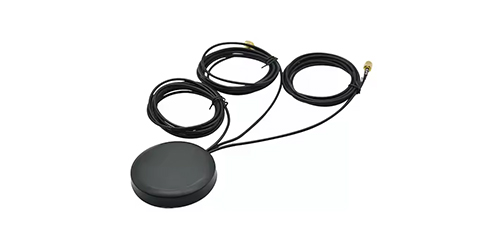
Magnetic mount antennas are the most widely used type in fleet management. Equipped with a high-strength neodymium iron boron magnetic base, they can be quickly adsorbed on the metal surface of vehicle roofs, with no drilling or wiring damage to the vehicle. This type of antenna features omnidirectional signal reception, no directional limitation, and is suitable for light-duty fleets such as delivery vans, logistics trucks, taxis, and online car-hailing vehicles. It is easy to install and replace, making it ideal for temporary tracking and flexible fleet management scenarios. Most magnetic mount antennas are equipped with 3m–5m extended cables, facilitating flexible wiring and hiding inside vehicle bodies to ensure aesthetic and safe installation.
5.2 Screw-Mount Waterproof GNSS 4G Antenna
Screw-fixed antennas are designed for heavy-duty commercial vehicles and engineering fleets, including heavy trucks, cement mixers, excavators, and sanitation vehicles. Adopting a fully enclosed waterproof shell and screw fixing structure, they have stronger stability and anti-vibration performance than magnetic antennas, not easy to fall off during long-term bumpy driving. With IP68 highest waterproof and dustproof rating, they can adapt to harsh working environments such as construction sites, mines, and muddy roads. This type of antenna is more durable and suitable for fixed long-term tracking of heavy fleets with high operational intensity.
5.3 Built-In Mini GNSS 4G Antenna
Built-in mini combo antennas are ultra-compact in size, designed for embedded installation inside fleet tracking terminals and on-board telematics equipment. They are suitable for small passenger car fleets, official vehicle fleets, and hidden anti-theft tracking scenarios. Although small in size, industrial-grade built-in antennas still maintain high-gain signal performance and anti-interference capability. They perfectly solve the problem of exposed external antennas being easily damaged or artificially shielded, realizing hidden and safe vehicle tracking. However, due to internal installation, their signal penetration is slightly weaker than external antennas, so they are more suitable for urban road operation scenarios with good network and satellite signal coverage.
6. Why Upgrade to Professional GNSS 4G Antennas for Fleet Management?
Many small and medium-sized fleet enterprises ignore antenna configuration and use cheap generic antennas or even built-in low-performance antennas of trackers, resulting in low overall efficiency of the tracking system. Upgrading to dedicated fleet tracking GNSS 4G antennas can bring significant operational and economic benefits to fleet businesses, solving multiple industry pain points:
6.1 Eliminate Tracker Offline and Signal Delay Issues
The most common problem of low-quality antennas is frequent tracker offline and delayed location updates, which makes fleet managers unable to grasp real-time vehicle dynamics. Professional GNSS 4G antennas strengthen signal reception in weak coverage areas, ensuring 99.9% online rate of fleet tracking devices. Real-time data synchronization ensures that vehicle position, speed, and status information are updated every second, completely solving the problem of "vehicle running but system no data".
6.2 Improve Positioning Accuracy to Optimize Route Management
Ordinary antennas are prone to positioning drift, with error up to tens of meters or even hundreds of meters, leading to inaccurate route monitoring and invalid mileage statistics. High-performance GNSS 4G antennas support multi-satellite fusion positioning, achieving meter-level high-precision positioning. Fleet managers can accurately monitor vehicle driving routes, avoid driver detours and private driving, optimize delivery routes, and effectively reduce fleet fuel consumption and time costs. Data shows that fleets using high-precision antenna tracking systems can save 10%–15% of annual fuel costs.
6.3 Enhance Fleet Safety and Anti-Theft Capabilities
For logistics fleets carrying high-value goods and long-distance transport fleets, vehicle and cargo safety is the top priority. Stable antenna operation ensures that the tracking system can trigger real-time alarms for abnormal vehicle status such as illegal parking, overspeed, and vibration. In case of vehicle theft or cargo loss, the high-precision positioning data provided by the GNSS antenna can quickly locate the vehicle position, improving the success rate of asset recovery. At the same time, stable 4G signal ensures remote locking and fault diagnosis of vehicles, further improving fleet safety management level.
6.4 Reduce Fleet Operation and Maintenance Costs
Low-cost inferior antennas have short service life and are prone to failure, requiring frequent replacement and maintenance, increasing enterprise operating costs. Industrial-grade fleet tracking GNSS 4G antennas have stable performance and long service life, almost no daily maintenance required. Meanwhile, accurate tracking data reduces vehicle idle time, detour driving, and abnormal fuel consumption, greatly reducing fleet operational losses. In the long run, antenna upgrading is a low-investment, high-return fleet optimization measure.
7. How to Choose the Best Fleet Tracking GNSS 4G Antenna (2026 Buying Guide)
To help fleet managers select the most suitable GNSS 4G antenna for their business scenarios, we summarize authoritative selection criteria based on fleet telematics industry standards and practical application experience:
7.1 Confirm Frequency Band Compatibility
First, confirm that the antenna’s 4G frequency band covers the local mainstream operator networks to ensure normal data transmission. Global universal 4G antennas covering 700MHz–2700MHz full bands are recommended, which are compatible with all LTE networks worldwide and suitable for cross-regional and international fleet transportation. For GNSS bands, prioritize multi-system full-band antennas supporting GPS/GLONASS/Galileo/BeiDou to ensure positioning stability in different regions.
7.2 Focus on Gain and Sensitivity Parameters
Antenna gain directly determines signal reception capability. For fleet tracking scenarios, the GNSS antenna gain should not be lower than 25dB, and the 4G antenna gain should be above 2dBi. High-gain and high-sensitivity antennas can adapt to complex signal environments, which is the core parameter to avoid tracking failures. Avoid low-gain low-priced antennas with incomplete parameter calibration.
7.3 Check Environmental Protection Grade and Durability
Prioritize antennas with IP67/IP68 waterproof and dustproof ratings, which can adapt to all weather conditions. For heavy-duty fleets and construction vehicle fleets, it is necessary to verify the antenna’s vibration resistance and wide temperature resistance performance to ensure stable operation in harsh environments. High-quality antennas adopt UV-resistant shell materials, which will not age or fade after long-term outdoor exposure, maintaining stable performance for years.
7.4 Select Appropriate Installation Method
Light-duty logistics fleets, delivery vehicles, and passenger car fleets are suitable for magnetic mount antennas, which are easy to install and flexible to adjust. Heavy trucks, engineering vehicles, and long-distance transport fleets should choose screw-fixed waterproof antennas with higher stability. Hidden tracking scenarios can choose embedded mini antennas to avoid artificial damage and signal shielding.
7.5 Verify Connector and Device Compatibility
Ensure the antenna connector matches the fleet tracker and telematics terminal interface. Common mainstream connectors include SMA male/female and TS9 interfaces, which are compatible with 99% of fleet tracking equipment on the market. It is recommended to choose antennas with thickened copper core cables and anti-oxidation connectors to avoid poor contact caused by long-term use and frequent vehicle vibration.
8. Professional Installation and Maintenance Tips for Fleet Tracking GNSS 4G Antennas
Even high-performance GNSS 4G antennas cannot exert optimal effects without standardized installation and daily maintenance. Correct installation methods can maximize antenna signal performance, while scientific maintenance can extend service life and reduce failure rates:
8.1 Standard Installation Guidelines
First, select a suitable installation position: the external antenna should be installed on the top of the vehicle with open vision, avoiding shielding by metal structures, luggage racks, and car roofs. Metal shielding will seriously weaken GNSS satellite signals and 4G cellular signals, leading to reduced positioning accuracy and network instability. Second, arrange the antenna cable neatly, avoid excessive bending and twisting, prevent cable core damage and signal attenuation, and fix the cable with cable ties to avoid friction and damage during vehicle driving. Finally, complete interface docking firmly, ensure no loose connection, and wrap the interface with waterproof tape for outdoor installation to prevent water ingress and oxidation.
8.2 Daily Maintenance and Fault Troubleshooting
Regularly clean the antenna surface dust, sediment, and oil stains to avoid signal shielding caused by dirt accumulation. Check the antenna base firmness regularly, especially for magnetic mount antennas, to prevent falling off during high-speed driving or bumpy roads. Inspect the cable appearance for wear, cracking, and aging, and replace damaged cables in time. For common faults such as positioning deviation and offline tracker, first check whether the antenna is shielded, loose, or damaged, and eliminate antenna failures first, which can solve more than 80% of tracking system faults.
9. Industry Applications of GNSS 4G Antennas in Fleet Tracking
Professional fleet tracking GNSS 4G antennas are widely used in various commercial fleet scenarios, becoming the core infrastructure of intelligent fleet management in multiple industries:
9.1 Logistics and Delivery Fleets
Express delivery, freight logistics, and cold chain transport fleets rely on GNSS 4G antennas to realize real-time vehicle tracking, route optimization, and cargo status monitoring. Stable signal transmission ensures that logistics companies and customers can query transportation progress in real time, improve delivery efficiency, and reduce cargo loss rates.
9.2 Engineering and Construction Fleets
Construction machinery such as excavators, loaders, and cement mixers operate in complex construction site environments with severe signal interference and harsh weather. Industrial-grade waterproof and anti-interference GNSS 4G antennas ensure continuous tracking of engineering vehicles, realizing equipment scheduling optimization, working hour statistics, and anti-theft management.
9.3 Public Transportation and Taxi Fleets
Buses, taxis, and online car-hailing fleets need high-precision real-time positioning to support passenger query, dispatching scheduling, and safety supervision. High-performance GNSS 4G antennas eliminate urban signal blind spots, ensuring stable tracking of public transport vehicles in urban complex environments and improving public travel service quality.
9.4 Special Vehicle Fleets
Official vehicles, police cars, ambulance, and sanitation vehicle fleets have high requirements for tracking stability and accuracy. Dedicated GNSS 4G antennas support 24/7 uninterrupted tracking, realizing standardized supervision of special vehicles, improving operational efficiency, and ensuring public service safety.
10. Frequently Asked Questions (FAQ) About Fleet Tracking GNSS 4G Antennas
Q1: What is the difference between a single 4G antenna and a GNSS 4G combo antenna for fleet tracking?
A single 4G antenna only supports cellular data transmission and cannot provide positioning signal reception, requiring an additional independent GNSS antenna, which increases installation complexity and cost. The integrated GNSS 4G combo antenna realizes dual functions of positioning and communication in one device, with simpler installation, lower mutual interference, and higher cost performance, which is the optimal choice for fleet tracking systems.
Q2: Can GNSS 4G antennas work in tunnel and underground parking lot scenarios?
Yes. High-gain industrial GNSS 4G antennas have strong signal penetration and weak signal reception capability. Although satellite signals are blocked in tunnels and underground parking lots, the 4G antenna can maintain network connection, and the tracker will cache positioning data automatically. Once the vehicle exits the blind area, the antenna will quickly relock satellite signals and synchronize all cached data to the cloud platform without data loss.
Q3: How long is the service life of a fleet tracking GNSS 4G antenna?
Industrial-grade fleet-specific GNSS 4G antennas have a service life of 5–8 years under normal use and maintenance conditions, far longer than consumer-grade antennas (1–2 years). Strict industrial production standards and high-quality materials ensure long-term stable operation in harsh vehicle environments without frequent failure.
Q4: Does antenna cable length affect signal performance?
Yes. Excessively long cables will cause signal attenuation. It is recommended to select standard 3m–5m cables matching vehicle size. Professional antennas use low-loss coaxial cables, which minimize signal attenuation within the effective length range and ensure stable signal transmission.
In the era of intelligent fleet management, the fleet tracking GNSS 4G antenna is no longer a trivial accessory but a core component that determines the overall performance of the vehicle telematics system. A high-quality dual-band combo antenna can completely solve common fleet tracking problems such as inaccurate positioning, delayed data transmission, and frequent offline faults, helping fleet enterprises realize refined management, cost reduction and efficiency improvement, and safety risk control.
When upgrading or configuring fleet tracking systems, fleet managers should abandon low-cost inferior antennas and choose industrial-grade, high-gain, waterproof and anti-interference GNSS 4G combo antennas suitable for commercial vehicle scenarios. Standardized installation and daily maintenance can further maximize antenna performance, provide stable and reliable technical support for long-term fleet operation, and help enterprises gain competitive advantages in the increasingly standardized and intelligent fleet management industry.
Lucy Yang | lucy.y@toxutech.com
Dotty Zhao | sales04@toxutech.com
Global Business Director / Sales Team / Global Operations


 En
 Cn
 Korean
 Home >
