

-
Products -PCBA Manufacturing RF Connectors RF Cable Assemblys Embedded Antennas External Antennas GNSS Positioning Solutions
RF Connectors

RF Cable Assemblys
Embedded Antennas
External Antennas
GNSS Positioning Solutions





 Language


Language


Time:2026-10-17 Views:0
In the fast-evolving landscape of wireless communication technology, the demand for space-saving, high-efficiency, and multi-functional antenna solutions has skyrocketed across commercial, industrial, automotive, and IoT sectors. A compact 3-in-1 combo antenna stands out as a game-changing innovation that integrates three independent high-performance antenna systems into a single ultra-slim, rugged housing. This all-in-one wireless antenna consolidates 5G/4G LTE cellular, dual-band WiFi, and GNSS/GPS positioning functionalities, eliminating the need for three separate standalone antennas in wireless device installations.
As global IoT deployment, smart vehicle transformation, and industrial wireless digitization accelerate, traditional single-function antennas can no longer meet the integrated communication and positioning demands of modern devices. Discrete antenna setups suffer from excessive installation space occupation, complex wiring, high signal interference risks, and increased deployment costs. The compact 3-in-1 combo antenna perfectly solves these industry pain points, becoming the preferred wireless accessory for smart terminals, vehicle telematics, industrial gateways, remote monitoring equipment, and portable communication devices. This comprehensive guide will delve into the working principles, core features, technical advantages, application scenarios, installation tips, and selection criteria of compact 3-in-1 combo antennas, helping businesses and engineers fully understand and leverage this advanced wireless solution.
What Is a Compact 3-in-1 Combo Antenna? Core Definition & Working Principle
A compact 3-in-1 combo antenna is a specialized multi-band integrated antenna that encapsulates three mutually independent, non-interfering antenna modules within a single miniaturized enclosure. Unlike ordinary single-frequency antennas or simple dual-combo antennas, this three-in-one design independently supports cellular network communication, wireless local area network transmission, and global satellite positioning, achieving three core wireless functions in one compact unit.
The three built-in antenna modules cover mainstream wireless frequency bands required for modern intelligent devices: the cellular antenna supports full-band 4G LTE and low/mid/high-band 5G NR networks, the WiFi antenna covers 2.4GHz and 5.8GHz dual-band WiFi 6/WiFi 6E signals, and the GNSS antenna is compatible with GPS, GLONASS, Galileo, and BeiDou global satellite navigation systems. Each antenna module adopts an optimized electromagnetic isolation design, with professional shielding and frequency division filtering technology built into the internal structure. This design completely avoids signal crosstalk and frequency interference between different modules, ensuring that each wireless function operates with independent, stable, and high-gain performance.
The "compact" feature is the core competitive advantage of this product. Through advanced miniaturization circuit design, high-density component integration, and streamlined radome structure optimization, the 3-in-1 combo antenna achieves an ultra-low-profile, ultra-small size while retaining full-performance multi-band coverage. Compared with traditional three separate antennas, it reduces installation space by more than 70%, simplifies wiring layout, and greatly improves the integration and aesthetics of wireless equipment. Whether for built-in device integration or external fixed installation, its compact form factor brings unparalleled flexibility for product design and engineering deployment.

Core Functional Configurations of Compact 3-in-1 Combo Antennas
Standard high-quality compact 3-in-1 combo antennas uniformly integrate three core functional modules, each with industry-leading parameter configurations to adapt to complex wireless application environments. The detailed functional breakdown is as follows:
1. 5G/4G LTE Full-Band Cellular Antenna Module
The cellular communication module is the core data transmission unit of the 3-in-1 combo antenna, supporting global mainstream 4G LTE and 5G NR frequency bands, including 700MHz, 800MHz, 900MHz, 1800MHz, 2100MHz, 2600MHz, and 5G sub-6GHz frequency bands. With a high gain of 3-5dBi, this module effectively enhances cellular signal reception and transmission capabilities, solves the problems of weak signals and unstable network connection in complex scenarios such as indoor shielding, urban high-rise occlusion, and remote suburban areas.
Adopting omnidirectional radiation design, the cellular antenna realizes 360° no-dead-angle signal coverage, ensuring stable uplink and downlink data transmission regardless of the installation orientation. It supports 2x2 MIMO dual-channel transmission technology, doubling wireless data throughput and improving network anti-interference and stability, which is crucial for high-speed IoT data transmission, real-time video monitoring, and vehicle network communication.
2. Dual-Band WiFi 6/6E Antenna Module
The built-in WiFi antenna covers 2.4GHz and 5.8GHz dual frequency bands, fully compatible with WiFi 4, WiFi 5, and the latest WiFi 6/6E wireless protocols. The 2.4GHz band provides ultra-wide coverage and strong wall-penetrating performance, suitable for long-distance and barrier-rich wireless transmission; the 5.8GHz band features high bandwidth, low latency, and anti-interference, meeting the high-speed data transmission demands of HD video streaming, large file transmission, and real-time device linkage.
Optimized impedance matching and radiation structure design enable the WiFi module to maintain high-efficiency signal conversion rate in a compact size, effectively reducing signal attenuation and transmission delay. It supports multi-device concurrent access, ensuring stable wireless connection for industrial gateways, smart devices, and terminal equipment in high-density networking scenarios.
3. High-Precision GNSS/GPS Positioning Antenna Module
The GNSS positioning module is an active high-gain antenna compatible with four major global satellite navigation systems: GPS (USA), GLONASS (Russia), Galileo (EU), and BeiDou (China). It covers the full L1 frequency band (1565MHz-1606MHz), with ultra-high positioning sensitivity and fast satellite capture capability. In open outdoor environments, it can complete satellite positioning within 10 seconds, with positioning accuracy up to meter level, supporting high-precision positioning and navigation demands of vehicles, drones, and mobile monitoring equipment.
The internal low-noise amplifier (LNA) effectively filters environmental noise signals, improves satellite signal reception sensitivity, and maintains stable positioning performance in weak signal environments such as urban valleys, under viaducts, and dense buildings. It supports real-time positioning, trajectory recording, and location tracking, providing accurate location data support for intelligent monitoring and mobile device management.
Key Advantages of Compact 3-in-1 Combo Antennas Over Traditional Antennas
In modern wireless system design and engineering deployment, compact 3-in-1 combo antennas have completely replaced traditional single-function discrete antenna solutions by virtue of multiple dimensional advantages in space, cost, performance, and installation. The core advantages are summarized as follows:
1. Ultra-Compact Size, Save Valuable Installation Space
Traditional wireless devices that need to support cellular, WiFi, and positioning functions must be equipped with three independent antennas, which occupy a large amount of internal or external installation space and restrict the miniaturization and lightweight design of equipment. The compact 3-in-1 combo antenna integrates three antennas into one ultra-slim housing, with a volume only one-third of the traditional three-antenna combination. The low-profile design (as low as 14mm in height) is suitable for narrow installation spaces such as device shells, vehicle roof edges, and industrial cabinet interiors, perfectly adapting to the miniaturization development trend of modern intelligent equipment.
2. Integrated Design, Simplify Installation & Wiring
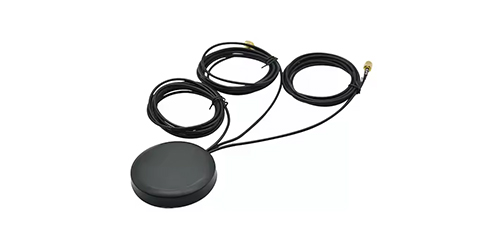
The three-in-one integrated structure greatly simplifies the on-site installation process. Traditional solutions require three independent drilling positions, three sets of fixing accessories, and three wiring harnesses, resulting in complicated construction, long cycle, and high error rate. The compact combo antenna only needs a single installation hole or a single magnetic adsorption fixing position, with three independent low-loss coaxial lines and standard SMA/RP-SMA connectors. The wiring is neat and standardized, which not only shortens the installation time by more than 60% but also reduces the failure rate caused by messy wiring and wrong connections.
3. Professional Isolation Design, Zero Signal Interference
Different wireless frequency bands are prone to mutual crosstalk, which leads to signal attenuation, network instability, and positioning deviation. High-quality compact 3-in-1 combo antennas adopt internal electromagnetic shielding isolation technology and frequency division filtering design. Independent cavity structures are set for cellular, WiFi, and GNSS modules to isolate signal interference between different frequency bands. After professional debugging and testing, the isolation degree between each module is far higher than the industry standard, ensuring that each wireless function maintains independent and stable performance without mutual influence.
4. Cost-Effective, Reduce Comprehensive Deployment Costs
From the perspective of comprehensive cost, the 3-in-1 integrated antenna has obvious cost advantages. Purchasing three independent single-function antennas requires higher component costs, while the integrated combo antenna reduces material costs through centralized production and integrated molding. At the same time, it saves installation labor costs, wiring accessory costs, and later maintenance costs. The unified integrated structure also reduces equipment failure points, lowering the after-sales maintenance rate and long-term operation costs for enterprises.
5. Rugged Industrial-Grade Durability & Environmental Adaptability
Most compact 3-in-1 combo antennas on the market adopt high-strength ABS or PC engineering plastic radomes, with IP65/IP67/IP68 industrial-grade waterproof, dustproof, and weatherproof ratings. They can work stably in extreme environments such as high temperature, low temperature, rain, snow, dust, and strong wind, adapting to outdoor open-air deployment, vehicle mobile operation, and industrial harsh working conditions. The built-in anti-aging and anti-oxidation structure ensures long-term stable service life, avoiding frequent replacement caused by environmental erosion.
Main Installation Types of Compact 3-in-1 Combo Antennas
To adapt to different application scenarios and equipment installation requirements, compact 3-in-1 combo antennas are mainly divided into three mainstream installation types, covering fixed installation, mobile adsorption, and built-in integration scenarios:
1. Magnetic Mount 3-in-1 Combo Antenna
The magnetic mount type is the most popular portable installation solution, equipped with a high-strength neodymium iron boron strong magnetic base. It can be firmly adsorbed on all metal surfaces such as vehicle roofs, iron cabinets, and industrial equipment shells without drilling or punching, realizing tool-free quick installation and disassembly. It is suitable for temporary deployment, vehicle mobile equipment, and frequently moved wireless terminals. The ultra-strong magnetic suction ensures that the antenna will not fall off during vehicle driving or equipment vibration, with high safety and stability.
2. Screw/Stud Mount 3-in-1 Combo Antenna
The screw stud mount type adopts through-hole fixed installation, with a standard thread fixing structure, which is suitable for permanent fixed deployment of equipment shells, cabinet tops, and metal panels. After drilling a single small hole, the antenna can be firmly fixed with nuts, with strong stability, good shock resistance, and tight waterproof performance at the installation interface. It is widely used in industrial gateways, fixed monitoring equipment, and outdoor communication base station terminals that require long-term fixed operation.
3. Adhesive Mount & Built-In Compact Antenna
The ultra-thin adhesive mount and built-in integrated antenna are designed for miniaturized portable devices. With an ultra-flat and ultra-compact body, it can be pasted inside the device shell through high-viscosity adhesive tape, completely hidden inside the equipment, without occupying external space and improving equipment integrity and aesthetics. It is mainly used for smart handheld devices, portable IoT terminals, and miniaturized wireless communication modules.
Wide Application Scenarios of Compact 3-in-1 Combo Antennas
Benefiting from its multi-functional integration, compact size, and strong environmental adaptability, the 3-in-1 combo antenna has penetrated almost all fields involving wireless communication and positioning, becoming a core supporting component of modern intelligent wireless systems. The main application scenarios are as follows:
1. Vehicle Telematics & Smart Transportation
Smart vehicles, logistics trucks, buses, new energy vehicles, and engineering vehicles all need integrated communication and positioning systems. The compact 3-in-1 combo antenna provides 5G/4G vehicle network data transmission, in-vehicle WiFi wireless coverage, and real-time GNSS navigation and positioning functions for vehicles. Its low-profile design does not affect the vehicle's appearance and wind resistance, and the shockproof and waterproof structure adapts to complex road conditions and outdoor driving environments. It is widely used in vehicle GPS trackers, car networking terminals, fleet management equipment, and in-vehicle intelligent monitoring systems.
2. Industrial IoT & Smart Industrial Equipment
Industrial gateways, IoT acquisition terminals, remote monitoring equipment, and intelligent sensing devices need stable multi-band wireless transmission and positioning functions. The industrial-grade compact 3-in-1 combo antenna adapts to high-temperature, dusty, and vibrating industrial environments, realizing remote data transmission, equipment networking, and position monitoring of industrial equipment. It helps enterprises realize industrial digitization, remote equipment operation and maintenance, and intelligent production management, improving industrial production efficiency and management level.
3. Smart City & Outdoor Monitoring Systems
Smart street lamps, outdoor monitoring cameras, environmental monitoring terminals, and smart community equipment are important components of smart city construction. These devices need cellular network upload data, WiFi local networking, and positioning calibration functions. The compact integrated antenna saves the installation space of outdoor equipment, simplifies on-site construction, and adapts to long-term outdoor wind and rain erosion. It provides stable wireless communication and positioning support for urban intelligent monitoring, environmental data collection, and public facility management.
4. Portable Communication & Mobile Intelligent Terminals
Portable IoT terminals, handheld communication devices, mobile monitoring instruments, and drone ground control equipment have strict requirements on equipment volume and weight. The miniaturized 3-in-1 combo antenna perfectly meets the lightweight and integrated design needs of portable devices, realizing multi-functional wireless support without increasing equipment volume. It is widely used in field detection equipment, mobile communication terminals, and portable intelligent monitoring devices.
5. Smart Home & Commercial Wireless Equipment
Smart home gateways, commercial wireless routers, intelligent display terminals, and office wireless equipment also adopt compact 3-in-1 combo antennas to integrate network transmission and positioning functions. The integrated design optimizes equipment appearance, reduces internal space occupation, and improves the stability of home and commercial wireless networks, bringing smooth wireless experience for users.
How to Choose a High-Quality Compact 3-in-1 Combo Antenna? Professional Selection Guide
With the increasing market demand, various types of 3-in-1 combo antennas have emerged on the market, with uneven quality and performance. To help users select cost-effective and suitable products, we summarize the core selection criteria from the perspective of actual engineering application:
1. Confirm Frequency Band Compatibility
First, confirm whether the antenna frequency band matches the local operator network and equipment functional requirements. For cellular networks, select full-band 4G LTE and sub-6GHz 5G compatible models to ensure global universal compatibility; for WiFi functions, prioritize dual-band 2.4G/5.8G WiFi 6 compatible products to adapt to the latest wireless protocols; for positioning functions, choose multi-system compatible GNSS antennas to ensure positioning accuracy and stability in different regions.
2. Check Gain & Signal Stability Parameters
Signal gain directly determines the antenna's signal reception and transmission capability. It is recommended to select a cellular gain of 3-5dBi, WiFi gain of 2-4dBi, and GNSS high-sensitivity active gain antenna. Avoid low-gain inferior products, which are prone to weak signals, network disconnection, and inaccurate positioning in complex environments. At the same time, check the antenna isolation parameter to ensure no interference between internal modules.
3. Match Installation Type & Size Specifications
Select the appropriate installation method according to the equipment installation environment: magnetic mount for mobile and temporary use, screw mount for permanent fixed deployment, and adhesive built-in type for miniaturized equipment. Meanwhile, confirm the antenna size, cable length, and connector type (SMA/RP-SMA) to match the equipment interface and installation space, avoiding installation mismatch problems.
4. Focus on Industrial-Grade Protection Performance
For outdoor and industrial scenarios, prioritize products with IP67 or above waterproof and dustproof ratings, with anti-aging, anti-corrosion, and anti-vibration capabilities. High-quality protective performance ensures long-term stable operation of the antenna in harsh environments and reduces later maintenance and replacement costs.
5. Verify Product Quality & Certification
Formal high-quality compact 3-in-1 combo antennas need to pass CE, FCC, RoHS and other international certifications, with standardized production processes and strict quality testing. Certified products have stable performance, compliant radiation parameters, and higher safety, which can meet commercial and industrial application standards.
Common FAQs About Compact 3-in-1 Combo Antennas
Q1: Will the three built-in antennas interfere with each other?
High-quality formal compact 3-in-1 combo antennas adopt independent cavity shielding and professional frequency division isolation design. After strict factory testing, the signal interference between cellular, WiFi, and GNSS modules is almost zero, and each function can operate independently and stably. Inferior products without professional isolation design may have signal crosstalk, so it is necessary to select regular certified products.
Q2: Is the compact integrated antenna performance worse than three separate antennas?
No. The latest miniaturization antenna technology realizes high-density integration without sacrificing performance. Through optimized circuit design and electromagnetic debugging, the signal gain, coverage, and stability of the integrated 3-in-1 antenna are completely comparable to or even better than ordinary single-function antennas. It avoids performance attenuation caused by messy wiring and unreasonable installation of discrete antennas.
Q3: What scenarios are not suitable for compact 3-in-1 combo antennas?
This antenna is suitable for most civil, commercial, and industrial conventional wireless scenarios. For ultra-long-distance high-power base station communication, professional high-precision surveying and positioning, and extreme high-frequency wireless transmission scenarios, professional high-power single-function antennas are still required. For conventional IoT, vehicle, monitoring, and smart device scenarios, 3-in-1 combo antennas are the best choice.
Q4: How to maintain the compact 3-in-1 combo antenna to extend its service life?
Daily maintenance is extremely simple. Regularly clean the dust and dirt on the antenna surface to avoid covering the radome and affecting signal transmission; check whether the cable interface is loose or aging to ensure stable connection; avoid strong extrusion and impact on the antenna body. Industrial-grade waterproof and dustproof products basically realize maintenance-free long-term operation.
With the continuous integration of 5G, IoT, artificial intelligence, and intelligent transportation technologies, wireless equipment is developing towards miniaturization, integration, and high efficiency. The compact 3-in-1 combo antenna, as an innovative integrated wireless solution, perfectly conforms to the industry development trend. It solves multiple industry pain points such as large space occupation, complicated installation, high interference risk, and high comprehensive cost of traditional discrete antenna solutions.
From vehicle telematics and industrial IoT to smart city monitoring and portable intelligent terminals, compact 3-in-1 combo antennas provide stable, efficient, and cost-effective multi-functional wireless support for various scenarios. Its ultra-compact size, integrated high performance, diverse installation methods, and industrial-grade durability make it the mainstream choice for modern wireless equipment antenna configuration. For enterprises and engineers pursuing efficient deployment, stable performance, and cost control, selecting a high-quality compact 3-in-1 combo antenna is the key to optimizing wireless system design and improving product competitiveness.
Lucy Yang | lucy.y@toxutech.com
Dotty Zhao | sales04@toxutech.com
Global Business Director / Sales Team / Global Operations


 En
 Cn
 Korean
 Home >
