

-
Products -PCBA Manufacturing RF Connectors RF Cable Assemblys Embedded Antennas External Antennas GNSS Positioning Solutions
RF Connectors

RF Cable Assemblys
Embedded Antennas
External Antennas
GNSS Positioning Solutions








 Language


Language


Time:2026-10-17 Views:0
In the era of smart vehicles, connected cars, and intelligent transportation systems, reliable wireless connectivity has evolved from a luxury feature to a fundamental necessity for modern automobiles. The automotive 3-in-1 combo antenna has emerged as a game-changing component that streamlines vehicle wireless communication systems by integrating three core signal reception and transmission functions into a single compact unit. Unlike traditional single-function car antennas that require separate installation, messy wiring, and excessive vehicle modification, the 3-in-1 automotive combo antenna consolidates GPS/GLONASS positioning, 4G LTE/5G cellular networking, and dual-band WiFi/Bluetooth connectivity to deliver stable, high-performance wireless signals for all vehicle smart systems.
As automotive technology advances rapidly, vehicles now rely heavily on real-time navigation, in-car entertainment, remote telematics, fleet monitoring, and intelligent driving assistance. Each of these functions demands consistent and high-quality wireless signal support. Traditional discrete antenna setups often suffer from signal interference, installation complexity, high maintenance costs, and unsightly exterior modifications. The innovative 3-in-1 vehicle combo antenna perfectly solves these pain points, becoming the mainstream antenna solution for new energy vehicles, commercial fleets, intelligent connected cars, and modified automotive systems in 2026. This comprehensive guide will cover everything you need to know about automotive 3-in-1 combo antennas, including core functions, technical advantages, key specifications, installation methods, application scenarios, buying tips, and frequently asked questions, helping you fully understand and select the best multi-functional antenna for your vehicle.
1. What Is an Automotive 3-in-1 Combo Antenna?
An automotive 3-in-1 combo antenna is a multi-band, multi-functional integrated antenna designed exclusively for vehicle-mounted wireless communication systems. It integrates three independent antenna modules inside one waterproof, shockproof, and weather-resistant housing, enabling simultaneous reception and transmission of three types of wireless signals without mutual interference. The most common and industry-standard configuration of a modern 3-in-1 car combo antenna is GPS/GLONASS positioning + 4G LTE/5G cellular network + 2.4G/5.8G dual-band WiFi/Bluetooth, which covers all mainstream wireless communication needs for current smart vehicles.
Different from traditional car radio antennas that only support FM/AM signal reception, the 3-in-1 automotive combo antenna focuses on intelligent vehicle connectivity services. Each built-in antenna module operates independently with dedicated frequency bands, signal amplifiers, and shielding structures, ensuring zero crosstalk between different signals. Most high-quality 3-in-1 combo antennas adopt an active amplification design with built-in low-noise amplifiers (LNA), which effectively improves signal sensitivity, enhances penetration, and reduces signal loss during transmission.
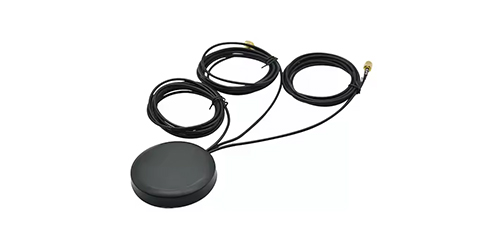
In terms of appearance and installation, mainstream automotive 3-in-1 combo antennas are divided into two classic designs: shark fin style and puck flat mount style. The shark fin antenna is installed on the vehicle roof with a streamlined and aerodynamic shape, which is not only beautiful and consistent with the original car design but also reduces wind resistance and avoids wind noise during high-speed driving. The flat puck antenna supports adhesive mounting and through-hole stud mounting, suitable for hidden installation inside the car roof, trunk, or dashboard, with strong concealment and wide adaptability. Both designs feature an all-in-one integrated structure, eliminating the need for multiple drilling and wiring operations required by traditional single antennas.
2. Core Functions of Automotive 3-in-1 Combo Antenna
The three integrated functional modules of the automotive 3-in-1 combo antenna correspond to the core wireless communication requirements of smart vehicles, covering positioning, cellular networking, and short-range wireless connection. Each module has independent technical parameters and application values, working together to build a full-coverage vehicle wireless communication system.
2.1 GPS/GLONASS Positioning Module (High-Precision Navigation)
The built-in GPS/GLONASS antenna module is the core guarantee for vehicle high-precision positioning and navigation. It supports global satellite signal reception, compatible with GPS, GLONASS, Galileo, and Beidou multi-satellite systems, achieving all-weather, full-region positioning coverage. Equipped with a high-sensitivity ceramic antenna chip and a 29dB high-gain low-noise amplifier, this module can effectively capture weak satellite signals even in complex environments such as urban high-rise shelters, tunnel entrances, and dense forests.
Compared with ordinary single GPS car antennas, the GPS module of the 3-in-1 combo antenna has stronger anti-interference performance. The independent shielding layer isolates the interference of cellular and WiFi signals, ensuring stable positioning accuracy within meters, and supports high-precision positioning requirements for intelligent driving, fleet tracking, and vehicle trajectory recording. It is widely used in vehicle navigation systems, driving recorders, fleet management terminals, and intelligent vehicle monitoring equipment.
2.2 4G LTE/5G Cellular Network Module (High-Speed Vehicle Networking)
The 4G LTE/5G multi-band cellular antenna module is responsible for vehicle long-distance data transmission and network access, supporting full-band coverage of mainstream global cellular frequency bands, including 700MHz, 800MHz, 900MHz, 1800MHz, 2100MHz, 2600MHz and other 4G LTE bands, as well as mainstream 5G sub-G frequency bands. With a 3dB high-gain design, it enhances cellular signal reception sensitivity, effectively solving the problems of weak vehicle network signals, slow network speed, and easy disconnection in suburban areas, remote roads, and underground parking lots.
This module supports 2×2 MIMO dual-channel transmission technology, realizing dual-link redundant backup and high-speed data throughput. It can stably support vehicle remote OTA upgrades, real-time vehicle condition data upload, remote vehicle control, in-car 4G/5G hotspot sharing, and fleet real-time positioning data transmission. For commercial vehicles, logistics fleets, and online car-hailing vehicles, the high-stability cellular network module ensures uninterrupted online operation of vehicle intelligent terminals and improves the efficiency of remote management and monitoring.
2.3 Dual-Band WiFi + Bluetooth Module (Short-Range Wireless Connection)
The integrated 2.4GHz + 5.8GHz dual-band WiFi and Bluetooth antenna module meets the short-range wireless interaction needs of vehicles. The 2.4GHz band features strong penetration and wide coverage, suitable for daily Bluetooth device connection, mobile phone vehicle connection, and low-speed data transmission; the 5.8GHz high-frequency band has fast transmission speed, low delay, and strong anti-interference ability, which can meet the high-bandwidth requirements of in-car high-definition video playback, large-file transmission, and real-time screen projection.
This module supports Bluetooth 5.0 and above protocols, realizing stable connection of vehicle Bluetooth hands-free calls, Bluetooth audio playback, and mobile phone device pairing. At the same time, it can build an in-car WiFi hotspot network, allowing multiple in-vehicle devices such as mobile phones, tablets, and car machines to access the network simultaneously. It perfectly matches the functional requirements of modern vehicle intelligent entertainment systems and mobile interconnection systems.
3. Key Advantages of Automotive 3-in-1 Combo Antenna
Compared with the traditional scheme of installing three separate GPS, cellular, and WiFi antennas, the integrated automotive 3-in-1 combo antenna has obvious comprehensive advantages in installation, performance, cost, appearance, and durability, which is why it has become the mainstream choice for modern smart vehicle wireless systems.
3.1 Simplified Installation and Reduced Vehicle Modification
The most prominent advantage of the 3-in-1 vehicle combo antenna is integrated installation. Traditional solutions require independent drilling, fixing, and wiring for GPS, 4G/5G, and WiFi antennas respectively, which is not only time-consuming and labor-intensive but also easy to damage vehicle roof waterproof layers and interior wiring harnesses, leading to hidden dangers of vehicle water leakage and circuit failure. The 3-in-1 combo antenna only needs one-time drilling or adhesive fixing, with three independent extension cables corresponding to different signal interfaces, which greatly simplifies the installation process, shortens the construction cycle, and avoids excessive vehicle modification.
Most products are equipped with 3-5 meters of high-quality extension cables and standard SMA/FAKRA connectors, which are compatible with most vehicle intelligent terminals, navigation hosts, and vehicle networking equipment on the market. The plug-and-play design reduces the technical threshold of installation and is suitable for professional modification factories and personal DIY installation.
3.2 Strong Anti-Interference and Stable Signal Performance
Signal interference is a common problem of vehicle multi-antenna systems. Discrete antennas are close to each other, and different frequency band signals are prone to crosstalk, resulting in reduced positioning accuracy, unstable network speed, and discontinuous Bluetooth connection. The automotive 3-in-1 combo antenna adopts an internal independent shielding structure, and each functional module is isolated by electromagnetic shielding materials, which completely eliminates mutual interference between GPS, cellular, and WiFi signals.
Equipped with professional low-noise amplifiers and impedance matching circuits, the antenna effectively reduces signal loss in the transmission process, improves signal gain and reception sensitivity, and maintains stable signal output in complex driving environments such as high-speed driving, urban signal shielding areas, and mountainous road sections. The overall signal stability is far better than that of discrete single antennas.
3.3 Beautiful Appearance and Aerodynamic Optimization
The mainstream shark fin 3-in-1 combo antenna adopts a streamlined aerodynamic design, which is highly integrated with the vehicle roof appearance, abandoning the messy and bulky layout of multiple traditional antennas. It not only improves the overall aesthetics of the vehicle but also effectively reduces wind resistance and wind noise during high-speed driving, which will not affect the vehicle's aerodynamic performance and fuel economy. The flat puck antenna realizes hidden installation, does not occupy the vehicle's exterior space, and is suitable for vehicle models with high appearance requirements and special installation environments.
3.4 Excellent Durability and All-Weather Adaptability
Vehicle antennas need to adapt to harsh outdoor working environments, including high temperature, low temperature, rain, snow, fog, dust, and strong vibration. The automotive 3-in-1 combo antenna uses high-strength ABS and waterproof silicone shell materials, with IP67-level waterproof and dustproof performance, which can effectively resist rainwater erosion, dust accumulation, and ultraviolet aging. It can work stably in the temperature range of -40℃ to +85℃, adapting to extreme weather conditions in different regions.
The internal circuit board adopts high-temperature resistant and vibration-resistant design, which can cope with the long-term vibration of vehicle driving and avoid virtual connection and damage of internal components. The high-quality wiring harness has anti-aging and anti-interference shielding layers, ensuring long-term stable service life and reducing later maintenance and replacement costs.
3.5 Cost-Effective and Space-Saving
Purchasing three independent GPS, 4G/5G, and WiFi antennas requires higher comprehensive procurement costs, while the integrated 3-in-1 combo antenna can realize three functions at one purchase, significantly reducing material costs. At the same time, the integrated structure saves vehicle interior and roof space, avoids the crowded layout of multiple antennas and wiring harnesses, optimizes the vehicle's internal circuit layout, and improves the safety and tidiness of vehicle electrical systems. For fleet enterprises and automobile manufacturers, batch application of 3-in-1 combo antennas can greatly reduce production and after-sales maintenance costs and improve product competitiveness.

4. Core Technical Specifications of Premium Automotive 3-in-1 Combo Antenna
To help users accurately screen high-quality products, we sort out the standard technical parameters of mainstream high-performance automotive 3-in-1 combo antennas in 2026. Professional parameter configuration is the core guarantee of antenna performance, and users must focus on these indicators when purchasing:
4.1 GPS/GLONASS Module Parameters
Working Frequency: 1575.42MHz (GPS L1) + 1602MHz (GLONASS), compatible with Beidou/Galileo
Signal Gain: ≥29dB high gain, built-in low-noise amplifier (LNA)
VSWR: ≤1.5, low standing wave ratio, low signal loss
Positioning Accuracy: Meter-level stable positioning, fast satellite search speed
Impedance: 50Ω professional wireless matching impedance
4.2 4G LTE/5G Cellular Module Parameters
Working Frequency Band: Full-band 4G LTE (700-2700MHz) + mainstream 5G sub-G bands
Signal Gain: 3dB omnidirectional high gain, enhanced signal penetration
Transmission Mode: Support 2×2 MIMO dual-channel high-speed transmission
VSWR: ≤2.0, stable signal transmission
Compatibility: Compatible with global mainstream operator network frequency bands
4.3 WiFi + Bluetooth Module Parameters
Working Frequency: 2.4GHz (2400-2483MHz) + 5.8GHz (5725-5850MHz) dual-band
Signal Gain: 3dBi high gain, wide coverage
Protocol Support: WiFi 802.11 b/g/n/ac, Bluetooth 5.0/5.2
Anti-Interference: Independent frequency band isolation, no crosstalk with other signals
4.4 Overall Product Parameters
Housing Material: High-strength ABS + waterproof silicone, UV-resistant and anti-aging
Protection Level: IP67 waterproof, dustproof, and shockproof
Working Temperature: -40℃ ~ +85℃, all-weather normal operation
Cable Length: Standard 3m/5m high-shielding extension cable
Connector Type: SMA male / FAKRA-Z compatible with mainstream vehicle equipment
Installation Method: Roof stud mounting / adhesive hidden mounting
5. Main Application Scenarios of Automotive 3-in-1 Combo Antenna
With the rapid popularization of intelligent connected vehicles, the application scope of automotive 3-in-1 combo antennas continues to expand, covering passenger cars, commercial vehicles, new energy vehicles, engineering vehicles, and special vehicle equipment. It is an essential core component of vehicle networking and intelligent driving systems.
5.1 Civil Passenger Smart Vehicles
For household smart passenger cars, the 3-in-1 combo antenna provides stable support for vehicle navigation, in-car WiFi hotspot, mobile phone interconnection, and remote vehicle control functions. It solves the problems of weak original car antenna signals, slow network speed, and inaccurate positioning after long-term use. It is widely used in original factory supporting and later modified intelligent vehicle systems, improving the overall intelligent experience of passenger cars.
5.2 Commercial Fleet Vehicles
Logistics trucks, delivery vehicles, online car-hailing, and taxi fleets have high requirements for real-time positioning and network stability. The 3-in-1 combo antenna supports 24-hour uninterrupted positioning and data transmission, which can accurately upload vehicle driving tracks, vehicle speed, and vehicle condition information to the fleet management platform. The stable 4G/5G network ensures real-time communication between the background and vehicles, realizing intelligent scheduling, safety monitoring, and efficient management of fleets, greatly reducing fleet operation costs.
5.3 New Energy Intelligent Vehicles
New energy electric vehicles and hybrid vehicles rely heavily on vehicle networking systems for OTA upgrades, battery monitoring, energy consumption data statistics, and remote fault diagnosis. The high-stability 3-in-1 combo antenna provides continuous and high-speed network support for these functions, ensuring timely system upgrades and real-time vehicle data monitoring. At the same time, the integrated lightweight design conforms to the lightweight manufacturing concept of new energy vehicles and will not increase vehicle energy consumption burden.
5.4 Special Engineering and Monitoring Vehicles
Engineering vehicles, environmental monitoring vehicles, mobile law enforcement vehicles, and other special vehicles need to work in complex and harsh environments. The IP67 waterproof and dustproof 3-in-1 combo antenna has strong environmental adaptability, which can stably support on-site data collection, real-time video transmission, and precise positioning of special vehicles, providing reliable wireless guarantee for special vehicle operation and monitoring work.
6. Installation Guide for Automotive 3-in-1 Combo Antenna
The installation of the automotive 3-in-1 combo antenna is simple and flexible, with two mainstream installation methods to adapt to different vehicle models and usage needs. Correct installation can maximize antenna signal performance and service life.
6.1 Roof Stud Mounting (Shark Fin Antenna)
This installation method is suitable for shark fin-style 3-in-1 combo antennas and is the most mainstream original factory installation scheme. First, select a flat and unobstructed position on the vehicle roof, clean the installation surface to remove dust and oil stains to ensure firm adhesion. Then, drill a reasonable wiring hole on the roof (avoid damaging the original car wiring harness and waterproof layer), pass the three signal cables of the antenna through the hole into the vehicle interior, fix the antenna base with fixing screws, and install waterproof gaskets to ensure roof waterproof performance. Finally, connect the GPS, 4G/5G, and WiFi cables to the corresponding interfaces of the vehicle navigation host or intelligent terminal respectively, and fix the internal wiring harness neatly to avoid extrusion and virtual connection.
6.2 Hidden Adhesive Mounting (Flat Puck Antenna)
This method is suitable for users who do not want to drill holes to modify the vehicle. The flat puck antenna can be directly pasted on the inner roof, inside the trunk, under the dashboard, and other hidden positions. Before installation, clean the pasting position, tear off the high-strength adhesive backing of the antenna base, and press it firmly to ensure firm pasting. The three signal cables are routed along the vehicle interior wiring harness to the intelligent equipment terminal for plug-and-play connection. This installation method has no damage to the vehicle, simple operation, and convenient disassembly and replacement, which is very suitable for personal DIY modification and temporary vehicle use.
6.3 Installation Notes
To ensure optimal signal performance, the antenna installation position should avoid being blocked by metal accessories, solar panels, and other metal shielding objects, because metal will seriously shield wireless signals. The wiring harness should avoid winding and extrusion, and keep a certain distance from the vehicle power harness to prevent electromagnetic interference. After installation, test the satellite search speed, network speed, and Bluetooth connection stability to ensure normal operation of all functional modules.
How to Choose the Best Automotive 3-in-1 Combo Antenna? (Buying Guide 2026)
There are many types of 3-in-1 vehicle combo antennas on the market with uneven quality. To help users avoid purchasing inferior products and select high-cost-performance and high-stability antennas, we summarize the core purchasing criteria:
7.1 Focus on Core Performance Parameters
Priority should be given to products with clear parameter labels, focusing on GPS gain, cellular frequency band coverage, WiFi dual-band support, and VSWR indicators. High-quality antennas must have built-in low-noise amplifiers, full-band 4G/5G coverage, and dual-band WiFi support. Avoid choosing low-gain, single-band, and parameter-ambiguous inferior products, which are prone to weak signals and frequent disconnection.
7.2 Check Material and Protection Grade
Vehicle antennas work outdoors for a long time, so material durability is crucial. It is recommended to select products with IP67 waterproof and dustproof grade, high-strength ABS shell, and high-shielding wiring harness. Inferior plastic shells are prone to aging, yellowing, and cracking after long-term sun and rain exposure, and low-grade wiring harnesses are easy to age and leak electricity, bringing hidden dangers to vehicle safety.
7.3 Confirm Interface and Compatibility
Before purchasing, confirm the interface type of the vehicle intelligent terminal (SMA or FAKRA) to ensure matching with the antenna connector. At the same time, check whether the antenna frequency band is compatible with the local operator network and satellite system, to avoid the problem of incompatible equipment and unavailable signals after installation.
7.4 Select Suitable Installation Style
Users who pursue original car appearance and long-term use can choose shark fin roof-mounted antennas; users who do not want to modify the vehicle and need convenient disassembly can choose flat hidden adhesive antennas. Reasonable selection according to vehicle model and usage scenario can maximize the use effect.
7.5 Prioritize High-Cost-Performance Brand Products
Choose regular manufacturers' products with complete after-sales service, avoid cheap inferior products without quality assurance. High-quality 3-in-1 combo antennas have stable performance, long service life, and lower comprehensive replacement cost in the later stage, with higher overall cost performance.
Frequently Asked Questions (FAQ) About Automotive 3-in-1 Combo Antenna
Q1: Will the three signals of the 3-in-1 combo antenna interfere with each other?
High-quality professional automotive 3-in-1 combo antennas adopt independent internal electromagnetic shielding structure, and each functional module is isolated and works independently. The dedicated frequency band design and impedance matching circuit completely eliminate signal crosstalk. There is no mutual interference between GPS positioning, 4G/5G cellular network, and WiFi/Bluetooth signals, ensuring stable operation of each function. Only inferior low-cost products without shielding design will have signal interference problems.
Q2: Can the 3-in-1 combo antenna improve the original car's weak signal problem?
Yes. Most original car antennas have low gain and single function, with poor signal reception ability in complex environments. The 3-in-1 combo antenna is equipped with a high-gain low-noise amplifier, which significantly improves signal reception sensitivity and penetration, effectively solving the problems of slow satellite search, inaccurate positioning, unstable network speed, and easy disconnection of original car antennas.
Q3: Is the installation of the 3-in-1 vehicle combo antenna destructive to the car?
It depends on the installation method. The adhesive flat antenna is completely non-destructive, no drilling and no modification to the original car, which can be disassembled at any time. The roof shark fin antenna needs a small amount of drilling and wiring, but it is equipped with professional waterproof gaskets and fixing accessories, which will not cause water leakage and damage to the vehicle after standard installation, and belongs to conventional safe vehicle modification.
Q4: What is the service life of the automotive 3-in-1 combo antenna?
High-quality products with IP67 waterproof and UV-resistant design have a service life of more than 5 years in normal vehicle driving environments. The high-temperature resistant and anti-aging materials can adapt to long-term outdoor exposure and vehicle vibration, with stable performance and low failure rate.
Q5: Is the 3-in-1 combo antenna compatible with 5G vehicles?
Most upgraded 2026 version 3-in-1 combo antennas support mainstream 5G sub-G frequency bands, which are fully compatible with 5G vehicle networking systems. It can meet the high-speed network transmission requirements of 5G smart vehicles, realizing faster OTA upgrade, lower-delay intelligent driving data transmission, and more stable in-car network experience.
As the core wireless communication component of smart connected vehicles, the automotive 3-in-1 combo antenna perfectly integrates GPS high-precision positioning, 4G/5G high-speed cellular networking, and dual-band WiFi/Bluetooth short-range connection functions. Compared with traditional single-function antennas, it has unparalleled advantages in installation simplicity, signal stability, environmental adaptability, and cost performance. It solves many pain points of vehicle wireless communication such as messy wiring, easy signal interference, poor durability, and high modification cost.
In 2026, with the continuous upgrading of intelligent vehicle technology and the comprehensive popularization of vehicle networking systems, the 3-in-1 integrated combo antenna will completely replace traditional discrete antennas and become the standard configuration of new smart vehicles and modified vehicle systems. Whether it is household passenger cars, commercial fleets, or new energy intelligent vehicles, equipping with a high-performance automotive 3-in-1 combo antenna can effectively improve vehicle positioning accuracy, network stability, and intelligent interaction experience, bringing a more safe, convenient, and intelligent driving experience for users.
When purchasing and using, users should focus on core performance parameters, material protection grade, and equipment compatibility, and select regular high-quality products and standard installation methods to maximize the service performance and service life of the antenna. For fleet enterprises and automobile manufacturers, batch application of 3-in-1 combo antennas can also effectively reduce production and operation costs and improve the overall competitiveness of vehicle intelligent systems.
Lucy Yang | lucy.y@toxutech.com
Dotty Zhao | sales04@toxutech.com
Global Business Director / Sales Team / Global Operations


 En
 Cn
 Korean
 Home >
