

-
Products -PCBA Manufacturing RF Connectors RF Cable Assemblys Embedded Antennas External Antennas GNSS Positioning Solutions
RF Connectors

RF Cable Assemblys
Embedded Antennas
External Antennas
GNSS Positioning Solutions








 Language


Language


Time:2026-10-17 Views:0
In the rapidly evolving landscape of wireless communication, the high gain tracking combo antenna has emerged as a cornerstone technology for applications demanding both reliable connectivity and precise positioning. Whether you are managing a fleet of vehicles, operating unmanned aerial vehicles (UAVs), or deploying advanced satellite communication systems, the ability to maintain a strong, stable signal while accurately tracking targets is paramount. This comprehensive guide explores every facet of high gain tracking combo antennas, from their fundamental design principles to their diverse applications and future potential.
What Is a High Gain Tracking Combo Antenna?
A high gain tracking combo antenna is an integrated antenna solution that combines multiple antenna elements—typically for cellular (4G/5G), Wi-Fi, and GNSS (GPS, GLONASS, BeiDou, Galileo)—into a single, compact housing while incorporating mechanisms for dynamic target tracking and high-gain signal reception. The term "combo" refers to the antenna's ability to support multiple frequency bands and communication standards simultaneously, while "tracking" denotes its capacity to follow moving targets such as satellites, UAVs, or vehicles in real time. "High gain" indicates that the antenna is engineered to amplify received signals significantly, extending range and improving signal-to-noise ratios.
Unlike traditional single-function antennas, a high gain tracking combo antenna eliminates the need for multiple separate installations, reducing clutter, installation complexity, and maintenance points. It is particularly valued in mobile and space-constrained environments where space, weight, and aerodynamic efficiency are critical considerations.
Core Technical Specifications
Understanding the technical specifications of a high gain tracking combo antenna is essential for selecting the right solution for your application. The following parameters define the performance envelope of these advanced systems.
Frequency Range and Band Coverage
Modern combo antennas typically cover an extensive frequency spectrum. For instance, the Taoglas MA1559.A.001 operates from 600 to 6000 MHz, encompassing 4G, 5G, Wi-Fi 6, and GNSS technologies in a single unit. This broad coverage ensures compatibility with virtually all major wireless standards, from legacy 2G/3G networks to cutting-edge 5G NR and Wi-Fi 6E.
GNSS coverage usually includes GPS L1/L2/L5, GLONASS G1/G2/G3, BeiDou B1I/B2I/B3I, Galileo E1/E5a/E5b, and QZSS L1/L2/L5. The Harxon HX-HE205A, for example, supports GPS L1/L2, BDS B1I/B2I, GLONASS G1/G2/G3, Galileo E1/E5b, QZSS L1/L2, and L-band, making it suitable for high-precision positioning across multiple satellite constellations.
Gain and Efficiency
Peak gain is a critical metric, as it determines the antenna's ability to capture weak signals over long distances. High gain tracking combo antennas can achieve peak gains ranging from approximately 2.7 dBi to over 28 dBi, depending on the specific model and frequency band. The BluTrak-90-D, an integrated dish tracking antenna, delivers up to 28 dBi of gain, enabling autonomous UAV tracking over distances of up to 90 kilometers.
Efficiency, expressed as a percentage, indicates how effectively the antenna converts received electromagnetic energy into usable electrical signals. Quectel's YEMD301L1A achieves up to 74% efficiency, while the YEMN308L1BM reaches up to 73.2% for 4G DIV-FS and 45.3% for GNSS-FS.
Polarization and Axial Ratio
Most GNSS antennas employ Right-Handed Circular Polarization (RHCP) to maximize signal reception from satellites. The axial ratio measures the quality of circular polarization; lower values indicate better performance. The Taoglas MA1559.A.001 achieves an axial ratio of less than 2.48 dB, ensuring high-quality GNSS signal reception.
LNA Gain and Noise Figure
Low Noise Amplifiers (LNAs) are integral to active combo antennas, boosting weak signals before they reach the receiver. LNA gains typically range from 18 dB to 33 dB, with noise figures as low as 0.92 dB. The Unictron MT-4B-AS-B2L, for example, provides 27 dB of active peak gain with noise figures around 0.98 dB for GNSS bands. The Harxon HX-HE205A offers 33±2 dB LNA gain with a noise figure of ≤1.5 dB.
VSWR and Impedance
Voltage Standing Wave Ratio (VSWR) measures impedance matching between the antenna and the transmission line. A VSWR of less than 2.0:1 is considered excellent, indicating minimal signal reflection. Most high-quality combo antennas maintain VSWR below this threshold across their operating bands. Standard impedance is 50 Ohms.
Mechanical and Environmental Specifications
High gain tracking combo antennas are designed for rugged environments. Common features include IP67 or IP69K ratings for dust and water resistance, operating temperature ranges from -40°C to +85°C, and UV-resistant radome materials. The Mobile Mark LTMG312, for instance, features an IP69K-rated ASA radome enclosure measuring 5.50 x 2.38 inches. The Annxin 7-in-1 antenna includes a UV-resistant, fiberglass-reinforced radome sealed to IP67 standards, designed to withstand vibration, temperature extremes, and road chemicals.
How Does a High Gain Tracking Combo Antenna Work?
The operation of a high gain tracking combo antenna involves a sophisticated interplay of multiple technologies. Understanding these mechanisms illuminates why these antennas are so effective in demanding applications.
Multi-Element Integration
At its core, a combo antenna houses multiple antenna elements within a single radome. Each element is tuned to a specific frequency band or communication standard. The Annxin 7-in-1 antenna, for example, consolidates seven critical signal paths: one high-accuracy GNSS/GPS antenna, four dedicated 4×4 MIMO cellular elements for 4G LTE and 5G, and two 2×2 MIMO dual-band Wi-Fi elements supporting 2.4 GHz and 5 GHz. This integration eliminates the need for multiple separate antennas, simplifying installation and reducing aerodynamic drag on vehicles.
Tracking Mechanisms
Tracking functionality is achieved through several methodologies, depending on the antenna type and application.
Monopulse Tracking: This technique, widely used in radar and satellite communication, employs sum and difference patterns to determine the angular position of a target. The sum pattern has a single main lobe, while the difference pattern features a null at boresight and two lobes on either side. By comparing the sum and difference signals, the system calculates the angular error and steers the antenna accordingly. A metamaterial-enhanced pentagonal patch antenna integrated with a monopulse comparator operating at 2.4 GHz achieved a measured gain of 19 dBi across the frequency band, with a null depth of more than −50 dB, ensuring precise target identification.
Phased Array Tracking: In phased array systems, multiple antenna elements are arranged in a grid, and the phase of each element's signal is electronically controlled to steer the beam without physically moving the antenna. This allows rapid, precise tracking of fast-moving targets. A compact monopulse phased array antenna utilizing substrate-integrated waveguide (SIW) technology for X-band 2-D tracking achieved a broadside gain of 16.5 dBi with a null-depth of -30 dB at 8.2 GHz.
Mechanical Tracking: Some tracking antennas, particularly large dish systems, use mechanical gimbals and servo motors to physically point the antenna toward the target. The BluTrak-90-D, for instance, incorporates an onboard microprocessor with embedded tracking algorithms, an internal GPS, and an IMU for enhanced tracking and automatic alignment.
Signal Amplification and Filtering
Active combo antennas incorporate LNAs and filters to boost signal strength and reject out-of-band interference. The Taoglas MA1559.A.001 includes an LNA providing 28 dB of gain with a noise figure of 4 dB, along with a filter offering more than 50 dB of out-of-band rejection. This ensures that weak GNSS signals are amplified without introducing excessive noise, while strong interfering signals from adjacent bands are attenuated.
Ground Plane Independence
Many modern combo antennas are designed to be ground plane independent, meaning they do not require a metallic ground plane to function effectively. This feature, exemplified by the PCTEL AllDisc Combi MIMO Wi-Fi-7 GNSS Antenna, enables flexible and easy installation on a variety of surfaces, including vehicle roofs, fiberglass enclosures, and metal panels.
Types of High Gain Tracking Combo Antennas
High gain tracking combo antennas come in various form factors and configurations, each suited to specific applications and installation environments.
Puck and Low-Profile Antennas
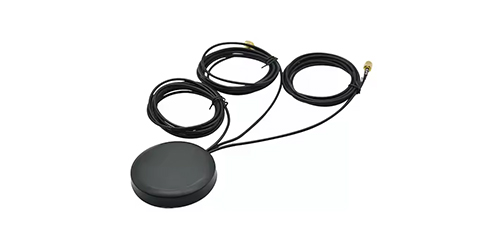
Puck-style antennas are compact, low-profile units typically mounted on vehicle roofs or flat surfaces. They are popular in fleet management, telematics, and asset tracking applications due to their unobtrusive appearance and ease of installation. The Taoglas MA1559.A.001, measuring 161.3 x 67.0 mm, is a prime example of a low-profile combo antenna designed for precision agriculture, robotics, and autonomous driving.
Shark Fin Antennas
Shark fin antennas are styled to resemble the dorsal fin of a shark, providing an aesthetically pleasing solution for automotive applications. Amphenol Procom's ProFin Plus is a 2x2 MiMo LTE and Wi-Fi multi-purpose shark fin antenna for GNSS, GPS, 2G/3G/4G/5G, and dual Wi-Fi 2.4/5.8 GHz, featuring a built-in high-gain, low-noise amplifier.
Panel and Blade Antennas
Panel and blade antennas are flat, rectangular units often used in fixed installations or where a low profile is required. Maswell's AN.8MIMO.600.8000.HP is a 9-in-1 ultra-wideband high-gain panel antenna supporting 8x8 MIMO and covering 5G, 4G, Wi-Fi 7/6E, Bluetooth, Zigbee, UWB, LoRa, and GNSS bands, with GNSS peak gain up to 5.5 dBiC and 5G main antenna gain up to 9.3 dBi.
Helix and Embedded Antennas
Helix antennas are often embedded in UAVs and lightweight devices, offering high gain and wide radiation beams. The Harxon HX-HE205A is a compact embedded helix antenna measuring just φ38.7 × 39.4 mm, designed for high-precision positioning and UAV integration. The Harxon HX-HE401A, weighing only 10 grams, is a D-Helix antenna supporting full-band GNSS reception with high phase center stability for centimeter-level accuracy.
Dish and Reflector Tracking Antennas
For long-range tracking applications such as UAV data links and satellite communication, dish and reflector antennas provide the highest gain and most precise tracking. The BluTrak-90-D is an integrated parabolic dish tracking antenna with a 60 cm dish diameter, delivering up to 28 dBi gain and supporting tracking via NMEA or RSSI + MAVLINK. The DH 3.7 Meter DR S+X Dual Band Antenna from Dolph Microwave is another example, designed for high-performance LEO satellite tracking with tracking accuracy better than 0.05°.

Key Applications of High Gain Tracking Combo Antennas
The versatility of high gain tracking combo antennas makes them indispensable across a wide spectrum of industries and applications.
Fleet Management and Telematics
Fleet management systems rely on continuous, reliable connectivity to track vehicle locations, monitor driver behavior, optimize routes, and ensure regulatory compliance. A high gain tracking combo antenna provides simultaneous GNSS positioning and cellular data connectivity, enabling real-time GPS tracking, dashcam video uploads, and ELD compliance data transmission. The Annxin 7-in-1 antenna is specifically engineered for modern fleet vehicles, integrating high-precision GNSS tracking, 4×4 MIMO cellular data, and dual-band Wi-Fi MIMO into a single ruggedized housing. PCTEL's AllDisc Combi MIMO Wi-Fi-7 GNSS Antenna is also ideal for fleet management, track and trace, navigation, and cargo handling, with LNA gain of 30 dB and IP6K9K class protection.
UAV and Drone Operations
Unmanned aerial vehicles require robust communication links for command and control, telemetry, and payload data transmission, as well as precise GNSS positioning for navigation and autonomous flight. High gain tracking combo antennas enable UAVs to maintain stable connections over extended ranges, even in challenging environments. The BluTrak-90-D is designed to autonomously track UAVs in demanding environments, incorporating a BluSDR mesh radio with two COFDM transceivers and embedded tracking algorithms. Harxon's helix antennas are optimized for UAV integration, delivering high gain and wide radiation beams for excellent reception of low-elevation satellite signals even under tree canopies or near buildings.
Satellite Communication and TT&C
Telemetry, Tracking and Control (TT&C) systems for satellites, rockets, and space vehicles require high-gain antennas with precise tracking capabilities. A high gain tracking combo antenna can support multiple frequency bands for telemetry downlink, telecommand uplink, and tracking simultaneously. Anywaves' S-Band TT&C Antenna, with realized gain > 6.5 dBi at boresight, is perfectly suited to LEO platforms. Kratos Defense's 3.5 Meter LEO XY ESA is designed for high-gain satellite communication and precise Low Earth Orbit tracking applications with tracking accuracy better than 0.05°. The dual reflector antenna and associated antenna system for on-board use in low earth orbit satellites supports high-throughput data downlink and telemetry, tracking, and command functions.
Public Safety and Mission-Critical Communications
Land Mobile Radio (LMR) and Private Mobile Radio (PMR) systems used by public safety agencies, first responders, and mission-critical operations demand reliable, high-gain connectivity. The Mobile Mark LTMG312 is specifically designed for mission-critical LMR and vehicle fleet management applications, combining a high-power LMR/P25 element, Wi-Fi 6E, and GNSS elements in a single form factor. It provides a gain of 2 dBi for LMR and 5 dBi for Wi-Fi 6E, with an LNA providing 26 dB of gain and a noise figure of 1.7 dB. It is tested for compatibility with Motorola APX4500 P25 radios.
Precision Agriculture and Autonomous Systems
Precision agriculture relies on centimeter-level positioning accuracy for automated tractors, harvesters, and drones, as well as reliable connectivity for data transmission. The Taoglas MA1559.A.001 is ideal for precision agriculture and positioning, telematics, asset tracking, timing accuracy synchronization, and autonomous driving. Its high-performance GNSS coverage across the entire GNSS spectrum ensures reliable positioning even in remote fields.
Maritime and Aviation
Shipborne and airborne platforms require high-gain autotrack antennas for satellite communications and tracking. A high gain autotrack antenna utilizing combined electronic and mechanical beam steering with two planar phased arrays mounted on a mechanical axis has been developed for maritime satellite communications, designed for unmanned operation with automatic search-and-track mode. For aviation, high gain reflector antennas with tracking capability have wide applications in the telemetry, tracking, and control of aircraft, rockets, satellites, and space vehicles.
IoT and Smart City Infrastructure
The Internet of Things (IoT) ecosystem depends on reliable, low-power wide-area connectivity and precise asset tracking. High gain tracking combo antennas support LTE Cat M, NB-IoT, and other IoT protocols while providing GNSS positioning for asset tracking and logistics. Quectel's YEMD301L1A provides backward compatibility to support 3G and 2G networks, as well as LTE Cat M and narrowband IoT (NB-IoT), with 18 dB ±3 dB GNSS LNA gain.
Benefits of High Gain Tracking Combo Antennas
Simplified Installation and Reduced Complexity
By integrating multiple antennas into a single housing, combo antennas eliminate the need for multiple separate installations, reducing installation time, labor costs, and the number of holes that must be drilled into vehicle roofs or equipment enclosures. This also minimizes the risk of water ingress and cable management issues. The Annxin 7-in-1 antenna replaces up to three separate antennas, simplifying vehicle roof installation, reducing wind drag, lowering maintenance points, and presenting a clean, professional appearance.
Enhanced Signal Reliability and Range
High gain and low noise figure characteristics ensure strong signal lock even in rural or low-coverage areas for both cellular and GPS signals. This extended range is critical for applications such as UAV operations, maritime communication, and remote asset tracking. The BluTrak-90-D achieves a distance range of up to 90 kilometers with its 28 dBi gain antenna.
Improved Data Throughput
Carrier-grade 4×4 MIMO configurations dramatically increase data throughput and connection stability for real-time video, diagnostics, and large data transfers. This is essential for fleet management applications that require real-time video uploads from dashcams or continuous telemetry data streams.
Rugged and Reliable Design
IP67 or IP69K ratings, UV-resistant radomes, and wide operating temperature ranges ensure reliable operation in the harshest environments, from desert heat to arctic cold, and from dusty construction sites to rain-soaked highways.
Space and Weight Savings
For UAVs and lightweight devices, compact, lightweight combo antennas minimize payload, enhancing endurance and portability. The Harxon HX-HE401A weighs only 10 grams, making it ideal for integration into lightweight UAVs.
Future-Proof Multi-Band Support
With support for 5G NR, Wi-Fi 6E, and multiple GNSS constellations, high gain tracking combo antennas are designed to remain compatible with evolving wireless standards, protecting investments in infrastructure and equipment.
Installation and Integration Best Practices
Proper installation is critical to maximizing the performance of a high gain tracking combo antenna. Consider the following best practices:
1. Mounting Location: Choose a location with an unobstructed view of the sky for GNSS reception and minimal obstruction for cellular and Wi-Fi signals. Vehicle roofs are ideal, but ensure the antenna is mounted on a flat, stable surface.
2. Ground Plane Considerations: While many modern combo antennas are ground plane independent, some may still benefit from a metallic ground plane for optimal performance. Consult the manufacturer's specifications.
3. Cable Routing: Use low-loss coaxial cables and keep cable runs as short as possible to minimize signal attenuation. Route cables away from sources of electromagnetic interference.
4. Connector Compatibility: Ensure that antenna connectors match the ports on your telematics gateway, router, or receiver. Common connector types include SMA, RP-SMA, FAKRA, and MCX.
5. Weatherproofing: Apply appropriate sealing compounds or gaskets to mounting holes and connectors to maintain the antenna's IP rating and prevent water ingress.
6. Calibration and Alignment: For tracking antennas, ensure proper calibration and alignment procedures are followed to achieve accurate target tracking.
Future Trends and Innovations
The field of high gain tracking combo antennas is rapidly evolving, driven by advances in materials science, signal processing, and wireless standards.
Metamaterial-Enhanced Antennas: Metamaterials are artificially engineered structures with properties not found in nature. Metamaterial-enhanced antennas can achieve higher gain, smaller form factors, and improved radiation patterns. The metamaterial-enhanced pentagonal patch antenna with monopulse comparator represents a significant step forward in compact tracking antenna design.
AI-Assisted Tracking: Artificial intelligence and machine learning algorithms are being integrated into tracking systems to improve target acquisition, prediction, and tracking accuracy, particularly in cluttered or dynamic environments.
6G and Beyond: As research into 6G wireless communication progresses, future combo antennas will need to support terahertz frequencies, massive MIMO, and ultra-reliable low-latency communication, driving further innovation in antenna design.
Integration with Edge Computing: Antennas with integrated edge computing capabilities could process tracking algorithms locally, reducing latency and bandwidth requirements for cloud-based tracking systems.
Sustainable Materials: Environmental concerns are driving interest in biodegradable, recyclable, and low-carbon-footprint materials for antenna radomes and housings.
The high gain tracking combo antenna represents a convergence of multiple cutting-edge technologies—multi-band integration, high-gain amplification, precise tracking, and rugged environmental design—into a single, elegant solution. From enabling autonomous UAV operations and precision agriculture to supporting mission-critical public safety communications and LEO satellite tracking, these antennas are indispensable enablers of the connected world.
As wireless standards continue to evolve and new applications emerge, the demand for high gain tracking combo antennas will only grow. By understanding the technical specifications, working principles, types, and applications outlined in this guide, engineers, system integrators, and decision-makers can make informed choices that ensure reliable, high-performance connectivity and tracking for years to come.
Whether you are designing the next generation of autonomous vehicles, deploying a fleet management system, or building a satellite ground station, investing in a high-quality high gain tracking combo antenna is a decision that pays dividends in performance, reliability, and operational efficiency.
Lucy Yang | lucy.y@toxutech.com
Dotty Zhao | sales04@toxutech.com
Global Business Director / Sales Team / Global Operations


 En
 Cn
 Korean
 Home >
