

-
Products -PCBA Manufacturing RF Connectors RF Cable Assemblys Embedded Antennas External Antennas GNSS Positioning Solutions
RF Connectors

RF Cable Assemblys
Embedded Antennas
External Antennas
GNSS Positioning Solutions


 Language


Language


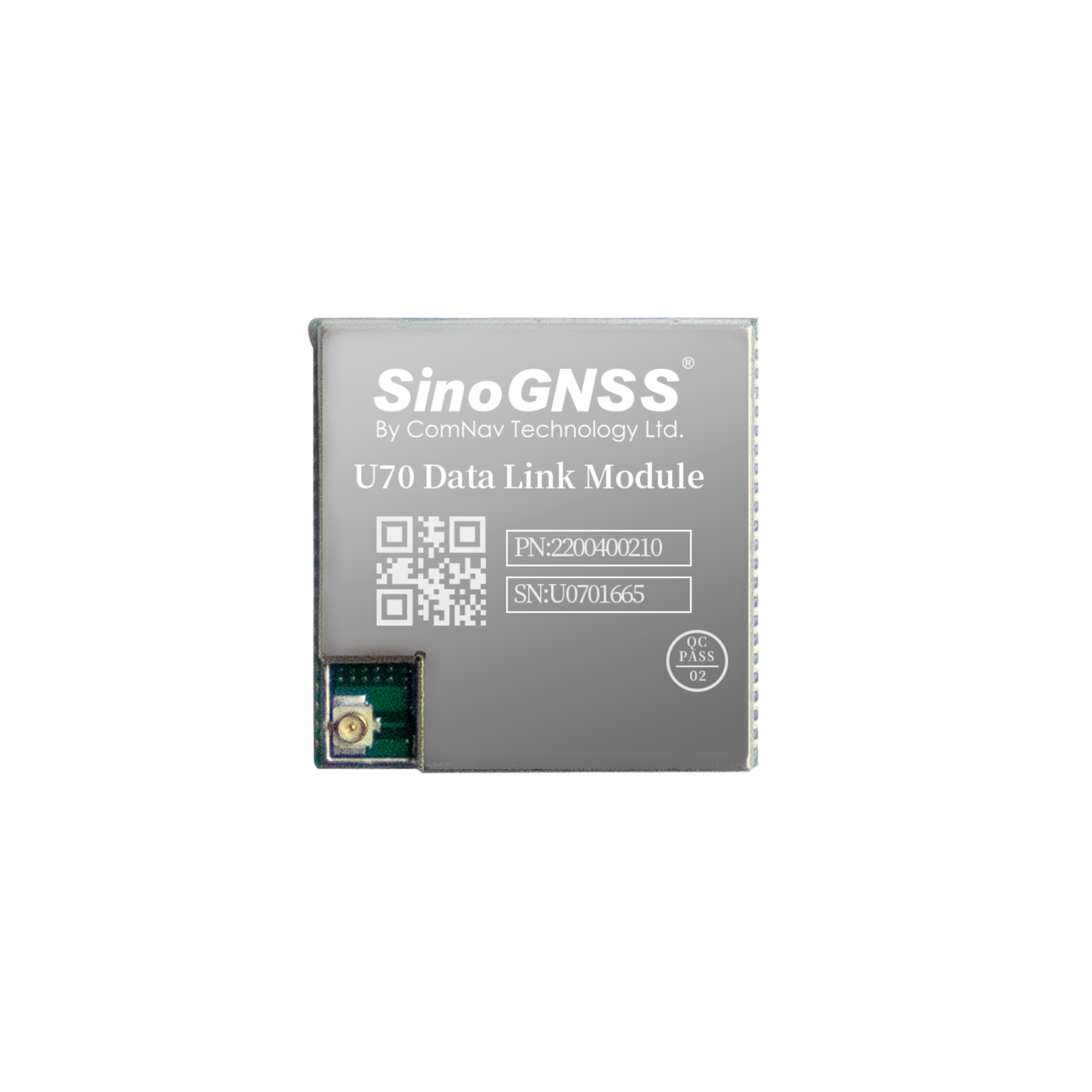
Model: TX-U70 | Manufacturer Model: U70
The SinoGNSS U70 is a 410–470 MHz UHF radio data link module for transmitting GNSS correction data between compatible RTK systems. Its compact OEM format, transmit/receive operation and 3.3 V LVCMOS interfaces support integration into custom base stations and rover equipment.
410–470 MHz Operating Range
Configure a matching radio channel for the base and rover data link.
LoRa Data Transmission
Supports a LoRa radio link for carrying correction data between compatible transmitting and receiving units.
Selectable RF Output Power
Manufacturer specifications list 0.5 W, 1 W and 2 W transmit settings for different link requirements.
Embedded Serial Connection
Three 3.3 V LVCMOS interfaces support communication with compatible host electronics.
Compact OEM Module
The 30 × 30 × 3 mm format and miniature RF connector support integration into custom GNSS equipment.
The SinoGNSS U70 is an embedded UHF radio data link module for GNSS correction-data transmission. TOXU supplies it under product model TX-U70 for OEM base stations, rover receivers and custom positioning equipment.
Operating within 410–470 MHz, the module supports transmit and receive functions in half-duplex operation. A compatible radio pair can carry correction data from a reference station to a rover through a local wireless link.
The OEM package allows designers to integrate the radio with their own receiver PCB, regulated power supply and antenna installation. Link performance depends on the radio configuration, antenna system, terrain and surrounding interference.
UHF Correction-Data Link
Use the radio to transport correction messages generated by the GNSS base station. The rover-side radio passes the received data to the positioning receiver.
Transmit and Receive Operation
The module supports both radio roles. Configure each unit for the intended base or rover installation and match the settings across the link.
Selectable Transmit Power
The available power settings allow engineers to assess link margin, supply demand and thermal conditions for their installation.
LVCMOS Host Interfaces
Connect the module to compatible embedded electronics using its serial interfaces. Match host baud rate, data flow and buffering to the correction-message stream.
External UHF Antenna Connection
The miniature RF connector supports a cable connection to an external antenna. Choose the antenna frequency coverage, mounting position and feed cable together when developing the enclosure.
| Attribute | Value |
|---|---|
| TOXU Product Model | TX-U70 |
| Manufacturer | SinoGNSS / ComNav Technology |
| Manufacturer Model | U70 |
| Product Type | UHF radio data link module |
| Operating Frequency | 410–470 MHz |
| Operating Mode | Half-duplex transmit/receive |
| Radio Protocol | LoRa |
| Transmit Power Settings | 0.5 W / 1 W / 2 W |
| Supply Voltage | 3.3–3.6 V DC |
| Host Electrical Interfaces | 3 × LVCMOS, 3.3 V |
| Module I/O | 44-position interface, 1.27 mm pitch |
| Antenna Connection | IPEX miniature coaxial connector |
| Dimensions | 30 × 30 × 3 mm, including connector |
| Weight | 8 g |
| Operating Temperature | −40°C to +75°C |
| Primary Application | Wireless GNSS correction-data transmission |
The U70 measures 30 × 30 × 3 mm including its connector. The RF connection is located at a corner of the shielded module. Use the manufacturer's mechanical drawing and pin definition when developing the carrier PCB, allowing space for the mating RF cable and its bend radius.
RTK Reference Stations
Integrate a transmitting radio into a base station to distribute GNSS correction messages over a local UHF link.
Surveying Rover Receivers
Receive corrections from a compatible base radio and forward them to the rover's GNSS engine.
Agricultural Guidance Equipment
Develop a local correction link between a farm reference station and compatible machine-mounted positioning hardware.
Robotics and Machine Positioning
Evaluate radio delivery of correction data for outdoor equipment using a matched GNSS receiver and antenna system.
GNSS base receiver → Transmitting radio → UHF link → Receiving radio → GNSS rover receiver
Connect the base receiver's correction-data output to the transmitting module. Configure the receiving unit with compatible frequency, protocol and air-link settings, then route its output to the rover receiver.
Size the supply and decoupling circuit for transmit operation. During integration, check correction-message throughput, radio reception and rover solution status using the intended antennas and installation layout.
TOXU can help select the UHF antenna, miniature coaxial cable and external RF connector for the radio installation. Related GNSS receiver hardware and GNSS antennas can be reviewed alongside the correction-data link.
Discuss the receiver, radio link and antenna installation together when specifying an OEM system. TOXU supports project-specific RF cable assemblies and PCBA integration requirements for evaluation and repeat orders.
TOXU Tech supplies GNSS positioning hardware, communication antennas, RF connectors and cable assemblies to equipment manufacturers and system integrators.
TOXU also provides PCBA manufacturing and OEM / ODM hardware integration services for RF and GNSS projects.
What role does U70 play in an RTK system?
It transports correction data over a radio link. The GNSS receiver uses the delivered corrections to calculate its position.
Can the module transmit and receive?
Yes. U70 supports transmit and receive functions in half-duplex operation.
How do I match the base and rover radios?
Match the frequency, radio protocol and relevant air-link parameters. Confirm that both firmware configurations support the selected settings.
Which antenna should be used?
Select a UHF antenna matched to the configured operating frequency and installation. Check the RF cable loss, connector mating and antenna placement.
What determines communication distance?
Distance depends on antenna height and characteristics, terrain, obstructions, transmit power, interference and radio settings. Evaluate the link under the project's expected conditions.
Can U70 communicate with another manufacturer's radio?
Provide the other radio's model, protocol and configuration for review. Interoperability depends on compatible protocols, firmware and operating parameters.
Lucy Yang | lucy.y@toxutech.com
Dotty Zhao | sales04@toxutech.com
Global Business Director / Sales Team / Global Operations


 En
 Cn
 Korean
 Home >


