

-
Products -PCBA Manufacturing RF Connectors RF Cable Assemblys Embedded Antennas External Antennas GNSS Positioning Solutions
RF Connectors

RF Cable Assemblys
Embedded Antennas
External Antennas
GNSS Positioning Solutions



 Language


Language

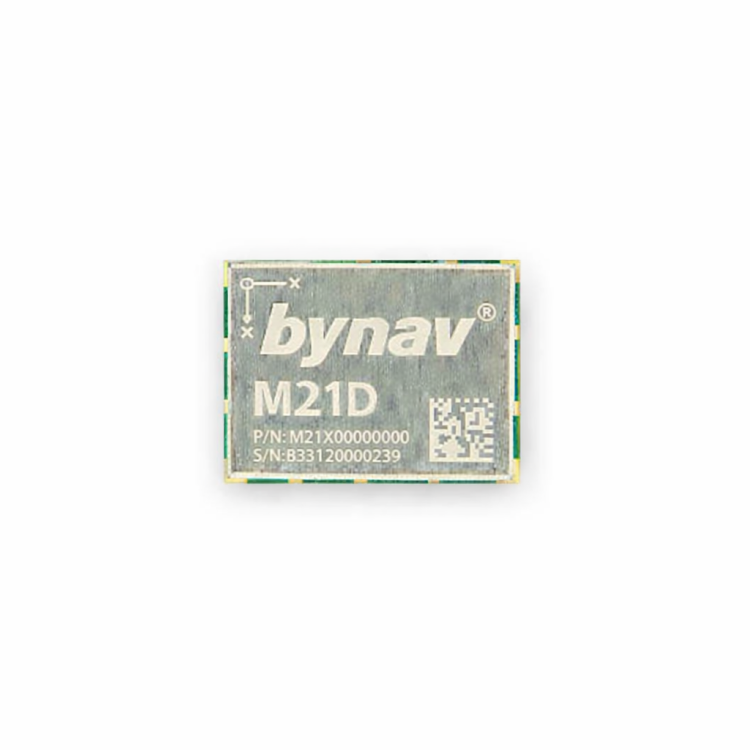
Model: TX-M21D
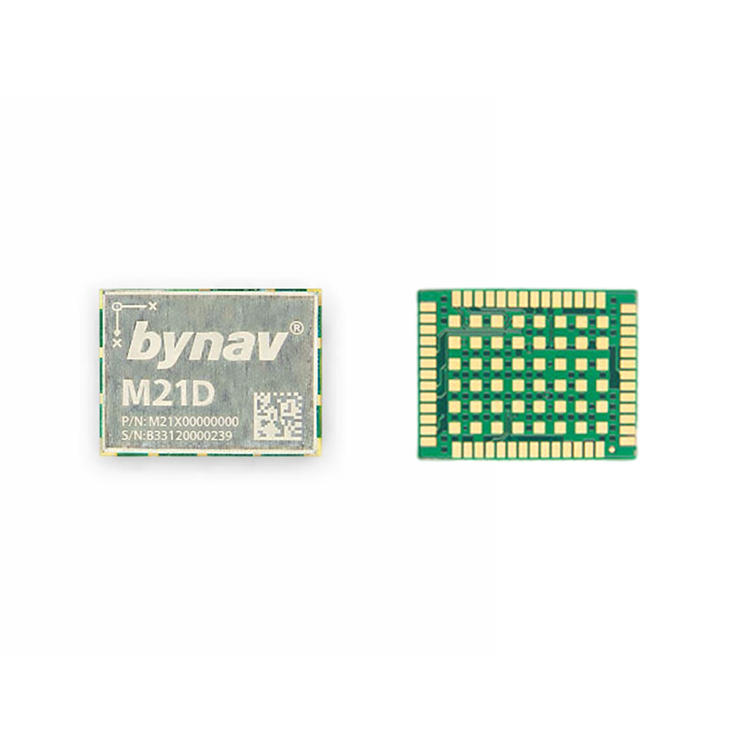
The TOXU TX-M21D is a dual-antenna GNSS RTK INS module based on the Bynav M21D platform. It integrates multi-frequency GNSS positioning, dual-antenna heading, a MEMS inertial measurement unit and deeply coupled navigation for autonomous vehicles, unmanned ground vehicles and intelligent robotics.
● Bynav M21D Platform: Uses the 22 nm Bynav Alice GNSS SoC with 1,500 channels for multi-constellation, multi-frequency positioning.
● Dual-Antenna GNSS Heading: Provides 0.2° RMS heading accuracy with a 1 m antenna baseline under suitable conditions.
● Integrated MEMS IMU: Includes a three-axis gyroscope and accelerometer for GNSS/INS integrated navigation and dead reckoning.
● Centimeter-Level RTK: Supports horizontal accuracy of 1.0 cm + 1 ppm and vertical accuracy of 1.5 cm + 1 ppm.
● 100 Hz INS Output: Provides 100 Hz integrated navigation results and 100 Hz raw IMU data.
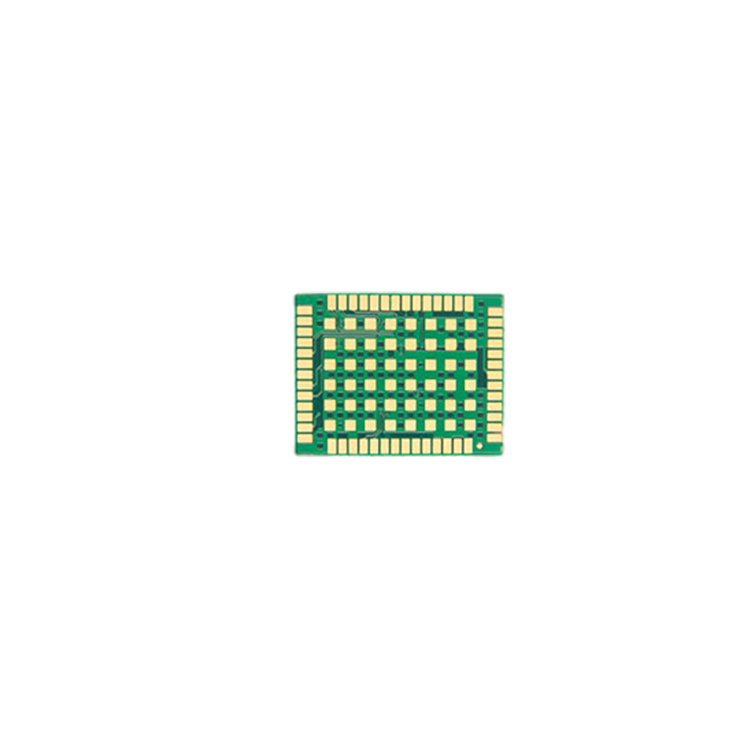
● Compact OEM Integration: Features a 16 × 21 × 2.6 mm 48-pin LGA package with UART, CAN FD, RMII and optional SPI interfaces.
The TOXU TX-M21D is a compact dual-antenna GNSS RTK INS module based on the Bynav M21D high-precision navigation platform. It combines multi-frequency GNSS positioning, dual-antenna heading, an integrated MEMS inertial measurement unit and a deeply coupled GNSS/INS navigation algorithm.
The module uses the 22 nm Bynav Alice automotive-oriented GNSS SoC and provides 1,500 channels for tracking supported signals from BDS, GPS, GLONASS, Galileo and QZSS.
With two connected GNSS antennas, the M21D calculates heading from carrier-phase measurements. It provides heading accuracy of 0.2° RMS with a 1 m antenna baseline under suitable operating conditions.
Unlike magnetic heading, dual-antenna GNSS heading is not dependent on the surrounding magnetic field. It is therefore suitable for vehicles and robots operating near motors, power cables, metallic structures and other sources of magnetic interference.
The integrated MEMS IMU contains a three-axis gyroscope and three-axis accelerometer. Its deeply coupled navigation algorithm combines GNSS observations and inertial measurements to improve positioning continuity when satellite signals are temporarily obstructed.
The standard output rates are 10 Hz for dual-antenna GNSS observations, 5 Hz for GNSS positioning and heading, 100 Hz for INS positioning and 100 Hz for raw IMU data. Applicable firmware can increase the GNSS positioning and heading rate to 10 Hz.
The TX-M21D is an OEM module rather than a finished receiver. A customized PCB, regulated power supply, two matched GNSS antenna circuits, host processor interface and application-specific protection circuitry are required.
Bynav Alice GNSS SoC
Uses the Bynav Alice GNSS SoC manufactured with a 22 nm process for high-precision positioning and heading.
1,500 GNSS Channels
Provides 1,500 channels for simultaneous tracking of supported multi-constellation and multi-frequency GNSS signals.
Dual-Antenna GNSS Heading
Uses two GNSS antennas to calculate heading from carrier-phase measurements without relying on a magnetic compass.
High-Accuracy Heading Output
Provides heading accuracy of 0.2° RMS with a 1 m antenna baseline under suitable satellite, antenna and installation conditions.
Centimeter-Level RTK Positioning
Supports horizontal RTK accuracy of 1.0 cm + 1 ppm and vertical RTK accuracy of 1.5 cm + 1 ppm.
Integrated MEMS Inertial Measurement Unit
Integrates a three-axis gyroscope and three-axis accelerometer for GNSS/INS navigation and dead reckoning.
Deeply Coupled GNSS/INS Navigation
Combines GNSS signal observations with inertial measurements to improve navigation continuity and positioning performance in obstructed environments.
Dead-Reckoning Capability
Supports dead-reckoning accuracy of 0.8% at 2σ when connected to an odometer and used with the applicable vehicle model.
100 Hz INS Positioning
Outputs integrated GNSS/INS positioning results at rates up to 100 Hz for dynamic navigation applications.
100 Hz Raw IMU Data
Provides raw gyroscope and accelerometer measurements at a rate of 100 Hz.
High-Performance Interference Suppression
The applicable anti-interference function supports single-frequency, multi-tone, narrowband, sweep-frequency and pulse interference suppression with an interference-to-signal ratio of up to 65 dBc.
Multiple Embedded Interfaces
Provides four UART interfaces, one CAN FD interface, one RMII interface and one optional SPI interface.
Compact LGA Package
The 16 × 21 × 2.6 mm 48-pin LGA package weighs approximately 1.90 g for compact embedded navigation hardware.
| Attribute | Value |
| TOXU Model | TX-M21D |
| Product Type | Dual-Antenna GNSS RTK INS Heading OEM Module |
| GNSS Platform | Bynav M21D |
| GNSS SoC | Bynav Alice, 22 nm process |
| Package | 48-pin LGA |
| Number of Channels | 1,500 |
| Antenna Configuration | Dual GNSS antennas |
| Integrated Inertial Sensors | Three-axis gyroscope and three-axis accelerometer |
| Navigation Functions | RTK positioning, dual-antenna heading and deeply coupled GNSS/INS navigation |
| GNSS Constellations | BDS, GPS, GLONASS, Galileo and QZSS |
| BDS Signals | B1I and B2I |
| Optional BDS Signals | B1C and B2b PPP with applicable firmware |
| GPS Signals | L1 C/A and L2 |
| Optional GPS Signal | L1C with applicable firmware |
| GLONASS Signals | G1 and G2 |
| Galileo Signals | E1 and E5b |
| QZSS Signals | L1 C/A and L2 |
| Optional QZSS Signal | L1C with applicable firmware |
| Single-Point Horizontal Accuracy | 1.5 m RMS |
| Single-Point Vertical Accuracy | 2.5 m RMS |
| RTK Horizontal Accuracy | 1.0 cm + 1 ppm RMS |
| RTK Vertical Accuracy | 1.5 cm + 1 ppm RMS |
| GNSS Heading Accuracy | 0.2° RMS at 1 m antenna baseline |
| Velocity Accuracy | 0.03 m/s RMS |
| Optional Timing Accuracy | ≤20 ns RMS |
| Cold Start Time | 30 seconds |
| Hot Start Time | 5 seconds |
| RTK Initialization Time | 5 seconds typical |
| Loss-of-Lock Re-Acquisition Time | ≤1 second |
| RTK Solution Latency | 50 ms |
| Default Dual-Antenna GNSS Observation Rate | 10 Hz |
| Default GNSS Positioning and Heading Rate | 5 Hz |
| Optional GNSS Positioning and Heading Rate | Up to 10 Hz with applicable firmware |
| INS Positioning Rate | 100 Hz |
| Raw IMU Data Rate | 100 Hz |
| Dead-Reckoning Accuracy | 0.8% at 2σ when connected to an odometer and using the vehicle model |
| Gyroscope Measurement Range | ±300°/s |
| Gyroscope Angle Random Walk | 0.5°/√h |
| Gyroscope Bias Instability | 5°/h |
| Gyroscope Full-Temperature Bias | 0.3°/s |
| Gyroscope Scale-Factor Error | 4‰ |
| Gyroscope Cross-Axis Coupling Error | 1.7‰, equivalent to 0.1° |
| Accelerometer Measurement Range | ±16 g |
| Accelerometer Velocity Random Walk | 0.3 m/s/√h |
| Accelerometer Bias Instability | 50 μg |
| Accelerometer Full-Temperature Bias | 5 mg |
| Accelerometer Scale-Factor Error | 2‰ |
| Accelerometer Cross-Axis Coupling Error | 0.9‰, equivalent to 0.05° |
| Anti-Interference Types | Single-frequency, multi-tone, narrowband, sweep-frequency and pulse interference |
| Interference-to-Signal Ratio | Up to 65 dBc with applicable anti-interference function |
| UART | 4 interfaces |
| CAN FD | 1 interface |
| RMII | 1 interface |
| SPI | 1 optional interface |
| Power Supply | 3.15–3.45 V DC |
| Power Consumption | 540 mW typical, excluding antenna power and external devices |
| Operating Temperature | −40°C to +85°C |
| Optional Operating Temperature | Up to +105°C for the applicable product version |
| Storage Temperature | −40°C to +105°C |
| Humidity | 95% non-condensing |
| Vibration | JESD22-B103 |
| Shock | JESD22-B110 |
| Module Dimensions | 16 × 21 × 2.6 mm |
| Module Weight | 1.90 g |
| Optional Quality-System Compliance | IATF 16949 for the applicable product configuration |
| Optional Functional Safety | ISO 26262 ASIL B for the applicable certified version |
| Optional Automotive Qualification | AEC-Q104 for the applicable certified version |
• Autonomous driving systems
• Unmanned ground vehicles
• Intelligent mobile robots
• Dual-antenna GNSS heading systems
• Vehicle dead-reckoning systems
• Navigation in magnetically disturbed environments
• Customized RTK INS receiver boards
• Industrial autonomous equipment
The TX-M21D is a 48-pin LGA OEM module intended for surface mounting on a customized host PCB. It requires a regulated 3.3 V power supply, two GNSS antenna circuits, host communication interfaces and application-specific protection components.
Two matched multi-frequency GNSS antennas must be connected for dual-antenna heading. The antennas must be mounted rigidly on the same vehicle with a known baseline length and orientation.
The specified heading accuracy of 0.2° RMS is based on a 1 m antenna baseline. Actual heading performance depends on antenna separation, satellite geometry, multipath, RF interference, cable matching and mechanical installation.
Increasing antenna separation can improve heading resolution. The antenna baseline and installation orientation must be configured correctly in the navigation system.
The integrated IMU requires rigid mechanical installation and correct alignment with the vehicle coordinate system. Incorrect axis orientation can produce inaccurate attitude and dead-reckoning results.
The specified 0.8% dead-reckoning accuracy applies when an odometer is connected and the applicable vehicle model is used. Performance depends on installation, calibration, vehicle dynamics and outage duration.
Centimeter-level absolute RTK positioning requires compatible correction data from a GNSS base station, CORS network or NTRIP service. Dual-antenna relative heading and absolute RTK positioning are separate navigation functions.
The module provides four UART interfaces, one CAN FD interface, one RMII interface and an optional SPI interface. Interface availability and pin multiplexing must be considered during host-board design.
B1C, B2b PPP, GPS L1C, QZSS L1C, anti-interference functions, SPI, system diagnostics and automotive certifications are extended capabilities requiring the applicable firmware or product configuration.
Dual GNSS Antenna Matching
TOXU provides matched multi-frequency GNSS antennas for dual-antenna RTK positioning and heading applications.
RF Cable Assembly
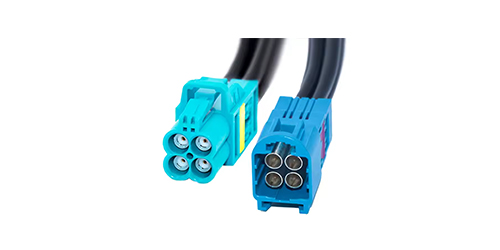
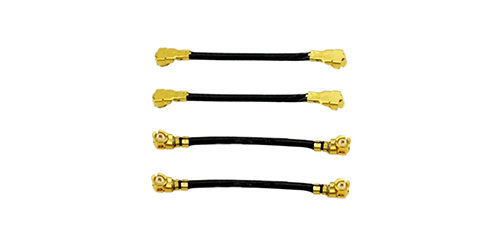
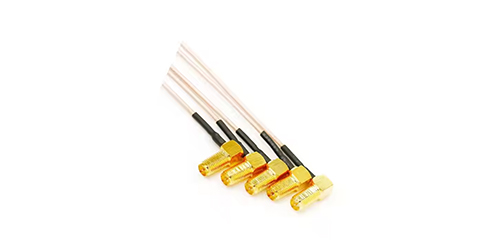
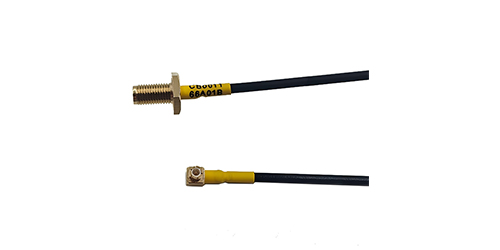
TOXU provides matched-length RF cable assemblies with SMA, MMCX, MCX, TNC, FAKRA and other connector options.
Connector Solution
TOXU supports RF connector selection and customized interconnection solutions.
GNSS/INS Board Development
TOXU can integrate the Bynav M21D into customized GNSS/INS receiver boards with dual antenna inputs, power supplies and host communication interfaces.
Heading System Integration
TOXU supports antenna-baseline planning, matched RF cables, mounting structures, module orientation and heading-system integration.
Hardware Customization
TOXU supports PCB design, prototype development, firmware integration and mass production for customized GNSS positioning products.
Professional Bynav M21D Integration
TOXU provides hardware integration support for the Bynav M21D dual-antenna GNSS RTK INS platform.
Complete Dual-Antenna Hardware Support
TOXU supports antenna selection, matched RF cables, receiver-board design, baseline planning and mechanical installation.
GNSS and Inertial Navigation Experience
TOXU supports power-supply design, RF layout, inertial module orientation, vehicle-interface integration and correction-data connectivity.
Prototype and Mass Production
TOXU supports engineering evaluation, prototype receiver boards, customized assembly and volume manufacturing.
Q: What is the difference between the Bynav M21D and M21?
The M21D supports two GNSS antennas and provides moving-baseline GNSS heading. The M21 is a single-antenna GNSS RTK INS module without dual-antenna heading.
Q: Does the TX-M21D include an IMU?
Yes. It includes a three-axis gyroscope and three-axis accelerometer for deeply coupled GNSS/INS navigation.
Q: Does the TX-M21D provide GNSS heading?
Yes. It calculates heading using two GNSS antennas and supports 0.2° RMS heading accuracy with a 1 m baseline under suitable conditions.
Q: Does GNSS heading rely on a magnetic compass?
No. Dual-antenna GNSS heading is calculated from carrier-phase measurements and is not dependent on the surrounding magnetic field.
Q: What are the output rates of the TX-M21D?
The standard rates are 10 Hz for dual-antenna GNSS observations, 5 Hz for GNSS positioning and heading, 100 Hz for INS positioning and 100 Hz for raw IMU data. Applicable firmware can provide up to 10 Hz GNSS positioning and heading.
Q: Does dual-antenna heading require an RTK base station?
Dual-antenna relative heading and absolute RTK positioning are separate functions. Centimeter-level absolute RTK positioning requires compatible correction data.
Q: Does the TX-M21D support dead reckoning?
Yes. It supports 0.8% dead-reckoning accuracy at 2σ when connected to an odometer and used with the applicable vehicle model.
Q: Does every M21D include ASIL B and AEC-Q104 certification?
No. Functional-safety and automotive certifications apply only to the corresponding certified product version and must be confirmed when ordering.
Q: Can TOXU integrate the M21D into a customized receiver board?
Yes. TOXU can design customized M21D receiver boards with dual antenna inputs, regulated power supplies, UART, CAN FD, RMII and external connector interfaces.
Q: Can TOXU customize the dual-antenna installation?
Yes. TOXU can provide matched antennas, equal-length RF cables, antenna mounts and baseline recommendations according to the vehicle structure and required heading performance.
Q: Can TOXU provide customized GNSS solutions?
Yes. TOXU provides complete GNSS hardware integration services including customized receiver boards, GNSS antennas, RF cable assemblies, connectors and PCB hardware development.
Q: Does TOXU support prototype and mass production?
Yes. TOXU supports schematic design, PCB development, prototype assembly, engineering validation and mass production for customized Bynav M21D GNSS/INS products.
Lucy Yang | lucy.y@toxutech.com
Dotty Zhao | sales04@toxutech.com
Global Business Director / Sales Team / Global Operations


 En
En Cn
Cn Korean
 Home >

